

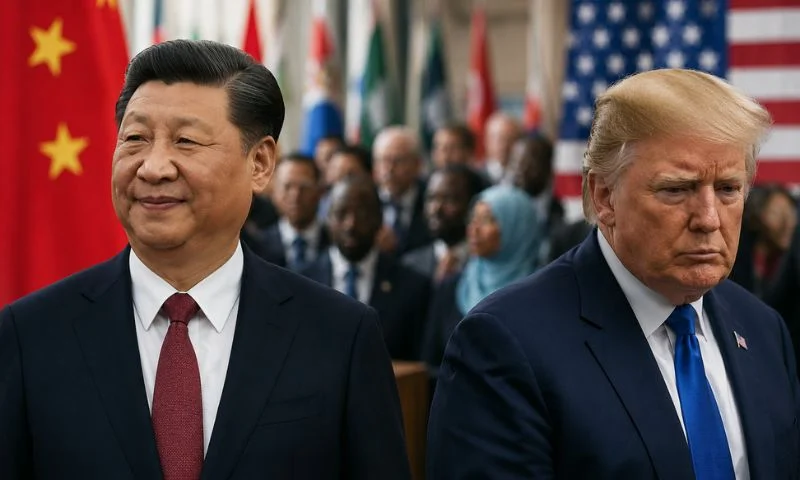
China is viewed more favourably than the United States globally, marking a reversal, a Pew Research Center survey found. China received better ratings than the US in 25 of 36 countries and territories, including Canada and Mexico. Only six countries viewed the US more positively. Pew surveyed 42,151 adults across 35 countries, plus the West Bank and East Jerusalem, from February to May. Margins of error ranged from 2.3 to 5.5 percentage points. China gains as US standing falls During the survey, the US and Israel launched a war against Iran. Pew researcher Laura Silver linked the conflict to worsening perceptions of Washington. “There was just an actual relationship between the outbreak of the war and the sense that the US is just not contributing to peace and stability and that people have less confidence in Donald Trump,” she said. Silver cited Trump’s demands to control Greenland, the US raid that captured Venezuela’s leader Nicolás Maduro and Washington’s handling of the Israeli-Hamas war in Gaza. “The US has done a lot in terms of global engagement in recent months to years that is not being perceived positively internationally,” she said. China benefited as memories of COVID-19 faded. “By comparison, we know that China is seen to be a more reliable partner in many places. It’s more likely to be seen to contribute to global peace and stability,” Silver said. Xi leads Trump in 22 countries People in 22 surveyed places rated Xi Jinping more favourably than Donald Trump. These included Canada, Mexico, France, Germany and the UK, although confidence in both leaders remained low. Pew said China had never held a significant advantage during 20 years of tracking global opinion. Canada recorded a shift. Positive views of the US fell from 57% in 2023 to 33%, while China’s rating rose from 14% to 44%. Trump imposed tariffs on Canadian goods last year and suggested Canada could become “the 51st state.” France, Germany, Spain, Italy, Sweden and the Netherlands shifted towards China. In the UK, the two powers now receive similar ratings. Three years ago, Washington held a 32-point advantage. US and China respond to findings White House spokesperson Olivia Wales said, “President Trump has done more for global stability than anyone else,” citing actions that “obliterated Iran’s nuclear facilities” and “eliminated hundreds of narcoterrorists.” “President Trump is the leader of the free world, and thanks to his bold leadership the United States of America has never been stronger,” Wales said. China’s embassy in Washington said the poll “demonstrates that China’s governance achievements and development progress are widely recognised.” Israel led the six countries favouring the US. About eight in 10 Israelis viewed Washington positively, compared with 19% for China. Japan, India, South Korea, the Philippines and Poland completed the group, although their US ratings have declined. The US still led China on government respect for personal freedoms, but the gap has narrowed. Pew said this was “driven largely by the fact that people in nearly every country surveyed have become less likely to say the US government respects its people’s personal freedoms” since 2021.
China Lands Reusable Rocket for First Time. Here’s What It Means
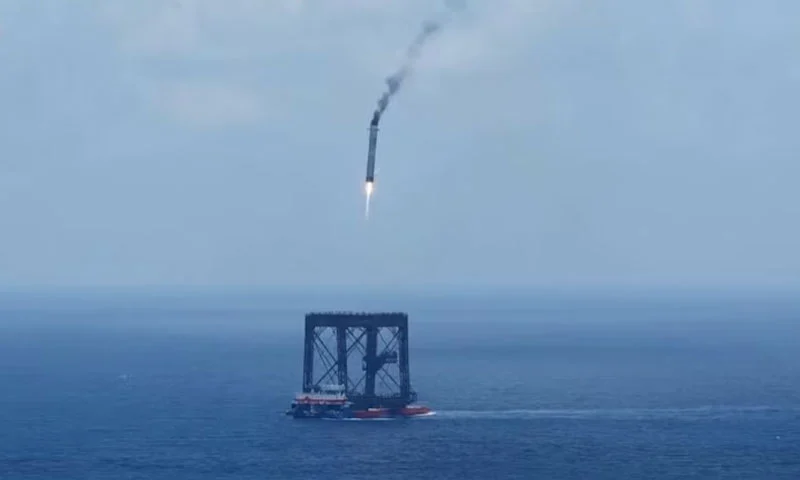
China has successfully landed a reusable rocket for the first time, marking a major breakthrough in its space programme and positioning itself as a stronger competitor to American aerospace companies such as SpaceX and Blue Origin. The Long March 10B rocket lifted off from the Wenchang Commercial Space Launch Site in Hainan Province on Friday around noon local time. The rocket can carry up to 16 metric tonnes of payload into low Earth orbit, a region located between 160 kilometres and 2,000 kilometres above Earth. About six minutes after launch, the rocket’s first stage booster separated from the upper stage, which continued its journey into space. Instead of falling into the ocean, the booster performed a controlled descent toward a floating recovery platform. China used a unique net based capture system to recover the booster successfully, making it only the third country to demonstrate reusable rocket landing technology after SpaceX and Blue Origin. New recovery system sets Long March apart Reusable rockets reduce launch costs by allowing expensive boosters to fly multiple missions instead of being destroyed after every launch. Most reusable rockets follow a similar return sequence. After separation, the booster flips itself using pressurised nitrogen, reorients its engines and uses aerodynamic fins to control its descent through the atmosphere. It then fires its engines in the opposite direction to slow down before landing. SpaceX and Blue Origin rely on hydraulic landing legs to touch down either on land or floating drone ships. Last year, SpaceX also demonstrated its mechanical “chopstick” arms to catch the returning Starship booster. China adopted a different approach. The Long March 10B uses onboard computers that communicate with a maritime recovery vessel. The vessel positions a suspended wire net beneath the descending rocket. Landing hooks attached to the booster catch the net as the engines shut down. Automated locking systems then secure the booster and prevent dangerous movement. By removing traditional landing legs, Chinese engineers reduced the rocket’s overall weight and increased its payload capacity. Anushka Saxena, Research Analyst at the Takshashila Institution’s Geostrategy programme, said: “The technological and commercial base in China is faring very well despite having been shaken up by internal wrangling and corruption in the past.” Success strengthens China’s lunar ambitions The successful test carries significant strategic importance as China accelerates plans to land astronauts on the Moon by 2030. The Long March 10 family will serve as the backbone of China’s future lunar missions, placing the country in direct competition with NASA’s Artemis programme. The reusable system also supports China’s plan to deploy thousands of communication satellites into low Earth orbit. Lower launch costs make these large constellations financially viable and strengthen China’s position against commercial rivals such as SpaceX. “SpaceX and the Chinese are competing on two fronts the frequency of launches and the capacity to fill up the lower-earth orbit. The Chinese have demonstrated that they can do whatever the Americans can and are actively bridging the gap that SpaceX had created a decade ago,” Saxena said. “For other spacefaring nations like India, it might take a long time before they can conclusively enter this current circle,” she added. Analysts also say the achievement supports China’s broader Military Civil Fusion strategy, which integrates commercial innovation with national defence capabilities. Xi Jinping elevated the strategy to a national priority in 2015, encouraging closer cooperation between civilian aerospace companies and military research institutions. Saxena said: “In 2015, Xi Jinping elevated the MCF as part of the National Development Strategy, which mandates whole-of-nation mobilisation.” The successful recovery of the Long March 10B demonstrates that China is rapidly narrowing the technological gap with the United States as competition intensifies over commercial launches, satellite deployment and future lunar exploration.

Trump Says ‘Fantastic Trade Deals’ Signal New US-China Era
Donald Trump said Friday that he had secured “fantastic trade deals” with Xi Jinping during a high-stakes summit in Beijing that also focused on Iran, Taiwan and artificial intelligence. The two leaders held final meetings at Zhongnanhai, the central leadership compound near Beijing’s Forbidden City. Trump described Xi as a “great leader” and “friend” during the visit. “We’ve made some fantastic trade deals, great for both countries,” Trump told reporters as Xi accompanied him through the gardens of the compound. Read More: Iran, Taiwan and AI: What’s Really Happening at the Trump-Xi Summit Xi called the visit a “milestone visit” and said both countries had established “a new bilateral relationship, which is a relationship of constructive strategic stability.” The Chinese leader also promised to send seeds for the White House Rose Garden. The summit marked the first visit by a US president to Beijing in nearly a decade. Trump arrived in China hoping to secure agreements in agriculture, aviation and artificial intelligence while easing tensions between the world’s two largest economies. Iran and Hormuz discussions dominate talks The Middle East conflict emerged as a major issue during the summit. In an interview with Fox News, Trump said Xi assured him that China would not provide military support to Iran. “He said he’s not going to give military equipment … he said that strongly,” Trump said. WATCH IN FULL: President Donald J. Trump's interview with @FoxNews amid his historic state visit to China pic.twitter.com/YpyOixp9A0— Rapid Response 47 (@RapidResponse47) May 15, 2026 Trump also claimed Xi offered to help reopen the Strait of Hormuz after regional tensions disrupted global shipping routes. “He’d like to see the Hormuz Strait open, and said ‘if I can be of any help whatsoever, I would like to help,’” Trump added. China’s Foreign Ministry later called for “a comprehensive and lasting ceasefire” in the region. “Shipping lanes should be reopened as soon as possible in response to the calls of the international community,” the ministry said. Meanwhile, analysts say China remains cautious because it relies heavily on Gulf energy supplies, particularly Iranian oil imports. Boeing, soybeans and AI take center stage Trade discussions also dominated Friday’s meetings. Trump claimed Xi agreed to purchase “200 big” Boeing aircraft, although investors reacted cautiously and Boeing shares later fell. Read More: US-China Relations Enter Critical Moment as Trump Meets Xi The US president said China also showed interest in purchasing American oil and soybeans. China sharply reduced soybean imports from the United States during previous tariff disputes and instead increased purchases from Brazil. US Treasury Secretary Scott Bessent said Washington and Beijing also discussed creating “guardrails” for artificial intelligence cooperation. Bessent told CNBC that the world’s “two AI superpowers are going to start talking.” However, advanced semiconductor export restrictions remain a major source of tension between both countries. Taiwan also overshadowed the summit. Chinese state media reported that Xi warned Trump that mistakes on Taiwan could push both powers into “conflict.” Xi also referenced the “Thucydides Trap,” a theory suggesting war becomes more likely when a rising power challenges an established one. Read More: Trump Administration Waives $15,000 Visa Bond for World Cup Fans Trump later responded on Truth Social, saying Xi referred to America as “perhaps being a declining nation” under former president Joe Biden. “Now, the United States is the hottest Nation anywhere in the world,” Trump wrote.

US-China Relations Enter Critical Moment as Trump Meets Xi
Donald Trump and Xi Jinping opened a closely watched summit in Beijing on Thursday as the two powers seek to stabilise trade ties while navigating rising tensions over Iran, Taiwan and advanced technology exports. Xi welcomed Trump at Beijing’s Great Hall of the People with a formal ceremony that included an honour guard and children waving Chinese and American flags. Read More: Trump Arrives in Beijing for Historic High-Stakes Summit With Xi Jinping “You’re a great leader, sometimes people don’t like me saying it, but I say it anyway,” Trump told Xi during opening remarks. “There are those who say this may be the biggest summit ever,” Trump added. “It’s an honour to be with you. It’s an honour to be your friend and the relationship between China and the USA is going to be better than ever before.” Xi stressed the importance of stable relations between the world’s two largest economies. “When we cooperate, both sides benefit; when we confront each other, both sides suffer,” Xi said, according to China’s state-run Xinhua news agency. The summit follows preparatory trade talks held in South Korea on Wednesday. Xi described those negotiations as producing an “overall balanced and positive outcome.” Trade, technology and investment dominate agenda The two sides aim to preserve a trade truce reached last October after months of escalating tariffs and supply chain disruptions. Under the agreement, Trump suspended triple-digit tariffs on Chinese goods while Beijing eased pressure on global rare earth supplies that industries rely on for electric vehicles, semiconductors and weapons production. The Star-Spangled Banner plays as President Donald J. Trump is greeted by President Xi at the Great Hall of the People in Beijing, China. 🇺🇸🇨🇳 pic.twitter.com/ANPzR3WQmi— The White House (@WhiteHouse) May 14, 2026 Trump arrived in Beijing alongside several top US business executives, including Elon Musk, Jensen Huang and Tim Cook. Musk described the opening talks as “wonderful” while leaving the venue. Washington wants China to increase purchases of Boeing aircraft, agricultural goods and US energy exports to reduce the trade deficit. Meanwhile, Beijing seeks relief from American restrictions on advanced semiconductor technology and chipmaking equipment exports. Analysts say the balance of power has shifted since Trump’s first Beijing visit in 2017. Read More: Elon Musk and Tim Cook to Join Trump on High-Stakes China Visit Ali Wyne, senior adviser at International Crisis Group, said China no longer needs to convince Washington of its global status. “This time around it’s the United States, unprompted, of its own volition, that is acknowledging that status,” Wyne said. Iran war and Taiwan tensions loom over summit Beyond trade, both leaders also discussed growing tensions in the Middle East and Taiwan. Trump is expected to push China to pressure Iran into reaching a deal with Washington to ease regional conflict. "It's an honor to be with you, it's an honor to be your friend, and the relationship between China and the USA is going to be better than ever before." – President Donald J. Trump 🇺🇸 pic.twitter.com/WZkoGeVqhv— The White House (@WhiteHouse) May 14, 2026 US Secretary of State Marco Rubio said China also has strong economic incentives to stabilise the Gulf region because many Chinese vessels remain stuck there. However, analysts doubt Beijing will significantly reduce support for Tehran because China views Iran as a strategic counterweight to the United States. Taiwan also remains a major source of friction between Washington and Beijing. Read More: Is China Really 6,000x Ahead in AI? The Reality May Surprise You China renewed opposition this week to planned US arms sales to Taiwan, including a reported $14 billion package awaiting Trump’s approval. The United States remains legally obligated to provide Taiwan with defensive capabilities despite lacking formal diplomatic ties with the island. Trump and Xi will continue meetings on Friday, including private discussions, cultural visits and a state banquet.
