China has successfully landed a reusable rocket for the first time, marking a major breakthrough in its space programme and positioning itself as a stronger competitor to American aerospace companies such as SpaceX and Blue Origin.
The Long March 10B rocket lifted off from the Wenchang Commercial Space Launch Site in Hainan Province on Friday around noon local time. The rocket can carry up to 16 metric tonnes of payload into low Earth orbit, a region located between 160 kilometres and 2,000 kilometres above Earth.
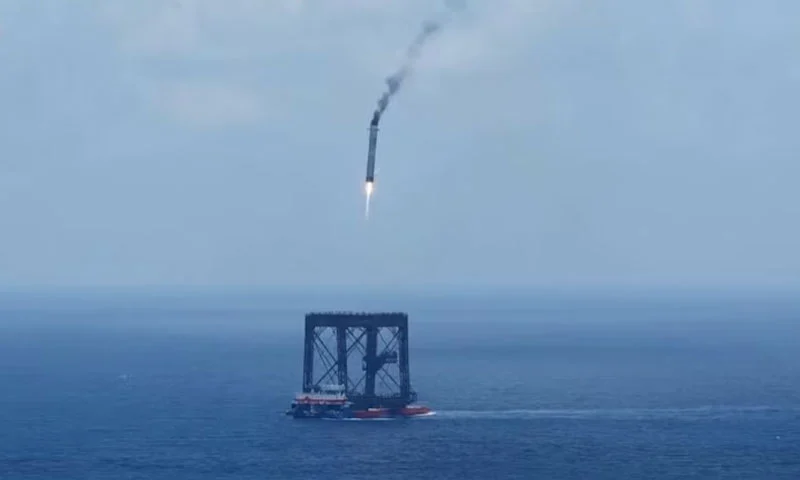
About six minutes after launch, the rocket’s first stage booster separated from the upper stage, which continued its journey into space. Instead of falling into the ocean, the booster performed a controlled descent toward a floating recovery platform.
China used a unique net based capture system to recover the booster successfully, making it only the third country to demonstrate reusable rocket landing technology after SpaceX and Blue Origin.
New recovery system sets Long March apart
Reusable rockets reduce launch costs by allowing expensive boosters to fly multiple missions instead of being destroyed after every launch.
Most reusable rockets follow a similar return sequence. After separation, the booster flips itself using pressurised nitrogen, reorients its engines and uses aerodynamic fins to control its descent through the atmosphere. It then fires its engines in the opposite direction to slow down before landing.
SpaceX and Blue Origin rely on hydraulic landing legs to touch down either on land or floating drone ships. Last year, SpaceX also demonstrated its mechanical “chopstick” arms to catch the returning Starship booster.
China adopted a different approach.
The Long March 10B uses onboard computers that communicate with a maritime recovery vessel. The vessel positions a suspended wire net beneath the descending rocket. Landing hooks attached to the booster catch the net as the engines shut down. Automated locking systems then secure the booster and prevent dangerous movement.
By removing traditional landing legs, Chinese engineers reduced the rocket’s overall weight and increased its payload capacity.
Anushka Saxena, Research Analyst at the Takshashila Institution’s Geostrategy programme, said: “The technological and commercial base in China is faring very well despite having been shaken up by internal wrangling and corruption in the past.”
Success strengthens China’s lunar ambitions
The successful test carries significant strategic importance as China accelerates plans to land astronauts on the Moon by 2030.
The Long March 10 family will serve as the backbone of China’s future lunar missions, placing the country in direct competition with NASA’s Artemis programme.
The reusable system also supports China’s plan to deploy thousands of communication satellites into low Earth orbit. Lower launch costs make these large constellations financially viable and strengthen China’s position against commercial rivals such as SpaceX.
“SpaceX and the Chinese are competing on two fronts the frequency of launches and the capacity to fill up the lower-earth orbit. The Chinese have demonstrated that they can do whatever the Americans can and are actively bridging the gap that SpaceX had created a decade ago,” Saxena said.
“For other spacefaring nations like India, it might take a long time before they can conclusively enter this current circle,” she added.
Analysts also say the achievement supports China’s broader Military Civil Fusion strategy, which integrates commercial innovation with national defence capabilities. Xi Jinping elevated the strategy to a national priority in 2015, encouraging closer cooperation between civilian aerospace companies and military research institutions.
Saxena said: “In 2015, Xi Jinping elevated the MCF as part of the National Development Strategy, which mandates whole-of-nation mobilisation.”
The successful recovery of the Long March 10B demonstrates that China is rapidly narrowing the technological gap with the United States as competition intensifies over commercial launches, satellite deployment and future lunar exploration.