

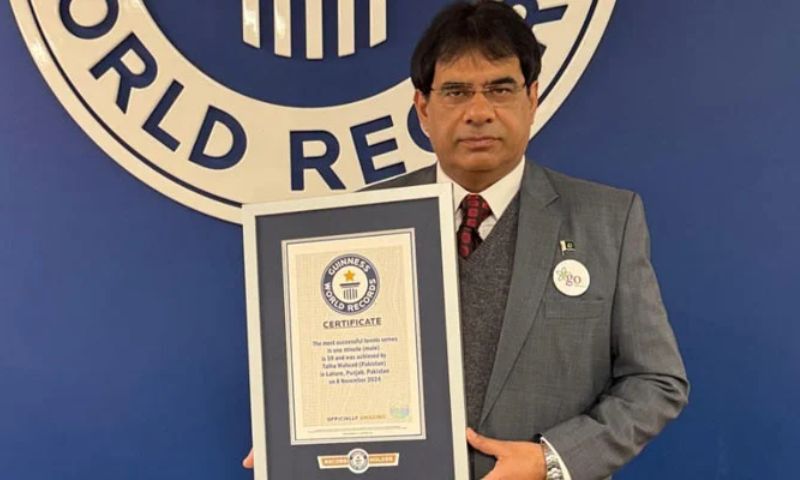
In a remarkable achievement that has put Pakistan on the global tennis map, senior tennis player Talha Waheed has been officially recognised by Guinness World Records for setting a new benchmark in serving speed and consistency. Waheed broke the previous record for the most successful tennis serves in one minute, reaching an astounding 59 accurate serves. Talha’s record-breaking performance took place on November 8, 2024, at a tennis facility in Lahore, where he served relentlessly under strict Guinness World Records guidelines. The previous mark of 42 successful serves had stood since 2019, making his achievement both historic and extraordinary. On January 15, 2026, Talha was invited to London to receive his official Guinness World Record certificate in a formal ceremony at the organisation’s headquarters. The event celebrated his dedication, precision, and stamina — qualities that brought international attention to his accomplishment. In an interview, Talha said, “My achievement marks a significant milestone for Pakistan’s sports community and highlights the capabilities of senior athletes who continue to push boundaries in their respective disciplines. I have consistently excelled in the international and national arenas through hard work.” Talha’s journey reflects years of commitment to tennis. He holds multiple titles in the 35+, 40+, and 45+ doubles categories at both national and International Tennis Federation (ITF) senior events, showcasing his broad competitive experience. His performance also underscored the potential of senior athletes to excel at elite levels, despite age or conventional expectations. His success drew praise from Aisam-ul-Haq Qureshi, President of the Pakistan Tennis Federation (PTF) and one of Pakistan’s most successful doubles players. Qureshi said, “Talha’s achievement is unique and securing a place in the Guinness Book of World Records is no easy task. This will serve as a great inspiration and a major boost for tennis in Pakistan.” Pakistan’s High Commissioner to the United Kingdom, Dr Mohammad Faisal, also congratulated Talha, saying his success not only honours an individual athlete but strengthens Pakistan’s sporting image abroad. “Talha Waheed’s achievement highlights the immense potential and resilience of Pakistani athletes,” Dr Faisal remarked. “His world record will inspire young players, promote tennis at the grassroots level, and contribute positively to the development of sports culture in Pakistan.” Talha has expressed his intention to pursue additional world records in the future, showing that his ambitions extend beyond this milestone. His accomplishment is expected to motivate young players across the country to aim higher and believe in the power of consistent effort and international competition.
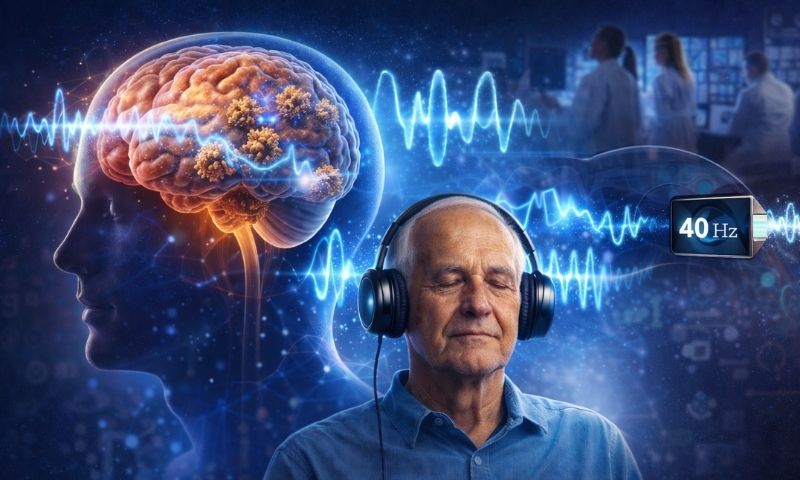
Sound Therapy Breakthrough: Could 40 Hz Frequency Treat Alzheimer’s?
Researchers are exploring a surprising new frontier in Alzheimer’s disease treatment: sound therapy. Recent scientific studies suggest that specific sound frequencies especially 40 Hz could help the brain clear toxic proteins and slow cognitive decline, offering hope for a future non-invasive therapy for the devastating neurodegenerative condition that affects millions worldwide. Alzheimer’s disease causes memory loss, confusion, and impaired thinking. These symptoms are linked to the buildup of abnormal proteins like beta-amyloid plaques and tau tangles in the brain, which damage neurons and disrupt brain function. Current treatments can ease symptoms, but there is still no cure that stops the disease’s progression. A recent study that has gained attention from scientists and the public examined 40 Hz sound stimulation in non-human primates. In this research, elderly rhesus monkeys listened to a low-frequency 40 Hz sound for one hour each day for a week. Scientists found that levels of beta-amyloid in the cerebrospinal fluid increased, indicating that the brain was clearing toxic proteins more effectively. This effect didn’t disappear quickly — it persisted weeks after the sound stimulation ended. Experts believe this type of therapy might work by resynchronizing brain activity and enhancing the brain’s waste-clearing system. In healthy brains, synchronized electrical rhythms help regulate processes like cleaning out harmful proteins. But in Alzheimer’s, these rhythms become disrupted. Sound stimulation at specific frequencies at least partially restores these rhythms, helping the brain flush out beta-amyloid plaques. The underlying mechanism of this effect has been studied in rodents and humans as well. Research shows that 40 Hz sensory stimulation whether light or sound can reduce amyloid burden and improve measures related to cognition in animal models. Early small human trials also suggest that daily 40 Hz sensory stimulation may slow cognitive decline and reduce biomarkers linked to Alzheimer’s progression. This approach, sometimes referred to as gamma frequency sensory stimulation, is being tested in larger clinical trials. Devices delivering coordinated light and sound at 40 Hz are under evaluation to determine if long-term use can help patients in the real world. A phase III clinical trial is underway to assess the effectiveness of such interventions in a broader group of Alzheimer’s patients. Separately, traditional music therapy and familiar audio have long been used to improve mood, social interaction and emotional well-being in people with dementia, though not specifically as a disease-modifying treatment. While researchers caution that sound therapy is not yet a proven cure, the accumulating evidence suggests it could become a valuable part of future Alzheimer’s treatment strategies — one that is non-invasive, affordable, and safe.

How MrBeast Can Be ‘Broke’ While Owning a $5B Content Company
YouTube megastar MrBeast has stunned fans and critics alike by claiming he is essentially “broke” despite building one of the most valuable influencer empires in the world. In a January 2026 interview with The Wall Street Journal, MrBeast (real name Jimmy Donaldson) said he currently has “negative money” and is borrowing funds even though his businesses hold massive valuation on paper. Donaldson, 27, boasts around 460 million YouTube followers, and his corporate umbrella Beast Industries has been valued at roughly $5 billion by investors. Forbes estimates his personal net worth at about $85 million, but most of that exists in investments and company equity, not spendable cash. The paradox lies in the financial model of today’s creator economy. MrBeast reinvests almost all earnings back into his content, merchandise, and ventures. He said he expects to spend about $250 million on video production in 2026 alone, covering everything from charity giveaways to record-breaking stunts and major media projects. This aggressive reinvestment strategy means his liquid cash remains low or even negative, even as his company’s valuation soars. In fact, he joked in public that he might have to borrow money from his mother to pay for his wedding to fiancée Thea Booysen. Analysts say this situation isn’t unique among founders who prioritize growth over profits early in a company’s life, but it’s rare in entertainment. MrBeast’s approach turns YouTube content creation into a startup-style business, where high operating costs may outpace revenue until scale catches up. While his company generates hundreds of millions in annual revenue, expenses for massive giveaways, elaborate set builds, and original shows like Beast Games can push finances into the red before ROI kicks in. His business portfolio is diverse. Beyond YouTube ad revenue which remains enormous thanks to billions of views MrBeast owns consumer brands like Feastables and MrBeast Burger, and his influence fuels lucrative sponsorships and merchandise sales. These ventures contribute to valuation and future profit potential, but don’t instantly translate into accessible cash for personal use. Critics argue that the illusion of wealth in the influencer world can mislead audiences. Just because someone has a high net worth estimate or company valuation doesn’t mean they carry that much money in the bank. MrBeast’s candid admission highlights how the economics of digital fame differ from classic celebrity wealth with vast assets tied up in business growth rather than personal liquidity. His transparency has sparked broader discussion about the sustainability of content-based business models, especially when creators pour revenue back into ever-bigger productions to maintain audience engagement. Whether this reinvestment strategy will pay off long term remains to be seen.

Trump Warns Protesters With the Military — How Often Has a US President Done This Before?
President Donald Trump has again ignited controversy after warning that he could deploy the US military to deal with protests in Minnesota targeting Immigration and Customs Enforcement (ICE). The remarks, made amid escalating demonstrations, revive a question that has followed Trump throughout his political career: how often has he threatened to use force against Americans—and how unusual is this in US history? Trump’s latest warning centres on the Insurrection Act, a centuries-old statute that allows a sitting president to deploy federal troops inside the United States to suppress rebellion or enforce federal law when state authorities are deemed unable or unwilling to act. Trump’s Record: Repeated Threats, Rare Use During his first term, Trump repeatedly raised the prospect of military intervention against domestic unrest. In 2020, amid nationwide protests following the killing of George Floyd, Trump publicly urged governors to “dominate the streets” and said he was prepared to invoke the Insurrection Act if states failed to restore order. Although active-duty troops were placed on standby near Washington, the Act was never formally invoked. Since returning to office, Trump has again turned to similar rhetoric. Protests linked to immigration enforcement, federal policing, and internal security have prompted warnings that federal troops could be deployed if local authorities resist or fail to act. The Minnesota protests represent the latest instance where Trump has threatened military involvement without yet taking the formal legal step required to do so. Legal scholars note that while Trump has frequently discussed the Insurrection Act, no US president has invoked it primarily to suppress political protest without state consent in modern times. When Other Presidents Actually Used Force Historically, US presidents have used military force domestically—but usually under narrow circumstances. George H. W. Bush invoked the Insurrection Act in 1992 at the request of California’s governor during the Los Angeles riots following the Rodney King verdict. Federal troops were deployed after local authorities were overwhelmed. During the civil rights era, Dwight D. Eisenhower, John F. Kennedy, and Lyndon B. Johnson used federal troops or nationalised the National Guard to enforce court-ordered desegregation and protect Black Americans from violent resistance. These actions were framed as enforcement of constitutional rights rather than suppression of dissent. Earlier presidents, including Abraham Lincoln, also used military power internally during periods of rebellion or civil war, but those cases predate modern democratic norms and legal safeguards. What Makes Trump Different What distinguishes Trump from many of his predecessors is not actual deployment, but the frequency and public nature of his threats. Experts argue that repeatedly raising the prospect of military force against civilians—even without invoking it—can have a chilling effect on democratic protest and civil liberties. Unlike past presidents who acted after state requests or court orders, Trump’s warnings have often come in direct response to political demonstrations against federal policy. This has prompted concerns from constitutional scholars and civil rights groups about the normalisation of military rhetoric in domestic governance. A Pattern, Not an Isolated Moment Trump’s Minnesota remarks do not stand alone. They reflect a broader pattern in which military force is positioned as a solution to internal political dissent. While the Insurrection Act remains unused—for now—the repeated threats themselves mark a significant shift in how presidential power is discussed in public life. As protests continue, the central question remains whether such warnings will remain rhetorical—or whether the United States could once again see troops deployed on its own streets.
