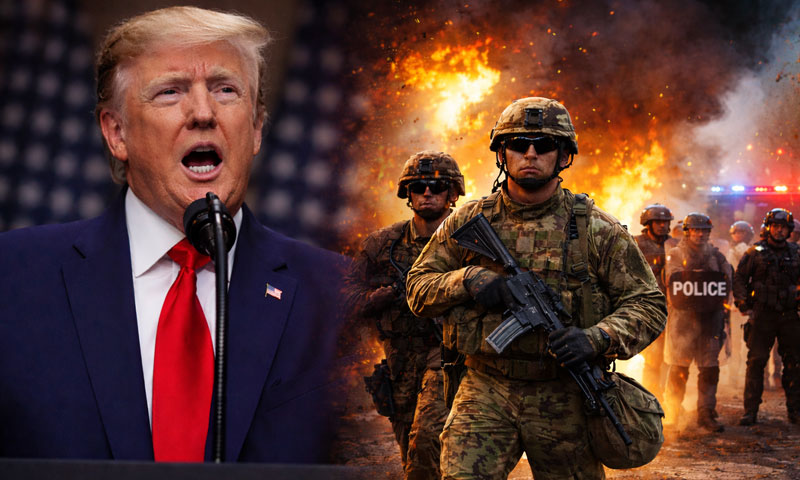
President Donald Trump has again ignited controversy after warning that he could deploy the US military to deal with protests in Minnesota targeting Immigration and Customs Enforcement (ICE). The remarks, made amid escalating demonstrations, revive a question that has followed Trump throughout his political career: how often has he threatened to use force against Americans—and how unusual is this in US history?
Trump’s latest warning centres on the Insurrection Act, a centuries-old statute that allows a sitting president to deploy federal troops inside the United States to suppress rebellion or enforce federal law when state authorities are deemed unable or unwilling to act.
Trump’s Record: Repeated Threats, Rare Use
During his first term, Trump repeatedly raised the prospect of military intervention against domestic unrest. In 2020, amid nationwide protests following the killing of George Floyd, Trump publicly urged governors to “dominate the streets” and said he was prepared to invoke the Insurrection Act if states failed to restore order. Although active-duty troops were placed on standby near Washington, the Act was never formally invoked.
Since returning to office, Trump has again turned to similar rhetoric. Protests linked to immigration enforcement, federal policing, and internal security have prompted warnings that federal troops could be deployed if local authorities resist or fail to act. The Minnesota protests represent the latest instance where Trump has threatened military involvement without yet taking the formal legal step required to do so.
Legal scholars note that while Trump has frequently discussed the Insurrection Act, no US president has invoked it primarily to suppress political protest without state consent in modern times.
When Other Presidents Actually Used Force
Historically, US presidents have used military force domestically—but usually under narrow circumstances.
-
George H. W. Bush invoked the Insurrection Act in 1992 at the request of California’s governor during the Los Angeles riots following the Rodney King verdict. Federal troops were deployed after local authorities were overwhelmed.
-
During the civil rights era, Dwight D. Eisenhower, John F. Kennedy, and Lyndon B. Johnson used federal troops or nationalised the National Guard to enforce court-ordered desegregation and protect Black Americans from violent resistance. These actions were framed as enforcement of constitutional rights rather than suppression of dissent.
Earlier presidents, including Abraham Lincoln, also used military power internally during periods of rebellion or civil war, but those cases predate modern democratic norms and legal safeguards.
What Makes Trump Different
What distinguishes Trump from many of his predecessors is not actual deployment, but the frequency and public nature of his threats. Experts argue that repeatedly raising the prospect of military force against civilians—even without invoking it—can have a chilling effect on democratic protest and civil liberties.
Unlike past presidents who acted after state requests or court orders, Trump’s warnings have often come in direct response to political demonstrations against federal policy. This has prompted concerns from constitutional scholars and civil rights groups about the normalisation of military rhetoric in domestic governance.
A Pattern, Not an Isolated Moment
Trump’s Minnesota remarks do not stand alone. They reflect a broader pattern in which military force is positioned as a solution to internal political dissent. While the Insurrection Act remains unused—for now—the repeated threats themselves mark a significant shift in how presidential power is discussed in public life.
As protests continue, the central question remains whether such warnings will remain rhetorical—or whether the United States could once again see troops deployed on its own streets.