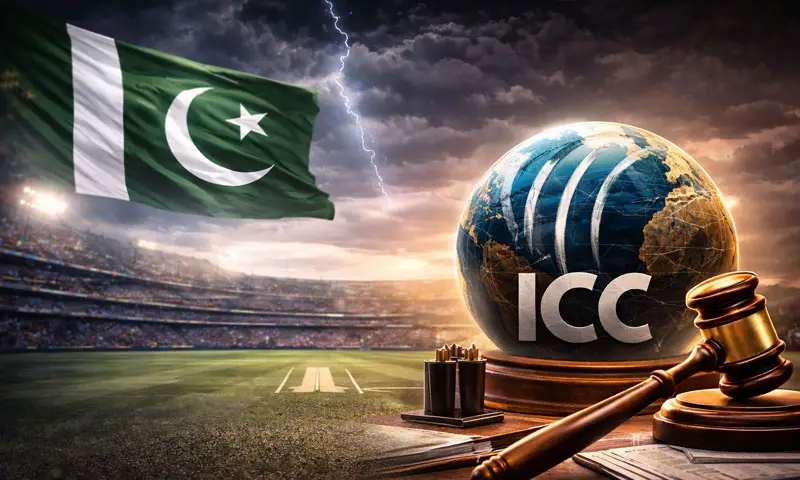
Speculation over Pakistan’s possible boycott of the ICC Men’s T20 World Cup has intensified after sections of Indian media claimed that the International Cricket Council (ICC) could impose severe and unprecedented sanctions on Pakistan if it withdraws from the tournament. However, a closer examination of ICC regulations and past precedents suggests that many of the reported threats may be overstated or legally unfounded.
The debate escalated following public remarks by Pakistan Cricket Board (PCB) Chairman Mohsin Naqvi, who voiced support for Bangladesh after it refused to participate in the tournament citing security concerns and was subsequently replaced by Scotland. Indian media reports claimed that if Pakistan follows the same path, the ICC could respond with harsh punitive measures, including isolating Pakistan cricket internationally.
Today, Naqvi also met Prime Minister Shehbaz Sharif and briefed him in detail on the ICC’s handling of Bangladesh’s case, as well as other related developments. According to Mohsin Naqvi it was agreed that any final decision from Pakistan regarding participation in the T20 World Cup would be taken after further consultations, with an announcement expected either on Friday or early next week.
What Indian Media Claims
According to unnamed sources quoted by Indian outlets, the ICC is allegedly prepared to impose “never-before” sanctions on Pakistan, including:
-
Preventing foreign players from participating in the Pakistan Super League (PSL)
-
Cutting ICC revenue allocations to the PCB
-
Stripping the PSL of international recognition
-
Excluding Pakistan from the Asia Cup
-
Suspending bilateral series involving Pakistan
These reports have framed the situation as an existential threat to Pakistan cricket. However, cricket governance experts argue that several of these claims do not align with how international cricket is actually governed.
What the ICC Can — and Cannot — Do
Under existing structures, the ICC does not issue No Objection Certificates (NOCs) for players to participate in domestic leagues such as the PSL. That authority lies entirely with players’ respective home boards.
Similarly, the ICC does not control bilateral series schedules, which are mutually agreed upon by individual cricket boards. Nor does it govern the Asia Cup, which falls under the Asian Cricket Council (ACC) — currently chaired by the PCB itself.
Therefore, claims that the ICC could unilaterally block the PSL, suspend bilateral cricket, or remove Pakistan from the Asia Cup are not supported by the governing framework of international cricket.
Government Decisions and Established Precedents
Crucially, if Pakistan’s participation is halted by the Government of Pakistan — rather than a unilateral PCB decision — the ICC’s scope for punitive action becomes extremely limited.
Multiple precedents already exist where teams declined to tour certain countries based on government advice, without facing sanctions. India’s refusal to travel to Pakistan for several ICC and ACC events is one such example, including the adoption of neutral-venue or hybrid models that were approved by governing bodies.
In Bangladesh’s case, their removal from the T20 World Cup stemmed from their refusal to play under the published schedule, despite ICC security assessments finding no specific threat. However, the ICC’s response was administrative — replacing the team — rather than punitive.
Why Claims of “Automatic Sanctions” Are Misleading
Experts note that portraying ICC sanctions as automatic or inevitable is misleading. The ICC’s primary enforcement mechanism is limited to tournament participation itself. Beyond that, its authority over domestic leagues, continental events, and bilateral cricket is constrained.
As a result, assertions that Pakistan would face sweeping punishments across all formats and competitions lack legal grounding under current ICC rules.
Pakistan’s Position
PCB Chairman Mohsin Naqvi has reiterated that Pakistan will not take a unilateral decision, stressing that any call regarding World Cup participation will follow directives from the federal government.
“Our stance will be what the government of Pakistan instructs me,” Naqvi said, adding that a final decision would be made after consultations at the highest level.
While a Pakistan boycott of the T20 World Cup would undoubtedly carry political, commercial and sporting consequences, the narrative that the ICC can independently impose crippling sanctions across Pakistan cricket is not supported by existing regulations or historical precedent.
Ultimately, any decision — whether to participate or withdraw — will likely hinge on government guidance, regional dynamics, and broader diplomatic considerations rather than fear of automatic ICC punishment.