

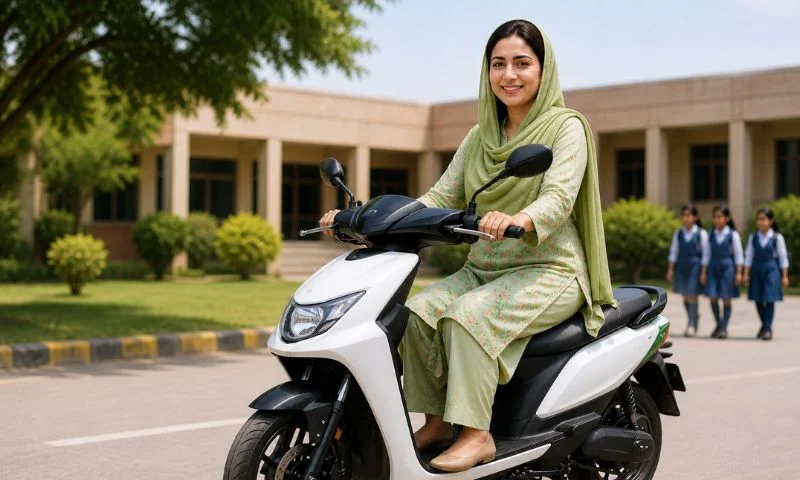
The Punjab government has announced an interest-free e-bike scheme aimed at helping teachers manage daily travel costs while promoting environmentally friendly transport options. Officials said the initiative will offer electric bikes on easy installments, with monthly payments expected to range between Rs3,600 and Rs4,200. The scheme targets government school teachers across the province, particularly those commuting from remote or semi-urban areas. Under the plan, each electric bike will cost between Rs200,000 and Rs250,000. The government will cover 30% to 40% of the total cost as a subsidy, reducing the financial burden on teachers. Authorities said the remaining amount will be paid in installments over a period of two to three years. The scheme has been designed to provide financial relief to educators who often face rising transport expenses. Officials added that the initiative also supports broader efforts to reduce fuel consumption and encourage sustainable mobility in urban and rural areas. Application Process and Eligibility Applications for the scheme will open online through the Punjab Teachers Foundation website. Teachers will need to submit several documents to complete their applications. These include a valid CNIC, service certificate, driving license and a passport-size photograph. After submission, applicants will receive a verification slip and will be informed about their eligibility through SMS or email. Read More: Rising Petrol Prices Drive Surge in Demand for Electric Bikes in Pakistan The government plans to implement the scheme in phases once the registration process concludes. Officials said this phased rollout will ensure smooth distribution and proper verification of applicants. Education authorities expect strong interest in the programme, given the increasing cost of fuel and transport across Pakistan. Push for Affordable and Green Transport The scheme reflects a growing policy focus on electric mobility in Pakistan. Several provincial and federal initiatives aim to reduce reliance on imported fuel and lower carbon emissions. Experts say electric bikes offer a practical solution for short-distance commuting, especially for teachers who travel daily between home and school. By lowering upfront costs through subsidies and interest-free financing, the government hopes to accelerate adoption among public sector employees. Read More: ‘Fuel Chhoro, Electric Chalao’: Revoo Announces Major Discounts Officials believe the initiative will improve access to workplaces, reduce travel time and provide long-term savings for teachers. The move also aligns with broader efforts to modernise public services and support the education sector through targeted welfare programmes.
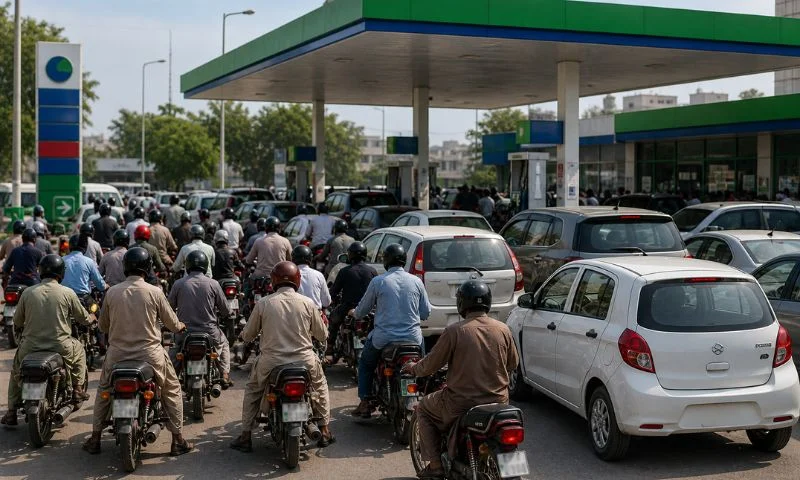
Pakistan Fuel Prices Jump 56% While India Holds Steady
Petrol prices in Pakistan have risen sharply by 56% since February, while rates in India and Bangladesh have remained largely unchanged, highlighting stark differences in policy responses to global oil price volatility. According to recent data, petrol in New Delhi stood at Indian Rs94.72 per litre on February 1 and remains unchanged at the same level. In Bangladesh, prices have also held steady at around BDT 130 per litre. In contrast, Pakistan’s petrol price has surged from Rs257 per litre on February 1 to Rs399.86 per litre. This reflects a 56% increase during a period when Brent crude oil prices rose from around $68–70 per barrel to $105–115, marking a 54% to 64% increase. “Hard truth: Prices unchanged in India and Bangladesh. Pakistan up 56 percent,” wrote Dr Farrukh Saleem in a commentary. Tax Policies and Market Structures Drive Differences Experts attribute the divergence to differing government strategies. In India, authorities manage fuel prices by adjusting taxes and relying on state-owned companies such as Indian Oil Corporation, Bharat Petroleum and Hindustan Petroleum to absorb part of the cost. “How does India do it? The government cuts taxes, and state-owned oil companies absorb the losses. Prices are managed. The consumer is protected while the cost is shifted to company balance sheets,” Saleem noted. Read More: Pakistan Becomes South Asia’s Most Expensive Country for Petrol Bangladesh follows a similar approach through the Bangladesh Petroleum Corporation, which adjusts prices infrequently and absorbs fluctuations on behalf of consumers. “How does Bangladesh do it? Prices are administered. The government-owned BPC absorbs the shock, adjusting prices infrequently. The consumer is protected, while the cost is shifted to the public balance sheet,” he added. Pakistan, however, applies a full pass-through mechanism. Prices adjust quickly in line with international markets, while the government raises petroleum levies to meet fiscal targets. “Pakistan does it differently. Prices are passed through immediately, petroleum levy is raised, and domestic refineries are paid import parity prices. The consumer absorbs the shock, the government collects the tax, and refineries make billions,” Saleem wrote. Diesel Prices Reflect Similar Trend The same pattern applies to diesel. Prices in India have remained around Indian Rs88 per litre since February, while Bangladesh continues to maintain diesel at about BDT 109 per litre. Pakistan’s diesel price has increased from roughly Rs267 per litre to Rs399.58 per litre, representing a rise of about 50%. Read More: Rs378 Petrol Explained: How Much Goes to Taxes and Profits Analysts say the contrasting approaches reflect broader economic priorities. Countries that shield consumers often shift costs to public finances or corporate balance sheets, while Pakistan’s approach prioritises fiscal targets and revenue generation. The difference, experts argue, underscores a key policy choice rather than a purely market-driven outcome. “Three countries. One oil shock – different choices. The oil price is global. The pain is a policy choice,” Saleem concluded.

Zayn Malik’s Family Asks Fans to Donate Instead of Sending Flowers
Zayn Malik’s family has urged fans to channel their support into charitable donations rather than sending flower bouquets, as the singer recovers in hospital following a recent health scare. The appeal came through a local flower business that had been handling requests from fans. The business said it could no longer accept new orders due to overwhelming demand. “Due to the high volume of requests for bouquets for Zayn Malik and his family, we are unfortunately no longer able to take any further orders at this time. We appreciate the love and support shown,” the business said in a social media post. Read More: Cristiano Ronaldo’s Partner Georgina Rodríguez Turns Heads With Multi-Million Lifestyle It added that the family would prefer a different form of support. “If you would like to make a meaningful gesture, the Malik family would greatly appreciate donations being made to the Palestine Project via the link below”. The message encouraged fans to redirect their spending. “You are welcome to donate the amount you would have spent on a bouquet and leave a message of support there,” the statement read. The business said contributions and messages would be shared with the family and appreciated during Malik’s recovery. Hospitalisation and Recovery Malik revealed in mid-April that he had been rushed to emergency care and later hospitalised. He did not disclose details about his condition but confirmed he received treatment from a cardiology team. In a message to fans, the singer expressed gratitude for the support he received during the ordeal. He thanked hospital staff, nurses and medical professionals for their care. Read More: The Quiet Shift: Why Natural Health Is Becoming a Long-Term Lifestyle Malik has not provided further updates on his health since the announcement. His family has also remained private about his condition, focusing instead on acknowledging public support. The singer, who rose to global fame as a member of One Direction, has maintained a strong fan following worldwide. His supporters often mobilise quickly during personal or professional milestones. Fans Rally Around Cause The latest appeal reflects a broader trend where public figures and their families encourage charitable giving in place of traditional gestures such as gifts or flowers. The fundraiser mentioned in the post focuses on humanitarian support for Palestinians. While details of the initiative were not outlined in the message, similar campaigns have gained traction globally amid ongoing humanitarian concerns. Fans have responded positively online, with many sharing donation confirmations and messages of support for Malik’s recovery. Analysts say such campaigns can significantly boost awareness and funding for social causes, particularly when backed by high-profile figures with global audiences. Malik’s decision to redirect support aligns with previous instances where celebrities have used personal moments to highlight broader humanitarian issues. For now, the focus remains on his recovery, as fans continue to send well wishes through both messages and donations.
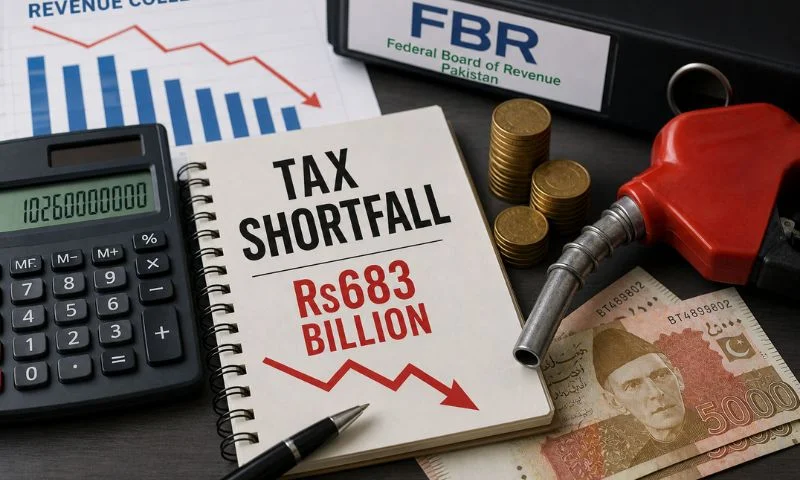
Pakistan’s Tax Shortfall Hits Rs683 Billion as Fuel Prices Rise
Pakistan’s tax shortfall has widened to Rs683 billion in the current fiscal year, increasing pressure on authorities to raise fuel levies to meet fiscal targets agreed with the International Monetary Fund. The Federal Board of Revenue collected Rs10.26 trillion during the July to April period of fiscal year 2025-26. However, the amount fell significantly short of the revised target, reflecting slower-than-expected revenue growth. The government had already revised its annual collection goal to Rs13.98 trillion, but the IMF has refused to lower the target further. Officials now face increasing pressure to bridge the gap through alternative measures. To manage the shortfall, authorities have turned to petroleum levies. Under a new understanding, the IMF has allowed Pakistan to pass on the remaining Rs53 per litre increase in two phases rather than implementing it all at once. Fuel Levy Adjustments and Inflation Concerns The government has already reintroduced a roughly Rs29 per litre levy on diesel while slightly reducing the tax on petrol by around Rs4 per litre. The revised petrol levy now stands at Rs103.5 per litre. Despite these adjustments, fuel prices have increased again, adding to inflationary pressures. Pakistan remains obligated under its IMF agreement to impose an Rs80 per litre petroleum levy on both petrol and diesel, although current rates have fluctuated due to global oil price movements. Read More: IMF Imposes New Conditions on Pakistan for $1.2bn Loan Officials said the remaining levy is likely to be implemented in the coming weeks regardless of international price trends. This approach aims to maintain the primary budget surplus target required under the IMF programme. Prime Minister Shehbaz Sharif had asked his economic team to seek temporary relief without jeopardising the approval of $1.2 billion loan tranches expected in May. Meanwhile, rising energy costs have made fuel increasingly unaffordable for many households, creating what analysts describe as a double burden of higher prices and higher taxes. Weak Growth in Key Tax Streams Detailed figures show that income tax collection reached Rs5.08 trillion in the first 10 months, missing its target by Rs210 billion despite a 13.6% annual increase. Sales tax receipts stood at Rs3.42 trillion, falling short by Rs382 billion. Growth in this category was limited to 8% compared to last year. Federal excise duty collection rose to Rs673 billion but still missed the target by Rs14 billion. Customs duty collection reached Rs1.08 trillion, also below expectations by Rs79 billion, with growth of just 3.6%. Read More: IMF Sets Tough Budget Priorities for Pakistan Ahead of FY26 Plan Overall, revenue growth of 10.5% remains far below the pace required to meet annual targets. The government also issued Rs499 billion in tax refunds, including Rs51 billion in April alone. April collections reached Rs956 billion, missing the monthly target by Rs72 billion despite a 13% increase from last year. To offset the shortfall, authorities have increased petroleum levies and cut development spending. Economists warn that these measures may create an illusion of fiscal stability rather than addressing structural weaknesses. The IMF has also tied the release of funds to the recovery of Rs322 billion in pending court cases, adding further pressure on revenue authorities.

Inflation May Hit 17% as Middle East Conflict Disrupts Pakistan Economy
Pakistan could face annual economic losses ranging from $10 billion to $68 billion due to the ongoing Middle East conflict, with inflation potentially rising to 17% under severe conditions, an economist told lawmakers on Thursday. Ali Salman, head of the Policy Research Institute of Market Economy, presented three impact scenarios during a briefing to the National Assembly Standing Committee on Finance. The session was chaired by Syed Naveed Qamar, who said the estimated losses could exceed the scale of Pakistan’s current $7 billion programme with the International Monetary Fund. The conflict, which began on February 28, has disrupted energy supply routes, with Iran effectively closing the Strait of Hormuz while the United States enforced a naval blockade targeting Iranian oil shipments. Current and Adverse Impact Outlook In the current scenario, based on 51 days of conflict, Pakistan faces annual losses between $10 billion and $14 billion. Salman said the country is already experiencing a $334 million monthly increase in oil import costs, alongside a $333 million drop in remittances and a $400 million hit to exports. Freight charges have also risen by about $100 million per month. Inflation in this scenario could remain between 10% and 12%. Prime Minister Shehbaz Sharif recently noted that the weekly oil import bill has surged from $300 million to $800 million, reflecting the immediate strain on external accounts. Under an adverse scenario where the conflict continues for three months, losses could rise to between $24 billion and $32 billion annually. Monthly oil import costs may increase by $1 billion, while remittances could fall by $700 million and exports by $800 million. Pakistan typically receives around $3.8 billion in remittances and earns roughly $2.5 billion in exports each month, making these declines significant. Inflation could climb to between 13% and 15% in this scenario, further eroding purchasing power. Read More: Pakistan Finance Minister Aurangzeb Heads to IMF Meetings as Pakistan Eyes Economic Stability Severe Scenario and Wider Fallout In a worst-case scenario, where oil prices surge to $150 per barrel, the economic impact could reach between $50 billion and $68 billion annually. Salman said this would translate into a monthly shock of $5.7 billion. The oil import bill alone could increase by $2.8 billion per month. Remittances may drop by $1.5 billion monthly, while exports could decline by $1.2 billion. The war risk surcharge could reach $5.7 billion per month, adding further pressure on trade and logistics. Inflation, he warned, could spike to 17%, posing a major challenge for economic stability. Salman noted that rising oil prices have already added about $4 billion to Pakistan’s external payments in just two months. Lawmakers also debated fiscal governance during the session. Members questioned proposed amendments to the Fiscal Responsibility and Debt Limitation Act, with concerns raised over expanding powers to appoint directors in the Debt Office. Read More:IMF Confirms Review Mission to Pakistan From February 25 After Economic Reform Gains Hina Rabbani Khar questioned why the government had failed to maintain the 56% debt-to-GDP limit, noting that the ratio stood at 70.7% last fiscal year. Bilal Azhar Kayani described the debt ceiling as an “aspirational clause,” a view that drew disagreement from committee members. Analysts say the evolving conflict could test Pakistan’s fragile economic recovery, particularly if energy prices remain elevated and external inflows weaken further.
