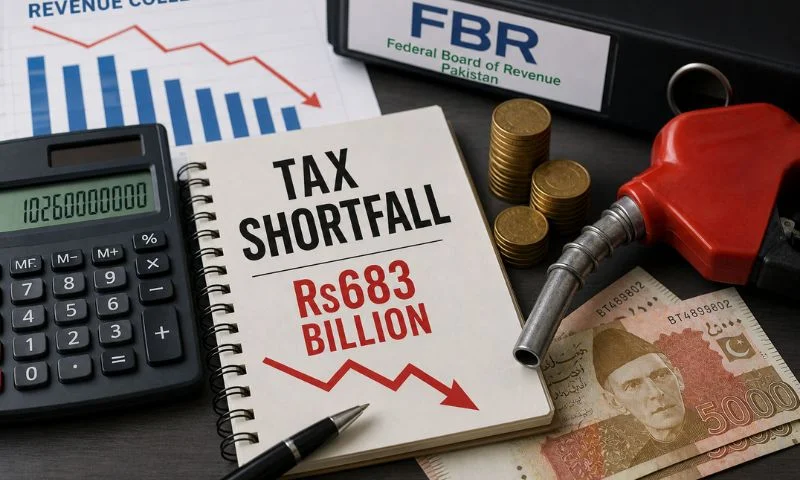
Pakistan’s tax shortfall has widened to Rs683 billion in the current fiscal year, increasing pressure on authorities to raise fuel levies to meet fiscal targets agreed with the International Monetary Fund.
The Federal Board of Revenue collected Rs10.26 trillion during the July to April period of fiscal year 2025-26. However, the amount fell significantly short of the revised target, reflecting slower-than-expected revenue growth.
The government had already revised its annual collection goal to Rs13.98 trillion, but the IMF has refused to lower the target further. Officials now face increasing pressure to bridge the gap through alternative measures.
To manage the shortfall, authorities have turned to petroleum levies. Under a new understanding, the IMF has allowed Pakistan to pass on the remaining Rs53 per litre increase in two phases rather than implementing it all at once.
Fuel Levy Adjustments and Inflation Concerns
The government has already reintroduced a roughly Rs29 per litre levy on diesel while slightly reducing the tax on petrol by around Rs4 per litre. The revised petrol levy now stands at Rs103.5 per litre.
Despite these adjustments, fuel prices have increased again, adding to inflationary pressures. Pakistan remains obligated under its IMF agreement to impose an Rs80 per litre petroleum levy on both petrol and diesel, although current rates have fluctuated due to global oil price movements.
Read More: IMF Imposes New Conditions on Pakistan for $1.2bn Loan
Officials said the remaining levy is likely to be implemented in the coming weeks regardless of international price trends. This approach aims to maintain the primary budget surplus target required under the IMF programme.
Prime Minister Shehbaz Sharif had asked his economic team to seek temporary relief without jeopardising the approval of $1.2 billion loan tranches expected in May.
Meanwhile, rising energy costs have made fuel increasingly unaffordable for many households, creating what analysts describe as a double burden of higher prices and higher taxes.
Weak Growth in Key Tax Streams
Detailed figures show that income tax collection reached Rs5.08 trillion in the first 10 months, missing its target by Rs210 billion despite a 13.6% annual increase.
Sales tax receipts stood at Rs3.42 trillion, falling short by Rs382 billion. Growth in this category was limited to 8% compared to last year.
Federal excise duty collection rose to Rs673 billion but still missed the target by Rs14 billion. Customs duty collection reached Rs1.08 trillion, also below expectations by Rs79 billion, with growth of just 3.6%.
Read More: IMF Sets Tough Budget Priorities for Pakistan Ahead of FY26 Plan
Overall, revenue growth of 10.5% remains far below the pace required to meet annual targets. The government also issued Rs499 billion in tax refunds, including Rs51 billion in April alone.
April collections reached Rs956 billion, missing the monthly target by Rs72 billion despite a 13% increase from last year.
To offset the shortfall, authorities have increased petroleum levies and cut development spending. Economists warn that these measures may create an illusion of fiscal stability rather than addressing structural weaknesses.
The IMF has also tied the release of funds to the recovery of Rs322 billion in pending court cases, adding further pressure on revenue authorities.