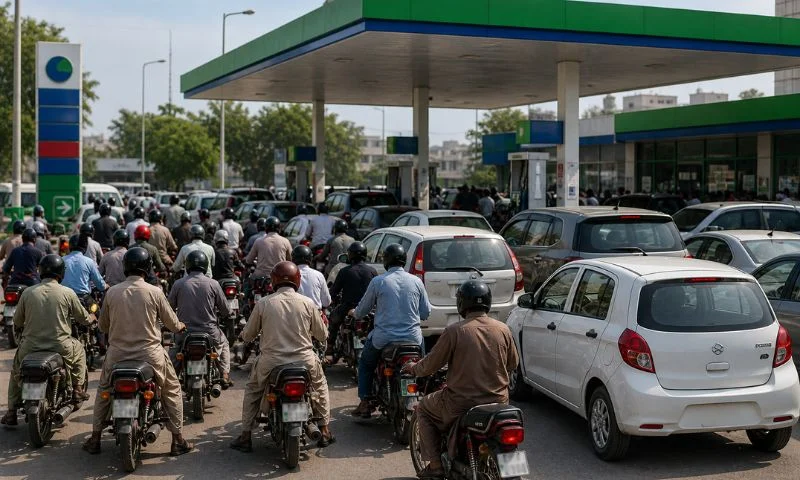
Petrol prices in Pakistan have risen sharply by 56% since February, while rates in India and Bangladesh have remained largely unchanged, highlighting stark differences in policy responses to global oil price volatility.
According to recent data, petrol in New Delhi stood at Indian Rs94.72 per litre on February 1 and remains unchanged at the same level. In Bangladesh, prices have also held steady at around BDT 130 per litre.
In contrast, Pakistan’s petrol price has surged from Rs257 per litre on February 1 to Rs399.86 per litre. This reflects a 56% increase during a period when Brent crude oil prices rose from around $68–70 per barrel to $105–115, marking a 54% to 64% increase.
“Hard truth: Prices unchanged in India and Bangladesh. Pakistan up 56 percent,” wrote Dr Farrukh Saleem in a commentary.
Tax Policies and Market Structures Drive Differences
Experts attribute the divergence to differing government strategies. In India, authorities manage fuel prices by adjusting taxes and relying on state-owned companies such as Indian Oil Corporation, Bharat Petroleum and Hindustan Petroleum to absorb part of the cost.
“How does India do it? The government cuts taxes, and state-owned oil companies absorb the losses. Prices are managed. The consumer is protected while the cost is shifted to company balance sheets,” Saleem noted.
Read More: Pakistan Becomes South Asia’s Most Expensive Country for Petrol
Bangladesh follows a similar approach through the Bangladesh Petroleum Corporation, which adjusts prices infrequently and absorbs fluctuations on behalf of consumers.
“How does Bangladesh do it? Prices are administered. The government-owned BPC absorbs the shock, adjusting prices infrequently. The consumer is protected, while the cost is shifted to the public balance sheet,” he added.
Pakistan, however, applies a full pass-through mechanism. Prices adjust quickly in line with international markets, while the government raises petroleum levies to meet fiscal targets.
“Pakistan does it differently. Prices are passed through immediately, petroleum levy is raised, and domestic refineries are paid import parity prices. The consumer absorbs the shock, the government collects the tax, and refineries make billions,” Saleem wrote.
Diesel Prices Reflect Similar Trend
The same pattern applies to diesel. Prices in India have remained around Indian Rs88 per litre since February, while Bangladesh continues to maintain diesel at about BDT 109 per litre.
Pakistan’s diesel price has increased from roughly Rs267 per litre to Rs399.58 per litre, representing a rise of about 50%.
Read More: Rs378 Petrol Explained: How Much Goes to Taxes and Profits
Analysts say the contrasting approaches reflect broader economic priorities. Countries that shield consumers often shift costs to public finances or corporate balance sheets, while Pakistan’s approach prioritises fiscal targets and revenue generation.
The difference, experts argue, underscores a key policy choice rather than a purely market-driven outcome.
“Three countries. One oil shock – different choices. The oil price is global. The pain is a policy choice,” Saleem concluded.