

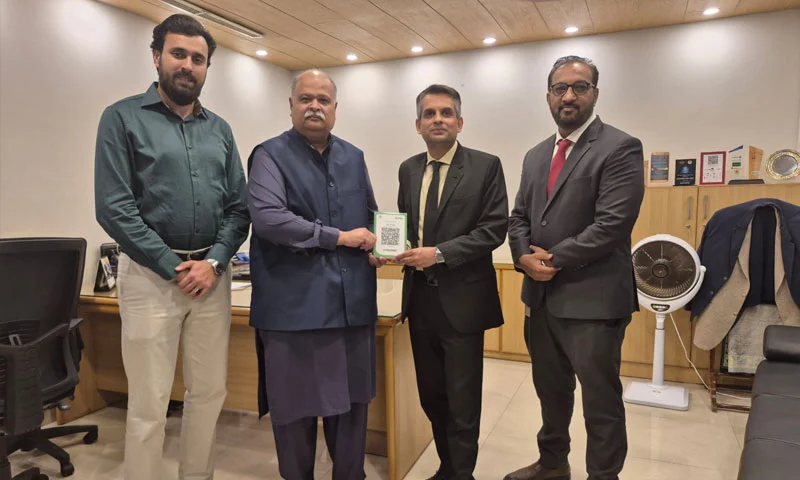
National Bank of Pakistan (NBP) has received approval to launch Raast Person-to-Merchant acquiring services commercially. The move marks another step in Pakistan’s shift toward digital payments and a cashless economy. The approval allows NBP to begin full commercial operations under the Raast framework developed by the State Bank of Pakistan. NBP announced the development in a statement issued from Karachi on Monday. Read More: NBP, ISTIQEME Join Hands to Accelerate Digital Payments Ecosystem Across Pakistan Officials described the approval as a major milestone in the bank’s digital transformation strategy. Moreover, they said the initiative would support Pakistan’s broader financial inclusion goals. Following the approval, representatives from NBP’s Digital Banking Group met officials from the State Bank’s Digital Innovations and Settlement Department. The meeting included Muhammad Imaduddin, Muhammad Hassan Memon, Adnan Nasir and Zohaib Ali Khan. NBP said the approval reflected continued support from the State Bank of Pakistan and Raast Payments Pakistan. Focus shifts to merchants and digital inclusion With the approval secured, NBP can now promote Raast P2M acquiring services to merchants, institutions, customers and government entities. In addition, the bank plans awareness campaigns to encourage digital payment adoption across Pakistan. NBP said it would focus strongly on underserved communities, small businesses and institutional payment systems. Raast serves as Pakistan’s first instant digital payment platform. The State Bank launched the system to modernise financial transactions and improve financial inclusion. Read More: Digital Channels Now Handle 90% of Retail Payments, SBP Reveals The platform allows users to transfer money instantly through bank accounts, mobile numbers and merchant QR codes. Meanwhile, Pakistan’s banking sector continues to accelerate digital transformation efforts. Smartphone usage, fintech growth and mobile banking services have expanded rapidly in recent years. According to State Bank data, digital retail transactions in Pakistan have increased sharply due to rising mobile banking adoption. Cashless economy drive gains momentum NBP said it would continue working with regulators, fintech companies and merchant communities to expand digital payment acceptance nationwide. The bank also plans to improve payment infrastructure for merchants and institutional users. Financial analysts believe Raast P2M services could lower transaction costs for businesses. Furthermore, experts say digital payments can improve transparency and payment efficiency. Many analysts also expect digital payment growth to reduce dependence on cash transactions in the long term. Pakistan’s digital payments market has become increasingly competitive as banks and fintech firms expand QR payments, mobile wallets and instant transfer services. Read More: Two-Week Digital Detox Shows Major Brain and Mood Benefits As a result, NBP’s commercial rollout of Raast P2M acquiring could help accelerate merchant onboarding across Pakistan. The bank described the launch as part of its long-term commitment to financial innovation and digital inclusion.

Xperia 1 VIII Could Be Sony’s Biggest Smartphone Upgrade in Years
Sony has confirmed that it will unveil the Xperia 1 VIII smartphone on May 13 at 11:00 AM Japan Standard Time, setting the stage for one of the company’s biggest mobile launches in recent years. The Japanese technology giant announced the launch through a teaser campaign but stopped short of revealing the phone’s full specifications. Industry reports, however, suggest Sony plans to push further into the premium photography-focused smartphone segment with a redesigned Xperia flagship and upgraded camera hardware. Sony is also expected to introduce the highly anticipated Sony A7R VI and a new 100-400mm f/4.5 GM lens during the same launch event. The move highlights Sony’s strategy of linking its smartphone and imaging businesses more closely as competition intensifies in the premium mobile market. Redesigned Xperia Expected With Major Camera Upgrades Leaks and early reports suggest the Xperia 1 VIII will feature a redesigned body and a square-shaped rear camera module. The phone is expected to include a new telephoto sensor alongside a 16mm ultrawide camera and a 24mm primary sensor. Sony has traditionally focused on photography enthusiasts and professional creators through its Xperia lineup. Analysts expect the company to continue that approach with deeper integration of Alpha camera technologies and AI-powered imaging features. Reports also indicate the Xperia 1 VIII may offer battery life lasting up to two days, a feature that could help Sony compete against flagship rivals from Samsung, Apple and Xiaomi. Sony’s Xperia smartphones hold a smaller share of the global market compared to larger Android competitors. Still, the brand maintains a loyal following among users seeking professional-grade camera controls, 4K displays and creator-focused tools. The Xperia 1 series has also gained recognition for retaining features many rivals have removed, including expandable storage and headphone jacks in some models. Sony Strengthens Imaging Ecosystem The expected launch of the A7R VI camera alongside the Xperia 1 VIII reflects Sony’s broader strategy of building a connected ecosystem for photographers, videographers and content creators. Sony remains one of the world’s leading image sensor manufacturers. Its sensors power devices from multiple smartphone brands, including Apple and Xiaomi. Analysts say the company continues to leverage its imaging expertise to differentiate Xperia devices from mainstream Android competitors. The smartphone market has become increasingly competitive as brands invest heavily in AI features, computational photography and longer battery life. Sony’s upcoming launch event will likely reveal whether the company can strengthen Xperia’s position in the premium smartphone segment while expanding its appeal beyond photography enthusiasts. The Xperia 1 VIII launch event will stream globally through Sony’s official digital platforms on May 13.

BCCI Under Pressure After Massive IPL 2026 Viewership Slide
Indian Premier League (IPL) has dominated franchise cricket for nearly two decades. However, IPL 2026 is now facing growing scrutiny after a sharp decline in television ratings and audience engagement raised fresh concerns over the league’s future trajectory. According to figures released by BARC India and TAM Sports, the first half of IPL 2026 recorded an 18.8% drop in TV ratings. Average viewership also declined by 26%. Read More: IPL Built for Entertainment Not Development, Muttiah Muralithan The downturn has intensified debate around whether the league has entered a phase of audience fatigue after years of uninterrupted dominance. The decline becomes even more striking because IPL 2026 still features many of cricket’s biggest stars, including Virat Kohli, Rohit Sharma, Pat Cummins and Jos Buttler. Despite explosive batting displays and frequent 200-plus totals, viewers appear increasingly disconnected from the tournament’s lengthy league phase. Analysts say the IPL’s once-unmissable appeal may now be weakening as repetitive schedules and familiar matchups reduce excitement levels among audiences. Viewer fatigue and gaming ban hit engagement One major factor behind the decline appears to be long-term viewer saturation. The IPL has remained cricket’s biggest commercial product since 2008. Nevertheless, experts believe audiences may now be showing signs of exhaustion after years of consuming a similar format every season. Many league-stage matches no longer generate the same urgency they once did, especially in a crowded entertainment market dominated by streaming platforms, football leagues, esports and short-form content. In addition, India’s crackdown on real money gaming platforms has significantly changed the IPL ecosystem. Read More: Vaibhav Sooryavanshi Child Labour Row: FIR Threat Shakes IPL Fantasy gaming brands such as Dream11 and My11Circle previously played a central role in keeping viewers emotionally invested throughout matches. Many fans followed fantasy team performances alongside live games. However, that layer of interaction has largely disappeared following restrictions on betting-related platforms. As a result, advertising engagement has weakened, while viewers are increasingly switching platforms during breaks and innings intervals.

AI Boom and Iran War Disruptions Hit Nintendo’s Console Business
Nintendo shares fell sharply on Monday after the gaming giant warned of weaker profits and announced higher prices for its Switch 2 console in several major markets. In early trading in Tokyo, Nintendo shares dropped as much as 9.9% to 6,908 yen following concerns over slowing momentum in the company’s gaming business. The decline came after Nintendo forecast a 27% drop in net profit for the current financial year despite strong sales growth last year. The company said on Friday that rising hardware costs and a weaker first-year game line-up for the Switch 2 would likely pressure earnings. Nintendo also confirmed price increases for the console in Japan, the United States and Europe. The Switch 2 price in Japan will rise by 20% from May 25. Meanwhile, prices in the United States will increase by 11% to $499.99 from September 1. European customers will also pay more, with the price rising by 6% to 499.99 euros. Analysts said the price hikes could affect demand because consumers remain sensitive to rising living costs and gaming expenses. AI chip costs and supply issues create pressure Nintendo’s challenges come as technology companies worldwide face rising semiconductor costs linked to the global artificial intelligence boom. Demand for advanced memory chips used in AI systems has increased sharply over the past year. Consequently, manufacturers of gaming consoles and electronic devices are facing higher production costs. Supply disruptions linked to the ongoing conflict involving Iran have also added pressure to global electronics supply chains. Industry experts say shipping disruptions and higher energy costs continue to affect technology manufacturers across Asia. Despite the weaker outlook, Nintendo reported strong financial results for the previous fiscal year. The company’s net profit surged 52% to 424 billion yen, while annual sales reached 2.31 trillion yen. Revenue nearly doubled compared with the previous year. Nintendo also revealed that sales of the Switch 2 reached 19.86 million units by the end of March. Popular titles including Pokemon Pokopia, Mario Kart World and Donkey Kong Bananza helped drive strong demand for the console. Analysts question software strategy Gaming industry consultant Serkan Toto said Nintendo now faces pressure to strengthen its software offering for the new console generation. “The first year game lineup for Switch 2 is much weaker than for its predecessor,” Toto told AFP ahead of the earnings announcement. He also warned that Switch 2 buyers are “especially price sensitive” at a time when inflation continues to affect consumer spending globally. “But now it’s time for them to really step on the gas on the software side,” he added. Nintendo’s original Switch became one of the best-selling gaming consoles in history after its launch in 2017, driven by blockbuster franchises such as The Legend of Zelda and Animal Crossing. Investors will now closely watch whether Nintendo can maintain strong console sales while convincing gamers to pay higher prices during a period of economic uncertainty.

Why Pakistan’s Salaried Class Could Finally Get Relief in Budget 2026
Pakistan’s government is considering income tax relief for salaried individuals in the upcoming federal budget while likely keeping salaries and pensions unchanged. The proposal aims to ease pressure on salaried workers without sharply increasing government spending. Officials familiar with the discussions said Finance Minister Muhammad Aurangzeb wants to lower income tax rates and possibly raise the taxable income threshold. The move comes as salaried individuals continue to shoulder one of the country’s heaviest tax burdens. Officials said the government wants to acknowledge the contribution of salaried workers compared to sectors such as real estate, wholesale trade, retail and exports. An official involved in the budget talks said, “There is no reason to increase salaries if it pushes employees into higher taxable income brackets, leaving government employees with little to no increase in take-home pay.” The official said lower tax rates and higher taxable income thresholds would still benefit government employees financially. “Government employees would not be worse off financially. That is neither the idea nor the intention,” the official added. IMF Talks and Fiscal Pressure The government plans to discuss the proposals with an IMF mission during budget consultations beginning on May 15. Pakistan remains under pressure to maintain fiscal discipline while trying to stabilize the economy. Officials said the government may also reduce development spending to control the fiscal deficit. Last year, salary and pension increases added more than Rs170 billion to the federal government’s expenditures. Provincial governments faced an even bigger financial impact. Officials now believe part of those savings could fund tax relief for salaried workers. Government salaries have increased by more than 60 percent during the past four years. Private sector wages, however, have largely remained stagnant despite rising inflation and weak economic growth. Pakistan’s inflation crisis sharply increased household expenses over the last two years. Food, fuel and utility prices have remained under pressure. Salaried Class Pays Record Taxes Official estimates show the salaried class paid more than Rs425 billion in taxes during the first nine months of the current fiscal year. That amount exceeded the real estate sector’s contribution of around Rs200bn. The figure also surpassed the combined tax revenue from wholesalers, retailers and exporters. Economists have repeatedly argued that Pakistan relies too heavily on documented salaried income while several sectors remain under-taxed. Meanwhile, the government has protected salary increases announced last month for employees working on Public Sector Development Programme projects. Authorities approved a 20 to 35 percent increase in minimum salaries for PSDP-funded employees starting July 1, 2026. Those employees had faced cuts of up to 28 percent in annual increments and 14 percent in maximum salaries under earlier revisions issued by the finance ministry. Pakistan is expected to announce the federal budget next month after IMF consultations and internal fiscal discussions conclude.

Midnight Sun Begins in Alaska With 84 Days Without Night
Residents of Utqiagvik, the northernmost city in the United States, witnessed their final sunset of the season on Saturday before entering an extraordinary period of nonstop daylight known as the “Midnight Sun.” The Sun dipped below the horizon for the last time before rising again at 2:57 am local time. It will now remain visible for 84 consecutive days until August 2. Located more than 500 kilometres north of the Arctic Circle, Utqiagvik experiences some of the most extreme daylight patterns on Earth. During the Midnight Sun period, the Sun circles the sky at a shallow angle and never sinks far enough below the horizon to create darkness. As a result, daylight continues even at midnight. For many residents, the phenomenon is a normal part of Arctic summer life. However, for visitors and scientists, it remains one of the planet’s most remarkable natural events. LAST SUNSET UNTIL AUGUST: Utqiagvik, the northernmost city in the U.S., saw its final sunset on Saturday until August 2nd! That's 84 straight days of daylight! Then in the winter, they'll see over 60 days of darkness.#AKwx pic.twitter.com/oHw1HijJCJ— WeatherNation (@WeatherNation) May 10, 2026 The opposite extreme arrives during winter. At that time, the city enters a prolonged “polar night” when the Sun disappears completely for more than 60 days. Earth’s tilt drives the phenomenon Scientists explain that the Midnight Sun occurs because of Earth’s axial tilt and its yearly orbit around the Sun. Earth tilts at approximately 23.5 degrees relative to its orbital plane. Consequently, different parts of the planet receive varying amounts of sunlight throughout the year. During summer in the Northern Hemisphere, the North Pole tilts toward the Sun. Therefore, regions above the Arctic Circle receive continuous sunlight because the Sun never falls low enough to set. Conversely, during winter, the Northern Hemisphere tilts away from the Sun. As a result, Arctic regions such as Utqiagvik remain in darkness for weeks. The closer a location lies to the poles, the more dramatic these seasonal shifts become. At the exact North Pole, the Sun rises only once each year during the March equinox and sets once during the September equinox. This creates nearly six months of daylight followed by six months of darkness. Researchers say these extreme cycles provide valuable insight into Earth’s orbital mechanics, atmospheric behaviour and human adaptation to harsh environments. Life under an unsetting Sun Although the Midnight Sun attracts global attention, daily life in Utqiagvik continues much like any other season. Residents often use blackout curtains and adjusted schedules to manage sleep during the endless daylight period. Meanwhile, tourism activity typically increases as travellers visit the Arctic region to witness the rare spectacle. Scientists also monitor the region closely because Arctic areas continue to warm faster than most parts of the world due to climate change. Utqiagvik, formerly known as Barrow, sits along Alaska’s northern coast near the Arctic Ocean. The city is home to a largely Iñupiat population and serves as an important centre for Arctic research and indigenous culture. Despite the scientific interest surrounding the phenomenon, locals often view the endless sunlight simply as another part of life in the far north. For the next 84 days, however, night will not return to America’s northernmost city.

Australia Picks Young Guns For Pakistan and Bangladesh Tours
Australia national cricket team will use upcoming white-ball tours of Pakistan and Bangladesh to test squad depth after selectors named several inexperienced players, including three potential debutants, for the subcontinent assignments. Cricket Australia announced separate squads for the ODI series in Pakistan and Bangladesh as well as the T20 series in Bangladesh. Mitchell Marsh will captain all squads during the tour. Regular ODI captain Pat Cummins and fellow pace bowlers Josh Hazlewood and Mitchell Starc will miss the series to rest following their Indian Premier League commitments. Read More: PCB Confirms Australia’s Return for Three Match ODI Series Australia will play three ODIs against Pakistan in Rawalpindi and Lahore from May 30 to June 4 before travelling to Bangladesh for additional ODI and T20 matches. Meanwhile, selectors dropped experienced all-rounders Glenn Maxwell and Marcus Stoinis after Australia’s disappointing campaign at the recent T20 World Cup, where the team failed to advance beyond the group stage. All-rounder Liam Scott earned selection in both ODI squads, while Victoria batter Ollie Peake received a call-up for the Pakistan series. In addition, T20 specialist Joel Davies joined the squad for the three-match T20 series in Chattogram starting on June 17. Selectors focus on long-term depth Chief selector George Bailey said the tours would provide an opportunity to evaluate emerging players in challenging subcontinent conditions. “It’s always exciting to see new players get an opportunity to play international cricket and be a part of the national team,” Bailey said in a statement. “The blend of experienced players coupled with new or returning players will provide a nice mix for these subcontinent tours,” he added. Fast bowlers Billy Stanlake and Riley Meredith also returned for the Pakistan ODI series. Read More: David Warner Ready to Accept Responsibility in Drink-Driving Case Leg-spinner Tanveer Sangha retained his place in both ODI squads, while Meredith will remain with the squad for the Bangladesh T20 matches. Selectors also confirmed that Travis Head, Cooper Connolly, Ben Dwarshuis and Xavier Bartlett would join the Bangladesh ODI squad after completing IPL commitments. As a result, Ollie Peake, Billy Stanlake, Riley Meredith and Matt Short will leave the group following the Pakistan series. Australia balances transition and preparation Australia’s selectors appear focused on building squad depth ahead of future ICC tournaments and the next T20 World Cup cycle. The subcontinent conditions in Pakistan and Bangladesh are expected to provide a strong test for younger batters and bowlers, especially against spin-friendly attacks and slower pitches. Australia retained experienced names such as Adam Zampa, Alex Carey and Marnus Labuschagne to guide the younger players during the tour. Read More: Vaibhav Sooryavanshi Child Labour Row: FIR Threat Shakes IPL The Pakistan ODI series will begin on May 30, while Bangladesh will host three ODIs from June 9 to June 14 before the T20 matches begin on June 17.

Poll Shows Trump Losing Support on Economy and Foreign Policy
More than half of American voters disapprove of Donald Trump’s handling of inflation and the economy, according to a new poll that highlights growing concerns over tariffs, rising fuel prices and the ongoing conflict involving Iran ahead of the US midterm elections. The nationwide survey, conducted by research firm Focaldata for the Financial Times, found that inflation and the rising cost of living remain the biggest concerns for voters before November’s congressional elections. According to the poll, nearly 58% of registered voters either “strongly” or “somewhat” disapproved of Trump’s management of inflation and living costs. Read More: New Passport Design in US to Include Trump Picture In addition, more than half of respondents expressed dissatisfaction with his handling of jobs and the broader economy. Around 55% of voters said Trump’s tariffs negatively affected the US economy. However, only about one-quarter believed his trade policies improved economic conditions. The findings arrive at a politically sensitive moment for the White House, with six months remaining before control of both chambers of Congress is contested. Trump returned to office in 2025 after winning the presidential election on promises to lower inflation, revive domestic manufacturing and prioritise American economic interests. Iran war and fuel prices create pressure The poll also reflected growing voter unease over the conflict involving Iran and its economic consequences. According to the survey, nearly 54% of voters disapproved of Trump’s handling of the Iran war, while fewer than one-third approved. Even among Republican voters, roughly one in five respondents expressed dissatisfaction with his management of the conflict. The war escalated after the United States and Israel launched air strikes on Iran in late February. As a result, tensions disrupted shipping through the Strait of Hormuz and tightened global oil supplies. Read More: From 2016 to 2026 US President DonalTrump Faces Growing List of Assassination Threats Although a fragile ceasefire remains in place, the conflict has continued to push fuel and consumer prices higher across the United States. Trump recently claimed petrol prices were “way down.” However, average gasoline prices reportedly climbed to about $4.60 per gallon last week. That figure stands nearly 50% higher than before the conflict began. Meanwhile, the administration has attempted to negotiate an agreement with Tehran to avoid further escalation and reduce inflationary pressure before the elections. Democrats gain advantage before midterms Overall, more than 54% of voters said they disapproved of Trump’s performance as president. By comparison, just over 39% approved of his leadership. Independent voters appeared especially critical. More than 58% of independents held an unfavourable opinion of Trump, according to the poll. The survey also showed Democrats holding an eight-point advantage over Republicans among registered voters heading into the midterms. Currently, Republicans control both the United States House of Representatives and the United States Senate. Nevertheless, Democrats hope to regain control of Congress in November. Read More: “You’d Be Speaking French”: Charles Teases Trump in Viral Moment Kush Desai defended the administration’s economic policies, saying Trump’s tax cuts, deregulation agenda and energy measures would keep the economy on a “solid economic trajectory.” He added that Americans would eventually see lower inflation and falling fuel prices once disruptions linked to the Iran conflict eased. The online poll was conducted between May 1 and May 5 among 3,167 registered voters. It carried a margin of error of plus or minus 2.1 percentage points.
