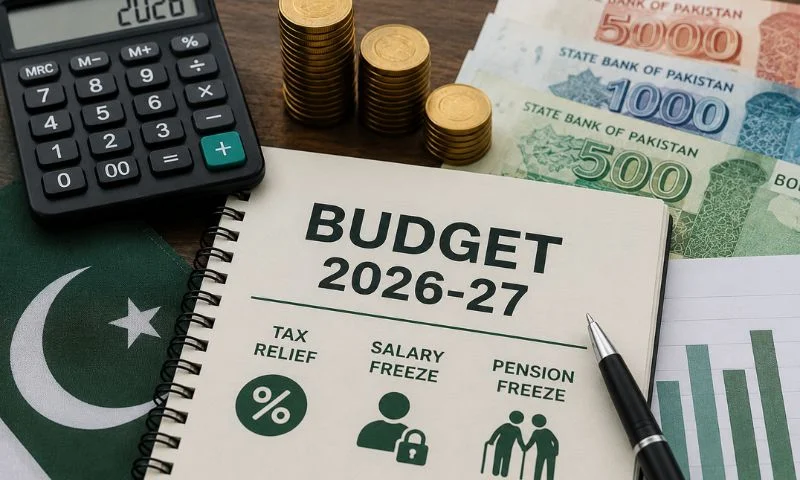
Pakistan’s government is considering income tax relief for salaried individuals in the upcoming federal budget while likely keeping salaries and pensions unchanged. The proposal aims to ease pressure on salaried workers without sharply increasing government spending.
Officials familiar with the discussions said Finance Minister Muhammad Aurangzeb wants to lower income tax rates and possibly raise the taxable income threshold. The move comes as salaried individuals continue to shoulder one of the country’s heaviest tax burdens.
Officials said the government wants to acknowledge the contribution of salaried workers compared to sectors such as real estate, wholesale trade, retail and exports.
An official involved in the budget talks said, “There is no reason to increase salaries if it pushes employees into higher taxable income brackets, leaving government employees with little to no increase in take-home pay.”
The official said lower tax rates and higher taxable income thresholds would still benefit government employees financially.
“Government employees would not be worse off financially. That is neither the idea nor the intention,” the official added.
IMF Talks and Fiscal Pressure
The government plans to discuss the proposals with an IMF mission during budget consultations beginning on May 15. Pakistan remains under pressure to maintain fiscal discipline while trying to stabilize the economy.
Officials said the government may also reduce development spending to control the fiscal deficit. Last year, salary and pension increases added more than Rs170 billion to the federal government’s expenditures.
Provincial governments faced an even bigger financial impact. Officials now believe part of those savings could fund tax relief for salaried workers. Government salaries have increased by more than 60 percent during the past four years.
Private sector wages, however, have largely remained stagnant despite rising inflation and weak economic growth.
Pakistan’s inflation crisis sharply increased household expenses over the last two years. Food, fuel and utility prices have remained under pressure.
Salaried Class Pays Record Taxes
Official estimates show the salaried class paid more than Rs425 billion in taxes during the first nine months of the current fiscal year.
That amount exceeded the real estate sector’s contribution of around Rs200bn.
The figure also surpassed the combined tax revenue from wholesalers, retailers and exporters.
Economists have repeatedly argued that Pakistan relies too heavily on documented salaried income while several sectors remain under-taxed.
Meanwhile, the government has protected salary increases announced last month for employees working on Public Sector Development Programme projects.
Authorities approved a 20 to 35 percent increase in minimum salaries for PSDP-funded employees starting July 1, 2026.
Those employees had faced cuts of up to 28 percent in annual increments and 14 percent in maximum salaries under earlier revisions issued by the finance ministry.
Pakistan is expected to announce the federal budget next month after IMF consultations and internal fiscal discussions conclude.