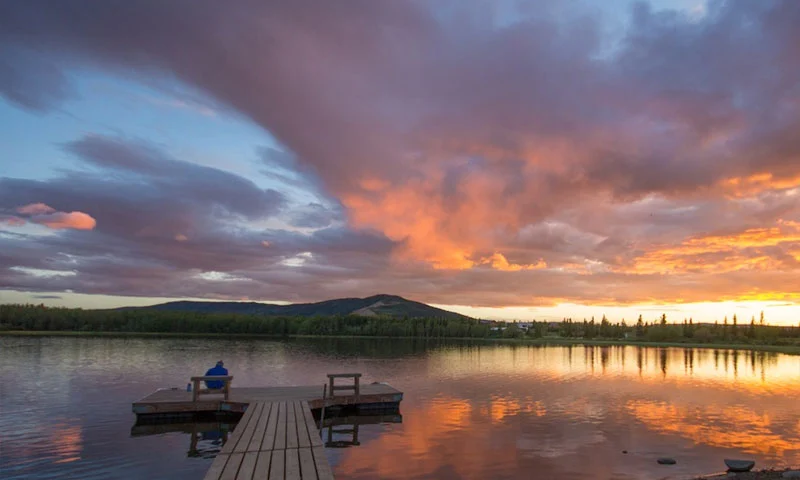
Residents of Utqiagvik, the northernmost city in the United States, witnessed their final sunset of the season on Saturday before entering an extraordinary period of nonstop daylight known as the “Midnight Sun.”
The Sun dipped below the horizon for the last time before rising again at 2:57 am local time. It will now remain visible for 84 consecutive days until August 2.
Located more than 500 kilometres north of the Arctic Circle, Utqiagvik experiences some of the most extreme daylight patterns on Earth.
During the Midnight Sun period, the Sun circles the sky at a shallow angle and never sinks far enough below the horizon to create darkness. As a result, daylight continues even at midnight.
For many residents, the phenomenon is a normal part of Arctic summer life. However, for visitors and scientists, it remains one of the planet’s most remarkable natural events.
The opposite extreme arrives during winter. At that time, the city enters a prolonged “polar night” when the Sun disappears completely for more than 60 days.
Earth’s tilt drives the phenomenon
Scientists explain that the Midnight Sun occurs because of Earth’s axial tilt and its yearly orbit around the Sun.
Earth tilts at approximately 23.5 degrees relative to its orbital plane. Consequently, different parts of the planet receive varying amounts of sunlight throughout the year.
During summer in the Northern Hemisphere, the North Pole tilts toward the Sun. Therefore, regions above the Arctic Circle receive continuous sunlight because the Sun never falls low enough to set.
Conversely, during winter, the Northern Hemisphere tilts away from the Sun. As a result, Arctic regions such as Utqiagvik remain in darkness for weeks.
The closer a location lies to the poles, the more dramatic these seasonal shifts become.
At the exact North Pole, the Sun rises only once each year during the March equinox and sets once during the September equinox. This creates nearly six months of daylight followed by six months of darkness.
Researchers say these extreme cycles provide valuable insight into Earth’s orbital mechanics, atmospheric behaviour and human adaptation to harsh environments.
Life under an unsetting Sun
Although the Midnight Sun attracts global attention, daily life in Utqiagvik continues much like any other season.
Residents often use blackout curtains and adjusted schedules to manage sleep during the endless daylight period. Meanwhile, tourism activity typically increases as travellers visit the Arctic region to witness the rare spectacle.
Scientists also monitor the region closely because Arctic areas continue to warm faster than most parts of the world due to climate change.
Utqiagvik, formerly known as Barrow, sits along Alaska’s northern coast near the Arctic Ocean. The city is home to a largely Iñupiat population and serves as an important centre for Arctic research and indigenous culture.
Despite the scientific interest surrounding the phenomenon, locals often view the endless sunlight simply as another part of life in the far north.
For the next 84 days, however, night will not return to America’s northernmost city.