

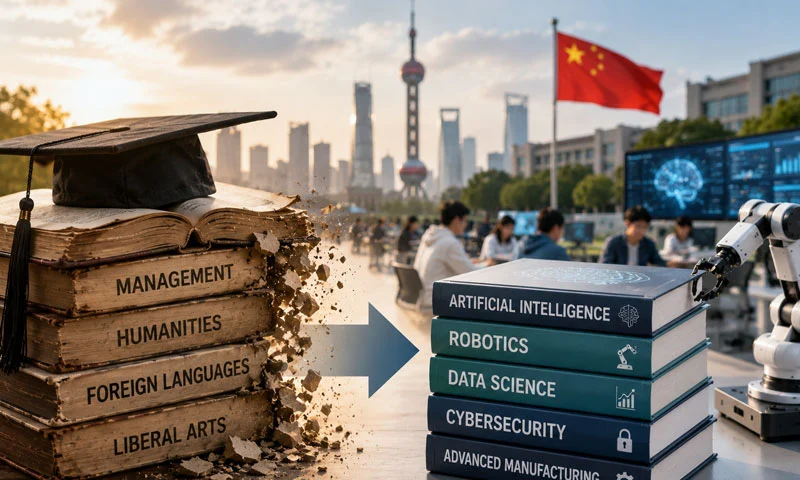
China is undertaking one of the largest overhauls of its higher education system in recent years as universities eliminate thousands of degree programmes and introduce new courses focused on artificial intelligence, robotics and advanced technologies. The changes reflect growing concern that rapid advances in AI are transforming the job market faster than traditional academic programmes can adapt. According to a report by the South China Morning Post, Chinese universities are removing courses considered outdated and replacing them with programmes aligned with Beijing’s long-term economic and technological goals. The move comes as AI increasingly automates tasks in sectors such as finance, consulting, marketing and management. As a result, students are becoming more cautious about investing in degrees that may offer uncertain career prospects. A similar trend has emerged in the United States. Several universities have reportedly reduced tuition fees for MBA programmes in response to weaker demand and growing concerns about the future value of traditional business qualifications. China, however, is pursuing reforms on a much larger scale. Officials want universities to produce graduates with skills that support national priorities, including artificial intelligence, advanced manufacturing, semiconductor development and robotics. Graduate Job Market Pressures Drive Reform The overhaul also highlights growing challenges in China’s labour market. More students are graduating from universities than ever before, but many struggle to find jobs that match their qualifications. Youth unemployment remains above 16 percent, according to official figures, increasing pressure on policymakers to align education with employer needs. Universities have concentrated many of the cuts in arts, humanities, foreign language and management-related disciplines. Officials and educators argue that these fields have become oversaturated while demand grows for technology-focused expertise. At the same time, institutions are launching programmes designed to support China’s next phase of industrial development. One of the fastest-growing fields is embodied intelligence, which combines artificial intelligence with physical machines such as robots. At least nine Chinese universities have already introduced majors in embodied intelligence as Beijing accelerates efforts to integrate advanced AI systems into factories, logistics networks and other sectors of the economy. More Than 12,000 Programmes Eliminated The current reforms build on a broader restructuring effort that has been underway for several years. Data from China’s Ministry of Education shows universities revoked or suspended approximately 12,200 undergraduate programmes between 2021 and 2025. During the same period, universities introduced around 10,200 new programmes. Overall, more than 30 percent of university programmes underwent some form of adjustment. Despite supporting the direction of the reforms, education experts caution that simply replacing one degree with another may not solve deeper challenges. Many programmes now facing closure were introduced only a few years ago and never had enough time to mature. Experts argue that universities should focus on building flexible education systems that allow students to adapt to changing industry demands throughout their careers. They also recommend greater emphasis on transferable skills, critical thinking and interdisciplinary learning. As competition in artificial intelligence intensifies globally, China’s latest reforms demonstrate how governments are increasingly redesigning higher education to prepare students for an economy shaped by automation, digital technologies and rapid innovation.
US-Iran Agree to End War, Switzerland Ceremony Set for June 19
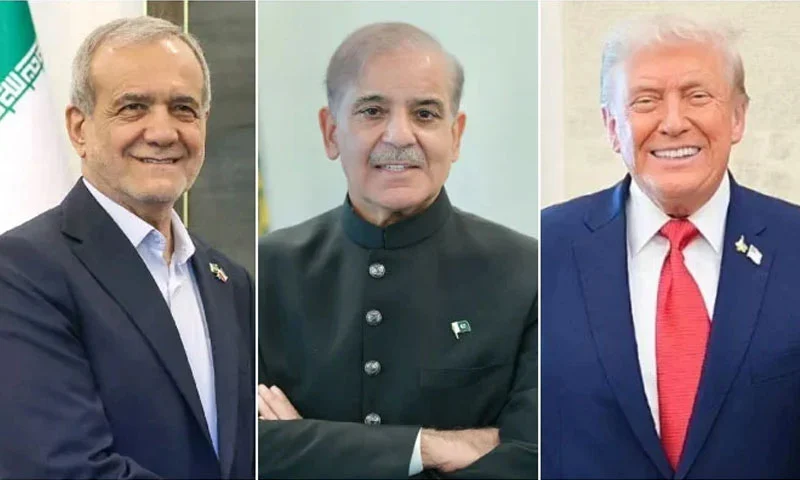
Prime Minister Shehbaz Sharif announced on Monday that the United States and Iran had reached a peace agreement following months of diplomatic engagement, marking a major breakthrough in efforts to end a conflict that has destabilised the Middle East and disrupted global energy markets. In a post on X, the prime minister said both sides had agreed to the “immediate and permanent termination of military operations on all fronts, including Lebanon”, with an official signing ceremony scheduled to take place in Switzerland on June 19. Following intensive talks, we are pleased to announce that the Peace Deal between the United States of America and Islamic Republic of Iran has been REACHED. Both sides have declared the immediate and permanent termination of military operations on all fronts, including in…— Shehbaz Sharif (@CMShehbaz) June 14, 2026 The announcement came hours after US President Donald Trump declared that negotiations had concluded successfully. “The Deal with the Islamic Republic of Iran is now complete,” Trump wrote on Truth Social around 5:30pm ET on Sunday. Pakistan played a key mediation role during the negotiations. Shehbaz thanked Qatar for facilitating dialogue and helping create conditions that led to the agreement. The premier also praised Saudi Arabia and Turkiye for what he described as their “immense contributions” to the diplomatic effort. He said mediators would now oversee a series of meetings aimed at preparing for technical discussions and the formal signing ceremony in Switzerland. The agreement follows an Israeli strike on Lebanon on Sunday that drew criticism from both Iran and Trump and threatened to complicate ongoing negotiations. Strait of Hormuz to Reopen as Ceasefire Begins A major element of the agreement involves the reopening of the Strait of Hormuz, one of the world’s most important energy shipping routes. The waterway has faced severe disruptions for months as tensions escalated between Washington and Tehran. Trump said the strait would reopen on Friday following the signing of the agreement and announced that the United States would end its blockade of Iranian ports. “Ships of the World, start your engines. Let the oil flow!” Trump wrote. “The Deal with Islamic Republic of Iran is now complete. Congratulations to all!” President Donald J. Trump 🇺🇸 pic.twitter.com/RdSwyEdEtO— The White House (@WhiteHouse) June 14, 2026 In another post, Trump described the accord as a “great deal” that would bring peace and security to the wider region. He also claimed that previous US administrations had failed to achieve a similar breakthrough and said regional leaders had finally found a US president capable of helping secure lasting peace. According to Iranian Deputy Foreign Minister Kazem Gharibabadi, negotiators will use a 60-day ceasefire period to pursue a broader agreement. Those talks are expected to focus on sanctions relief, regional security issues and the future of Iran’s nuclear programme. Sources familiar with negotiations previously told Reuters that Tehran’s nuclear activities would form a key part of follow-up discussions. Regional Leaders Welcome Agreement Qatari Prime Minister Sheikh Mohammed bin Abdulrahman bin Jassim Al Thani welcomed the agreement and thanked Pakistan and other regional partners for helping facilitate progress. In a statement posted on X, he said Qatar hoped all parties would engage in future negotiations in a “positive and constructive spirit”. We welcome the agreement reached on the Memorandum of Understanding between the United States of America and the Islamic Republic of Iran. We extend our thanks to our brothers in the Islamic Republic of Pakistan, as well as to all regional and international parties that…— محمد بن عبدالرحمن (@MBA_AlThani_) June 14, 2026 He also reaffirmed Doha’s commitment to promoting regional security through dialogue and peaceful diplomacy. British Prime Minister Keir Starmer also welcomed the development. “We are clear that toll-free freedom of navigation must now be restored in the Strait of Hormuz,” Starmer said, while reiterating that “Iran must never have a nuclear weapon.” The conflict began after US and Israeli forces launched attacks on Iran on February 28. Since then, thousands of people have died, mainly in Iran and Lebanon. The fighting triggered major disruptions to regional trade and energy supplies. Iran restricted movement through the Strait of Hormuz, while US forces responded by blocking Iranian ports. Although the agreement represents a significant diplomatic breakthrough, Israel has stated that it is not a party to the proposed deal. Analysts say successful implementation could ease tensions across the Middle East, restore energy flows and reduce pressure on global oil markets after months of uncertainty.
