


The International Cricket Council (ICC) and the International Olympic Committee (IOC) have confirmed the qualification pathway for cricket’s return to the Olympic Games at Los Angeles 2028. They also announced the first ever ICC Olympics Qualifier. Cricket will return to the Olympics for the first time since 1900. Six teams will compete in both the men’s and women’s T20 tournaments. Africa, Asia, Europe and Oceania will each have guaranteed representation. The ICC will award five qualification places through existing ICC tournaments and the ICC T20I rankings. The new ICC Olympics Qualifier in 2027 will decide the sixth and final spot in both competitions. The ongoing ICC Women’s T20 World Cup 2026 has already produced the first qualifiers. Australia, Great Britain through England, India and South Africa secured Olympic places after finishing as the highest ranked eligible teams from their respective continents. Each continent could qualify only one nation. Rankings and new qualifier to decide remaining teams The USA can qualify automatically as host in both competitions. However, each team must enter the top 15 of the relevant ICC T20I rankings between June 30 and December 31, 2026. If either USA team misses that target, the ICC will award the automatic place to the next highest ranked eligible nation. The West Indies cannot compete directly because they represent several Caribbean countries instead of one IOC recognised National Olympic Committee. If either West Indies team ranks among the top eight non qualified sides by December 31, 2026, the region will stage a Caribbean Qualifier. The winning National Olympic Committee will then enter the ICC Olympics Qualifier in 2027. The ICC will determine the remaining men’s automatic places through the ICC Men’s T20I rankings. The highest ranked eligible teams from Africa, Asia, Europe and Oceania will book direct places at LA28. The ICC Olympics Qualifier will feature eight men’s teams and eight women’s teams. The ICC will announce the dates and host country later. ICC says Olympic return will grow the game ICC Chairman Jay Shah welcomed the announcement and described it as a major milestone. “Cricket’s return to the Olympic Games is a landmark moment for our sport and a powerful opportunity to showcase the very best of cricket to the world. The confirmation of this qualification pathway is an important step towards Los Angeles 2028 and gives Members across the world a clear and exciting route to the Olympic stage.” He added: “The Olympic Games represent the pinnacle of multi event sport, and cricket’s inclusion at LA28 will inspire players and fans in every region. This is an historic moment, and one of great opportunity for our Members, as we continue to grow the game and take it to new audiences around the world.” ICC Chief Executive Sanjog Gupta said: “Cricket’s return to the Olympic Games gives the sport a unique showcase on global sport’s grandest stage, supporting its introduction to new audiences and development in emerging markets, while providing the Olympic movement a gateway into the hearts and minds of more than two billion Cricket fans.” He added: “This qualification structure has been designed to optimise competitive standards and global representation within the IOC and LA28 participation guidelines. We are leveraging the existing ICC elite competition structure and introducing a new qualification event, which adds an exciting new milestone on the journey to LA28.” Each qualified nation can select a squad of 15 players. The six teams will compete in two groups of three. Every team will play two group matches and two crossover matches. The top two teams will compete for gold. The third and fourth placed teams will play for bronze. Organisers will stage all 28 matches at the purpose built cricket venue in Pomona, California.

Saudi Arabia Uses 19,300-Ton Cooling System at Prophet’s Mosque
The central cooling system at the Prophet’s Mosque in Madinah is operating around the clock to maintain a comfortable environment for worshippers and visitors during the intense summer season. According to the Saudi Press Agency, the system delivers a cooling capacity of more than 19,300 refrigeration tons. It covers 98,700 square meters across the mosque and its courtyards. The General Authority for the Care of the Affairs of the Grand Mosque and the Prophet’s Mosque manages the cooling network. The system relies on an external central station equipped with six units. These units pump chilled water through the mosque and its surrounding courtyards. The network helps maintain steady indoor temperatures despite high summer heat in Madinah. It also supports the smooth movement of worshippers during prayer times and peak visiting hours. Engineers monitor system 24/7 A specialised national team of engineers and technicians monitors the system throughout the day and night. The team works within the operations and maintenance department and supervises performance through a central control network. The authority said this continuous monitoring ensures high efficiency and stable thermal levels for worshippers. It also helps technical teams respond quickly to any operational issue. The cooling system distributes chilled air across interior sections of the mosque through advanced ventilation systems. Reports say these systems run through specialised outlets and infrastructure designed to serve large prayer areas. Saudi authorities have increased operational readiness at the two holy mosques in recent years. The goal is to improve comfort, safety and crowd management for pilgrims, Umrah performers and visitors from around the world. Marble courtyards add to cooling efforts The cooling system also works alongside other environmental measures at the Prophet’s Mosque. Earlier this month, Saudi officials said 117,000 square meters of white Thassos marble cover the rooftop and outdoor courtyards. The marble reflects sunlight and helps keep surfaces cooler during hot weather. It also allows worshippers to walk and pray more comfortably in open areas. The authority regularly cleans, polishes and sanitises the marble using safe materials. This helps preserve its appearance and cooling properties throughout the year. Saudi Arabia continues to invest in advanced systems at the Grand Mosque in Makkah and the Prophet’s Mosque in Madinah. These efforts aim to improve services for millions of worshippers, especially during hot weather and busy religious seasons. The latest cooling capacity update highlights the scale of the infrastructure inside the Prophet’s Mosque. It also reflects the Kingdom’s focus on using technology and specialist teams to provide a safer, calmer and more comfortable worship experience.

Ford Reveals Why Human Engineers Still Beat AI in Building Cars
Ford Motor has acknowledged that artificial intelligence and automation alone cannot replace the expertise of experienced engineers in designing and building high quality vehicles, marking a significant shift in how one of the world’s largest automakers approaches product development. The company has strengthened its engineering teams by hiring, rehiring and promoting around 350 experienced technical specialists after concluding that AI powered systems could not solve every quality challenge on their own. Ford executives said veteran engineers now play a central role in improving vehicle quality, mentoring younger employees and helping refine AI based quality tools. The move follows years of heavy investment in automation and artificial intelligence to accelerate engineering processes, detect manufacturing defects and improve efficiency across vehicle development. While AI remains an important part of Ford’s production strategy, company leaders now say technology performs best when paired with experienced human judgment. Charles Poon, Ford’s Vice President of Vehicle Hardware Engineering, said: “Artificial intelligence is a fantastic tool, but it’s only as good as information you use to train it.” Human Expertise Returns to the Forefront Ford’s renewed focus on experienced engineers reflects the company’s recognition that practical knowledge, critical thinking and decades of engineering experience remain difficult for AI systems to replicate. According to the company, veteran engineers now lead design reviews, improve automated testing systems and help identify complex issues before vehicles reach customers. Their experience also supports younger engineers by transferring technical knowledge that cannot easily be captured through software alone. The company admitted it had previously overestimated what artificial intelligence could achieve without sufficient human oversight. “Mistakenly, we thought that by just introducing artificial intelligence and adjusting the design requirements that we had, that that would produce a high quality product,” Poon said during a media briefing. Ford’s quality improvement efforts have already produced measurable results. The automaker recently ranked as the highest rated mainstream brand in the latest JD Power Initial Quality Study, a major turnaround after years of struggling with quality concerns. However, the company continues working to reduce recalls and improve long term reliability. AI Works Best Alongside Experienced Engineers Industry experts increasingly argue that AI should enhance engineering rather than replace it. Artificial intelligence can rapidly process vast amounts of data, automate repetitive tasks and identify patterns that humans might overlook. However, it still lacks the creativity, judgment and real world problem solving abilities that experienced engineers develop over decades. Ford’s experience highlights a broader lesson for businesses embracing AI across manufacturing and other industries. Technology can improve productivity, but human expertise remains essential for maintaining quality, making critical decisions and driving innovation. Rather than replacing people with machines, Ford’s strategy now focuses on combining the speed of artificial intelligence with the knowledge and experience of skilled engineers. The company’s latest approach suggests that the future of manufacturing will depend on collaboration between advanced technology and human talent, not one replacing the other.
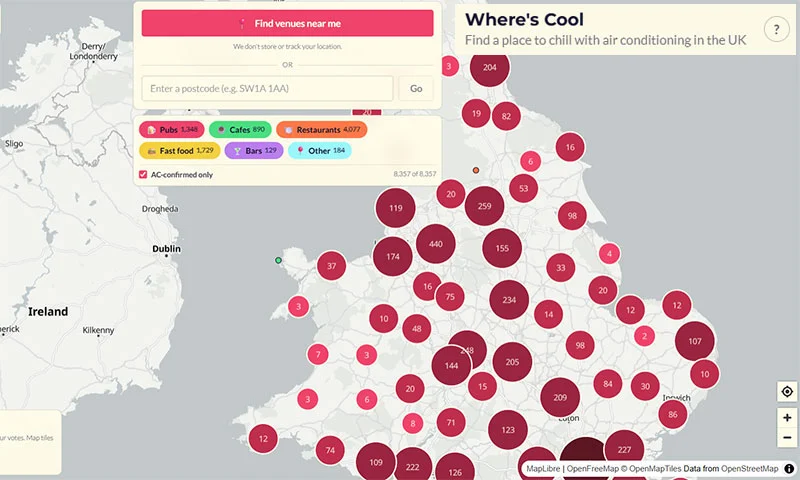
This Free Map Makes UK Heatwaves Easier to Handle
As another intense heatwave grips the United Kingdom, a free interactive map is helping people locate the nearest air conditioned cafes, pubs, restaurants and other food venues where they can escape soaring temperatures. The online tool, called Where’s Cool, allows users to enter their postcode and instantly find nearby venues with air conditioning. The project was created by founder Thomas Chivers after he struggled to find a comfortable place to work during an earlier spell of extreme heat, highlighting a challenge faced by millions of people across Britain where air conditioning remains uncommon in homes. “I built it during the last heatwave because I couldn’t find anywhere cool to sit and work, and I couldn’t face reading through every cafe’s Google reviews to check. It turned out everyone had exactly the same problem,” Chivers said. He said the tool has become even more relevant as the UK experiences increasingly severe heatwaves driven by changing climate conditions. “During unprecedented temperatures felt across the UK last week, it genuinely matters to know where the nearest cool room is,” he added. Unlike many countries where residential air conditioning is widespread, most UK households rely on opening windows, using fans or seeking shade to stay cool during hot weather. Built from official government data Chivers developed the map by combining official datasets rather than relying solely on user submissions. He used the Food Standards Agency’s register of food businesses across England and Wales and cross referenced it with the UK government’s Energy Performance Certificate records to identify venues equipped with cooling systems. The platform also encourages public participation. Users can tap on individual venues and confirm whether air conditioning is available. Once several people verify the information, the map automatically updates, making it increasingly accurate over time. The community driven approach allows the database to expand as more people contribute while helping others quickly identify safe and comfortable indoor locations during periods of extreme heat. Record temperatures raise health concerns The launch comes after Britain experienced one of its hottest June heatwaves on record. Temperatures climbed to 36.1 degrees Celsius in Gosport, Hampshire, while several other areas also recorded exceptional heat. The extreme weather forced hundreds of schools across England and Wales to close and disrupted transport services, with rail passengers advised to avoid all non essential travel. The Met Office issued a rare red warning for extreme heat covering parts of the UK from Wednesday to Friday. It marked the first time such a warning had remained in place for three consecutive days. Andy Page, Met Office Chief Meteorologist, said: “Significant disruption to daily life is likely and the public should take every effort to adapt their daily routines to cope with these levels of heat, which up to now have been extremely rare for the UK.” The UK Health Security Agency also issued red heat health alerts, warning of a risk to life “for even the healthy population”. Health officials urged people to stay hydrated, avoid direct sunlight during the hottest hours of the day and keep their homes as cool as possible. As climate experts warn that prolonged heatwaves are becoming more frequent across Britain, tools such as Where’s Cool are emerging as practical solutions to help residents stay safe during extreme weather.a

Survey Shows Public Support for 5% Tax on Social Media Creators
A majority of Pakistanis support the government’s proposal to impose a 5 percent withholding tax on income earned by social media influencers, according to a new survey by the Press Network of Pakistan (PNP). However, respondents also urged policymakers to protect small creators through exemptions and supportive measures. The online survey was conducted after the government announced the proposal in the Finance Bill 2026. It included responses from 100 participants, comprising 45 men and 55 women. The findings showed broad support for bringing digital creators into Pakistan’s formal tax system. At the same time, respondents stressed that taxation should not discourage young entrepreneurs or people entering the digital content industry. The proposed 5 percent withholding tax forms part of the Finance Bill 2026. The government says the measure aims to document income generated through social media platforms and improve tax collection. Officials from the Federal Board of Revenue (FBR) have noted that earnings from digital platforms have grown rapidly in recent years while much of that income remains outside the country’s tax net. According to government estimates, Pakistan’s social media economy generates between Rs4 billion and Rs10 billion annually. Survey highlights support for fair taxation The PNP survey gave the proposed 5 percent withholding tax an average support score of 3.42 out of 5. Meanwhile, respondents expressed even stronger support for the broader principle that influencers should pay taxes like other professionals and businesses. That statement received an average score of 3.89 out of 5. However, participants also recognised potential challenges. They gave an average score of 3.34 out of 5 to concerns that the tax could discourage young people from pursuing careers in digital content creation. Many respondents supported exempting smaller creators from the proposed tax. The recommendation to exclude influencers earning below a certain income threshold received an average score of 3.88 out of 5. Read More: Why Traditional News Outlets Are Losing Ground to Social Platforms Participants also strongly supported government incentives alongside taxation. That recommendation received the survey’s highest average score of 3.92 out of 5. The report concluded, “As Pakistan’s digital economy continues to expand, balanced policymaking will be essential to ensure that taxation strengthens rather than hinders one of the country’s fastest-growing sectors.” YouTube creators expected to feel the biggest impact The survey also explored which platforms would feel the greatest impact if the proposal becomes law. A total of 53.8 percent of respondents said YouTube creators would face the biggest effect. Another 24.6 percent believed the tax would affect all social media platforms equally. Meanwhile, 9.2 percent selected Instagram, while 6.2 percent identified TikTok. Facebook and blogs or websites each received 3.1 percent of responses. Pakistan’s digital creator economy has expanded rapidly in recent years as thousands of individuals generate income through YouTube, TikTok, Instagram, Facebook and other online platforms. Industry experts say the sector has created new employment opportunities, particularly for young entrepreneurs and freelancers. The survey suggests that most Pakistanis support taxing influencer income. At the same time, they want the government to adopt balanced policies that encourage innovation, protect small creators and promote long term growth in the country’s expanding digital economy.

UK TikTok Star’s Dubai Murder Case Sparks Global Attention
A 23 year old British TikTok influencer has been charged with premeditated murder in Dubai following the death of her boyfriend. A human rights advocacy group says she could face the death penalty if a court convicts her under United Arab Emirates law. Brooke George, from Kent, England, went into police custody on June 22 after the incident. According to Detained in Dubai, she acted in self defence during a violent domestic dispute. The organisation alleges that her boyfriend became abusive. It says he punched her, withheld her passport and attacked her inside their apartment. “She feared for her life and, reaching for a kitchen knife within her grasp, acted in self defence,” Detained in Dubai Chief Executive Radha Stirling told the BBC. Authorities later charged George with premeditated murder. UAE law allows the death penalty for certain murder convictions. However, judges will decide any sentence only after the legal process concludes. Mother describes daughter’s condition after arrest George’s mother, Thereza George, told the BBC that her daughter was “absolutely terrified” when they spoke soon after the incident. She also said her daughter had a visibly swollen eye. “I firmly believe my daughter was desperately trying to escape whatever had happened to her,” she added. Detained in Dubai also questioned the circumstances surrounding George’s move to the UAE. The organisation claimed her boyfriend bought her a one way ticket and later withheld her passport. It also alleged that his behaviour changed significantly after they arrived. The advocacy group further claimed that investigators denied George access to British consular officials during the early stages of her detention. It also alleged that officers questioned her without legal representation and subjected her to a strip search by male officers. Neither the BBC nor UK officials have independently verified those allegations. UAE authorities have not publicly responded to the claims. UK government confirms consular assistance The UK Foreign, Commonwealth and Development Office confirmed that it is assisting a British woman detained in the UAE. A spokesperson told the BBC that officials continue to support the woman and her family. The department also remains in contact with local authorities. The case has attracted widespread attention because of George’s social media profile and the allegations surrounding the incident. Legal experts say UAE courts will examine the evidence before reaching a verdict. George will also have the opportunity to present her defence during the proceedings. The investigation remains ongoing. No court has ruled on George’s guilt or innocence. The allegations against her have not yet been tested in court.

PTA to Block SIM Cards Linked to Expired or Invalid CNICs
The Pakistan Telecommunication Authority (PTA) has launched a nationwide awareness campaign for mobile users. It has urged subscribers to renew their Computerised National Identity Cards (CNICs) before they expire. The regulator warned that SIM cards linked to invalid, cancelled or expired CNICs could face suspension under existing telecom rules. PTA advised users to renew their CNICs before the expiry date. It also asked them to update the renewed details with their mobile operator immediately after receiving the new identity card. The authority said only SIM cards linked to valid and verifiable identity documents will remain active. Users who ignore the deadline could lose mobile services. According to PTA, the campaign aims to improve subscriber verification and reduce the misuse of mobile connections through fake or inactive identities. Nearly 4.9 million SIM cards face phased blocking The latest warning follows directions issued earlier this month by the Ministry of Interior. The ministry asked PTA to implement recommendations submitted by the National Database and Registration Authority (NADRA). The campaign forms part of a wider effort to strengthen identity verification across Pakistan’s telecom sector. Authorities also want to prevent criminals from using mobile numbers registered on fake or outdated identities. A NADRA spokesperson confirmed that authorities plan to block 4,906,611 SIM cards in phases. The campaign targets SIMs linked to expired CNICs and identity records belonging to deceased individuals. The spokesperson said the initiative aims to “enhance national security and strengthen the digital ecosystem by making it more secure and reliable.” PTA has previously carried out nationwide biometric verification campaigns. Those exercises helped ensure every mobile connection remained linked to its rightful owner. Officials believe accurate subscriber records will support law enforcement. They also expect the campaign to reduce identity fraud and illegal mobile use. PTA urges users to update records without delay PTA has instructed telecom companies to keep subscriber records updated. Operators must ensure customer information matches NADRA’s latest database. The regulator reminded users that renewing a CNIC alone is not enough. Subscribers must also update their information with their mobile company after receiving the renewed card. Users can check the number of SIM cards registered against their CNIC through PTA’s SIM Information System or authorised telecom services. They should also report any unauthorised SIMs registered in their name. Pakistan’s telecom regulations require every active SIM to remain linked to a valid identity document. Officials say this policy supports secure digital communication and strengthens trust in the country’s telecom network. PTA has urged subscribers to complete the process before their CNIC expires. Early action will help avoid service interruptions while supporting efforts to build a safer and more reliable digital ecosystem.

How AI Powered Bicycles Are Helping Revive a Struggling Industry
Artificial intelligence is rapidly expanding beyond smartphones and cars into the cycling industry, where manufacturers are introducing AI bicycles that can improve safety, adjust performance and simplify riding through advanced algorithms and sensors. The latest innovations are on display at EUROBIKE 2026 in Frankfurt, where companies are showcasing AI powered bicycles and digital services aimed at reviving a market that has struggled since the post pandemic slowdown. One of the biggest attractions at the exhibition is Avinox, an electric bicycle motor manufacturer backed by Chinese drone giant DJI. The company has developed an intelligent motor system that continuously analyses a cyclist’s movements and surrounding terrain through built in sensors. The system automatically adjusts pedal assistance in real time, helping riders tackle changing road conditions without making manual adjustments. “This makes the ride easier and safer without having to think about it,” Avinox developer Ferdinand Wolf said. The technology also allows riders to connect their heart rate monitors to the bicycle. The AI system then changes the motor’s level of assistance based on the rider’s physical condition, making long rides more comfortable while reducing unnecessary strain. AI safety systems aim to prevent cycling accidents Artificial intelligence is also reshaping bicycle safety. German bicycle manufacturer Canyon has unveiled a prototype racing bike equipped with cameras and radar sensors that monitor surrounding traffic and identify potential dangers before riders notice them. The system can detect hazards such as parked vehicles whose doors may suddenly open into a cyclist’s path. “It alerts cyclists to the presence of elements they do not necessarily perceive,” Canyon spokesman Ben Hilldson said. “If a car is parking, the system can anticipate the opening of a door and warn the cyclist,” he added. Depending on user preferences, the system sends warnings through lights mounted on the bicycle frame, vibrations in the handlebars or audio and visual alerts displayed inside a smart helmet visor. Although the technology remains in the prototype stage, Canyon is also working with Volkswagen on a communication platform that will allow bicycles to exchange information with nearby vehicles and road infrastructure. The companies expect to launch the system in about three years. However, most vehicles currently on the road cannot yet support that type of communication. Digital services expected to support market recovery Artificial intelligence is also changing customer services across the cycling industry. German insurer Linexo expects around 90 percent of bicycle insurance claims to be processed automatically by the end of this year. “Automation handles standard cases, while experts review complex claims and detect fraud, the only way to keep insurance premiums stable,” said Soeren Hirsch, head of Linexo’s bicycle division. Meanwhile, start up Wunderfix uses AI through a mobile application that connects customers, repair shops and retailers. Cyclists can diagnose faults and complete simple repairs themselves. The company says it has already handled around 3,000 service requests this year. Industry analysts believe these innovations could help revive the European bicycle market, which declined for a third consecutive year in 2025. According to EY Parthenon, sales fell four percent to 15.2 million bicycles. However, the consultancy expects the market to stabilise this year before gradually recovering. It forecasts industry revenue will reach 21.2 billion euros by 2031, supported by infrastructure investment and “digital and data-driven offerings.”

UK Orders Air Conditioner Removal as Europe Swelters. But Why?
Several local councils in the United Kingdom have ordered homeowners to remove air conditioning units during an intense heatwave, sparking criticism over the balance between climate policies and public comfort. British media, including The Telegraph and GB News, reported that planning authorities in parts of London issued enforcement notices requiring residents to remove air conditioning systems installed without the necessary planning approval. The cases largely involve homes in conservation areas, where stricter planning rules apply to protect buildings with architectural or historical importance. The controversy comes as parts of the UK prepare for temperatures close to 40 degrees Celsius. The Met Office has issued extreme heat warnings, while transport operators have warned of possible disruptions because of high temperatures. Across Europe, a prolonged heatwave has pushed temperatures to record levels in several countries. Planning guidance used by several councils states that residents should first rely on passive cooling measures before installing energy intensive air conditioning systems. These measures include opening windows, improving ventilation, using shading and operating fans. According to reports, one North London resident in Camden received a permanent order to remove two air conditioning units. Planning officers argued there was no sufficient justification for the installation because the home did not include ceiling fans and other passive cooling measures. When the homeowner raised security concerns about leaving windows open, officials reportedly advised him to “ventilate by opening ground-floor windows and balcony doors” and close them at night. He later retained the units after demonstrating that the property included solar panels and other environmentally friendly features. Critics question enforcement during extreme heat The enforcement has drawn political criticism as Britain experiences increasingly frequent periods of extreme heat. Former UK Energy Secretary Claire Coutinho described the situation as “completely absurd.” She also urged Britain to move away from what she called a pessimistic approach to carbon neutrality that “keeps the country in the dark ages, denying modern conveniences taken for granted elsewhere.” However, government officials say air conditioners are not banned across the UK. Instead, planning permission may be required for certain properties, particularly flats, listed buildings and homes located within conservation areas. London currently has 28 designated conservation areas where additional planning controls apply. Camden Council has defended its policy, saying it follows the London Plan, which encourages low energy cooling methods before conventional air conditioning. The council argues that widespread air conditioner use increases electricity demand and contributes to the urban heat island effect. Europe’s heatwave intensifies pressure on policymakers The debate comes as much of Europe struggles with exceptionally high temperatures. Germany recorded 41.7 degrees Celsius in Brandenburg, while the Czech Republic reached 41.1 degrees and Poland recorded 40.5 degrees. Meanwhile, parts of the UK have experienced rail disruptions and growing concerns about public health during the ongoing heatwave. Climate experts expect extreme heat events to become more frequent across Europe. Consequently, governments face increasing pressure to balance carbon reduction goals with practical measures that protect residents during dangerous weather conditions. The latest controversy has highlighted the growing challenge of adapting cities to rising temperatures while maintaining ambitious net zero targets. It has also renewed debate over whether current planning policies remain suitable as heatwaves become more severe.
