

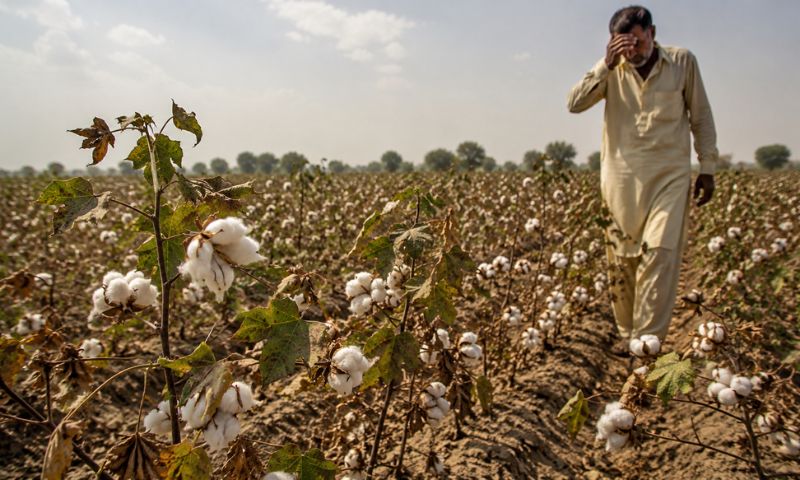
Pakistan’s cotton sector faces mounting pressure from climate change as rising temperatures, water shortages and erratic rainfall continue to reduce production, threatening one of the country’s most important export industries. Experts warn that temperatures in major cotton growing regions could remain 2 to 4 degrees Celsius above normal during May and June this season. Some areas may even record temperatures of up to 52°C during severe heatwaves, increasing the risk of flower drop, boll shedding and lower crop yields. Cotton remains the backbone of Pakistan’s textile industry, which contributes around 60 percent of the country’s exports. However, climate related challenges have significantly weakened production in recent years, raising concerns for farmers, exporters and policymakers. Cotton output falls sharply as extreme weather intensifies According to agricultural experts, Pakistan produced about 5.6 million cotton bales during the 2025 to 2026 season, almost 45 percent below the official target of 10.2 million bales. South Punjab suffered some of the worst conditions. Temperatures climbed above 45°C, while irregular rainfall created ideal conditions for boll shedding, pest attacks and disease outbreaks. Farmers also reported higher pressure from Cotton Leaf Curl Virus, which further reduced yields. The latest projections show above normal temperatures across key cotton producing districts, including Multan, Bahawalpur, Rajanpur, Dera Ghazi Khan, Rahim Yar Khan, Sukkur, Khairpur, Nawabshah, Hyderabad, Badin, Tando Allah Yar, Tando Adam, Jacobabad, Shikarpur, Larkana, Quetta’s surrounding agricultural areas, Nasirabad, Jaffarabad and Sohbatpur. Experts explain that cotton responds differently to heat stress during each stage of growth. Temperatures above 45°C can damage pollen development, reduce seed formation and cause flowers and young bolls to fall before maturity. High night temperatures also reduce plant energy, while drought limits fibre quality and boll development. Excessive rainfall and flooding create separate risks by increasing boll rot, crop lodging and viral diseases. The Food and Agriculture Organization has repeatedly warned that climate change poses one of the greatest long term threats to agricultural production in South Asia, particularly in water stressed countries such as Pakistan. Scientists promote climate smart farming Researchers say farmers can reduce climate related losses through better crop management and climate smart farming techniques. Studies show that split application of 150 to 200 kilograms of urea per acre, or fertiliser use guided by leaf colour charts, can reduce nitrous oxide emissions by 30 to 65 percent without causing major yield losses. Scientists at the Central Cotton Research Institute (CCRI) in Multan also tested deficit irrigation methods. Their research found that cotton variety BTCIM 678 achieved water use efficiency between 0.55 and 0.64 kilograms per hectare per millimetre of water when supplied with only 50 percent of available irrigation water. The method reduced yields by just 7 to 9 percent while saving nearly 37 centimetres of irrigation water. The institute continues to evaluate heat tolerant cotton varieties, including BTCIM 663, BTCIM 785, BTCIM 343, BTCIM 678, BT Cyto 535, BT Cyto 537, BTCIM 775, BT Cyto 511 and the newly approved BTCIM 990. Researchers say these varieties perform better under high temperatures, limited water supplies and viral disease pressure. CCRI has also introduced its Low Expenditure and Environment Friendly (LEEF) Technology, which aims to increase cotton productivity while lowering production costs. Call for coordinated action Experts recommend timely sowing, drip irrigation, balanced fertiliser use, reduced tillage and integrated pest management to strengthen cotton’s resilience against climate change. They stress that Pakistan must move quickly from reactive policies to long term adaptation strategies. Strong coordination between the government, researchers and farmers will remain essential to protect cotton production, textile exports and rural livelihoods from worsening climate risks.
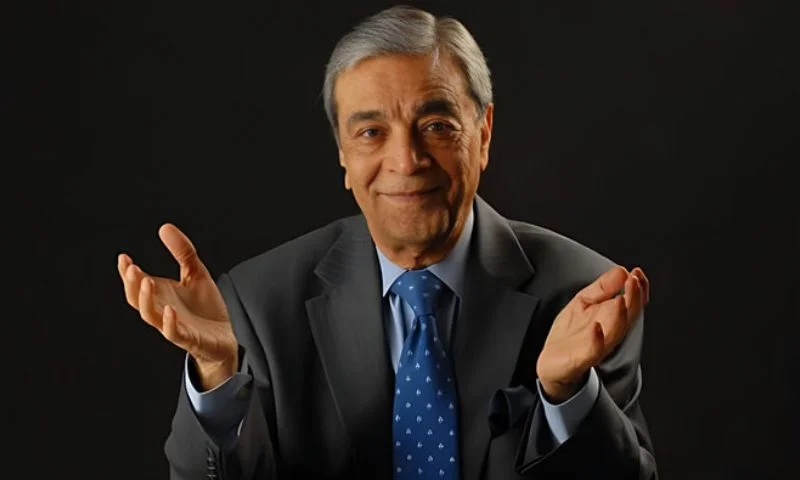
The World Is About to Witness Zia Mohyeddin’s Untold Story
A documentary celebrating the extraordinary life and legacy of legendary Pakistani actor, broadcaster and theatre icon Zia Mohyeddin will make its international debut at the 49th Asian American International Film Festival (AAIFF) in New York later this month, marking a major milestone for one of Pakistan’s most ambitious documentary projects. After spending nearly 15 years developing the film, director Umar Riaz and his team at Asna Pictures have completed The Colour of My Heart (Rung Hai Dil Ka Mere Dil Ka), a feature length documentary that explores Mohyeddin’s artistic journey, his enduring love for Urdu poetry and his lasting influence on Pakistan’s cultural landscape. The film will screen on August 9 at 2pm local time, the final day of the festival, which runs from July 30 to August 9. Fifteen years in the making Announcing the selection on Instagram, Riaz described the international premiere as a deeply personal moment for his team. He wrote that they “could not have wished for a more special return” of the documentary to New York, where the project first began as his university film thesis more than a decade ago. He added that much of the documentary’s post production also took place in the city. The filmmaker also said the team looked forward to celebrating the achievement alongside colleagues in New York while giving audiences “a window into a vital part of [Pakistani] culture” The documentary traces Mohyeddin’s remarkable life between Pakistan and the United Kingdom. It highlights his dedication to theatre, television, literature and the preservation of Urdu poetry. The narrative also weaves the timeless poetry of Faiz Ahmed Faiz into the story, reflecting Mohyeddin’s lifelong passion for bringing classical Urdu literature to new generations. Presented by the late scholar and human rights activist Dr Arfa Sayeda Zehra, the film serves as both a tribute to Pakistan’s cultural giants and an intimate portrait of a complex artist whose work continues to inspire audiences years after his death. Tribute to a cultural icon Zia Mohyeddin passed away on February 13, 2023, at the age of 91. During a career spanning more than six decades, he earned international recognition through theatre, television and film. He appeared in the Hollywood classic Lawrence of Arabia, hosted the acclaimed The Zia Mohyeddin Show, and later founded the National Academy of Performing Arts in Karachi, where he mentored generations of performers. Rather than following a conventional biography, The Colour of My Heart focuses on Mohyeddin’s philosophy, artistic vision and relationship with language. The documentary captures his celebrated recitations of Faiz’s poetry while examining the personal experiences that shaped his creative life. The documentary first opened in Pakistani cinemas on February 6, just days before the third anniversary of Mohyeddin’s passing. Following a limited theatrical run, Riaz plans to bring the film back to Pakistani cinemas later this autumn. International recognition for Pakistani cinema The film’s inclusion in AAIFF places Pakistani storytelling before one of North America’s oldest and most respected festivals dedicated to Asian and Asian American cinema. Founded in 1978, the festival showcases independent films from across Asia and the global diaspora while promoting cultural exchange through cinema. For Riaz and his team, the New York screening represents more than an international premiere. It also brings the documentary back to the city where the project first took shape, completing a journey that began 15 years ago and now introduces Zia Mohyeddin’s remarkable legacy to audiences from around the world.

Pakistan’s Top-Selling Cars Are Out. Fronx Makes a Stunning Leap
Pakistan’s automotive industry ended fiscal year 2025-26 on a high note after passenger car and light commercial vehicle sales rose 28.9 percent month on month in June, according to the latest figures released by the Pakistan Automotive Manufacturers Association (PAMA). Total sales reached 21,983 units in June, compared with 17,033 units in May. The strong growth reflects improving consumer confidence, easing inflation, a more stable exchange rate and better vehicle availability after months of supply chain disruptions. Industry analysts also linked the strong performance to lower financing costs, recovering economic activity and steady demand across both entry-level cars and premium SUVs. Pak Suzuki dominates as Fronx steals the spotlight Pak Suzuki Motor Company retained its position as Pakistan’s largest automaker. The Suzuki Alto remained the country’s best-selling vehicle, recording 7,239 units in June, up 21 percent from 5,964 units in May. The biggest surprise came from the newly launched Suzuki Fronx, whose sales jumped an impressive 211 percent, rising from 552 units to 1,717 units. Other Suzuki models also posted healthy gains. Cultus sales climbed 72 percent to 439 units, while Every rose 12 percent to 480 units. Swift remained almost unchanged at 1,668 units. Toyota maintains stable performance Indus Motor Company delivered another consistent month despite slight weakness in its sedan lineup. Combined sales of the Toyota Corolla, Yaris and Corolla Cross slipped just 1 percent to 2,650 units. Meanwhile, demand for Toyota’s premium utility vehicles remained strong. Fortuner and Hilux sales increased 6 percent, reaching 857 units during June. Honda records strong double-digit growth Honda Atlas Cars Pakistan enjoyed one of its strongest months of the fiscal year. Sales of the Honda City and Civic surged 33 percent, climbing from 1,952 units in May to 2,594 units in June. Honda’s SUV lineup also performed well. Combined sales of the BR-V and HR-V rose 36 percent to 378 units, reflecting growing consumer interest in crossover vehicles. Haval strengthens its SUV market position Sazgar Engineering continued its rapid expansion in Pakistan’s premium SUV segment. Sales of the Haval and Tank lineup jumped 70 percent, increasing from 1,604 units in May to 2,720 units in June. The performance places Haval among Pakistan’s fastest-growing automotive brands and highlights the continued shift toward SUVs. Hyundai posts impressive gains Hyundai Nishat recorded strong growth across several product categories. The Hyundai Tucson led the company’s performance with a 91 percent increase, reaching 548 units. The Santa Fe posted the highest percentage growth among Hyundai models, rising 133 percent to 84 units. Meanwhile, Sonata sales climbed 65 percent to 51 units. Elantra maintained steady deliveries at 237 units. Commercial vehicles and EV segment show mixed results The commercial vehicle segment also recorded healthy momentum. Sales of the ISUZU D-MAX increased 87 percent, rising to 101 units during June. The electric vehicle segment, however, showed mixed results. Sales of the Honri VE declined 33 percent to 20 units, while JETOUR maintained stable deliveries of 200 units. The latest PAMA figures suggest Pakistan’s auto sector has entered a stronger recovery phase. Analysts believe demand could remain healthy if inflation continues to ease, financing stays affordable and supply chains remain stable.

Pakistanis Can Earn Up to $50,000 From OpenAI. Here’s How
Pakistani researchers working in artificial intelligence security, cybersecurity and biosafety can now apply to participate in OpenAI’s newly launched Bio Bounty Program, which offers rewards of up to $50,000 for identifying critical vulnerabilities in advanced AI systems. The program aims to strengthen the biological safety safeguards built into OpenAI’s frontier AI models. It invites qualified researchers to uncover “universal jailbreaks” that could bypass the company’s predefined biosafety protections. By identifying these weaknesses before malicious actors do, participants will help improve the security and reliability of future AI systems. Pakistan is among the eligible countries listed on the application form, allowing local experts to compete alongside researchers from around the world. However, the initiative is not open to the general public. Instead, OpenAI requires interested researchers to submit an application outlining their experience and qualifications. The company will review applications on a rolling basis and invite only selected candidates to join the private testing platform. Successful applicants must also have an existing ChatGPT account and sign a non disclosure agreement before participating. Rewards double to encourage advanced AI safety research OpenAI has increased the program’s top reward from $25,000 to $50,000, reflecting the growing importance of external security research as AI systems become more capable. The Bio Bounty Program evolved from the earlier GPT 5.5 Bio Bug Bounty into an ongoing initiative that will initially focus on GPT 5.6 and future frontier models. Researchers must identify a universal jailbreak capable of defeating OpenAI’s biological safety challenge rather than finding conventional software bugs or infrastructure vulnerabilities. Unlike traditional bug bounty programs that focus on websites or applications, OpenAI’s initiative specifically targets biological misuse risks. The company wants experts to test whether advanced AI models can be manipulated into bypassing safeguards designed to prevent the generation of dangerous biological information. Researchers who discover significant vulnerabilities could receive payouts of up to $50,000, while OpenAI may also grant smaller rewards for partial findings at its discretion. Growing global focus on responsible AI development The launch of the expanded Bio Bounty Program reflects a broader international effort to ensure increasingly powerful AI models remain safe and resistant to misuse. Governments, technology companies and research institutions have intensified efforts to strengthen AI governance as frontier models become more capable across scientific and technical fields. External red teaming has become a key part of that strategy because independent researchers can identify weaknesses that internal testing may overlook. For Pakistan, inclusion in the program provides an opportunity for researchers to contribute directly to global AI safety while gaining international recognition for their expertise in cybersecurity, AI security and biosafety. Although selection is competitive, the initiative gives qualified Pakistani experts access to one of the world’s most advanced AI safety testing programs. Their findings could influence the development of future OpenAI models while helping reduce biological risks associated with advanced artificial intelligence. OpenAI said the Bio Bounty Program will continue to expand as it develops new frontier models and strengthens safeguards against emerging threats in the rapidly evolving AI landscape.aa

Why Your Petrol Price Could Change Every Morning in Pakistan
The federal government is considering a major change to Pakistan’s petroleum pricing system. Officials are discussing a shift from fortnightly fuel price revisions to weekly or even daily reviews. The move comes as renewed tensions in the Strait of Hormuz create uncertainty in global energy markets. The proposal came up during the fourth meeting of the high level committee formed by Prime Minister Shehbaz Sharif to review the petroleum pricing mechanism. The committee also discussed plans to operationalise a petroleum price stabilisation fund that could help protect consumers from sudden price shocks. Global oil markets have turned volatile after fresh tensions around the Strait of Hormuz. The waterway handles nearly one fifth of the world’s oil trade. Brent crude recently climbed to around $85 per barrel as traders reacted to fears of supply disruptions, according to Reuters. Government weighs faster fuel price reviews Officials are studying a pricing model that would allow petrol and diesel prices to change every week or even every day. Pakistan temporarily shifted from fortnightly to weekly fuel price reviews during earlier market disruptions linked to the Iran US conflict. Officials took that step to prevent fuel shortages. India already updates retail fuel prices every day. Petroleum Minister Ali Pervaiz Malik urged the committee to establish a transparent system for the proposed stabilisation fund. He said, “A proper mechanism for the fund should be finalised to avoid its use based on political considerations.” He added, “Relief should be provided to oil consumers.” Sources said that the committee will submit proposals on the pricing mechanism and the stabilisation fund at its next meeting. Members must also decide how the fund will generate revenue. KPMG presented a detailed study during the meeting. The consultancy outlined the benefits and risks of reviewing fuel prices daily or twice a week. It also warned that the renewed closure of the Strait of Hormuz could trigger fresh oil price shocks. The study noted that petrol prices in Pakistan remain lower than those in Bangladesh, Sri Lanka and Türkiye. Refinery reforms and transparency measures The government recently increased petrol and diesel prices by nearly Rs14 per litre after fresh tensions disrupted global oil markets. Malik said the committee’s work had become more important because of “the renewed closure and resulting uncertainty in global energy markets.” He also said petrol prices in Pakistan remain lower than those in Bangladesh, Sri Lanka and Türkiye. They remain broadly comparable with prices in India. The minister said the government has proposed changes to the Refinery Policy. The amendments aim to increase local diesel production and reduce dependence on imported diesel. The committee also asked OGRA to publish daily Platts pricing data on its website. Officials believe the move will improve transparency by giving the public direct access to the benchmark used to calculate fuel prices. Members agreed that the petroleum price stabilisation fund should operate under “a fully rule based framework with clearly defined mechanisms for funding and disbursements.” They said the framework would keep the fund transparent and protect it from arbitrary decisions. Final recommendations due after next meeting Committee members also stressed the need to digitise Pakistan’s oil supply chain. They believe digitisation will improve efficiency and strengthen oversight. Malik instructed members to complete their work at the next meeting. After that, the committee will submit its recommendations to Prime Minister Shehbaz Sharif. Federal Minister for Economic Affairs Ahad Khan Cheema, Minister of State for Finance Bilal Azhar Kayani, OGRA Chairman Nabeel Awan, representatives from KPMG, Pakistan State Oil, the Finance Division, the Ministry of Law and Justice, the Petroleum Division and other committee members attended the meeting. Energy analysts have warned that prolonged disruption in the Strait of Hormuz could push crude oil prices much higher. That would increase import costs and inflationary pressure for countries such as Pakistan, Reuters reported.
