

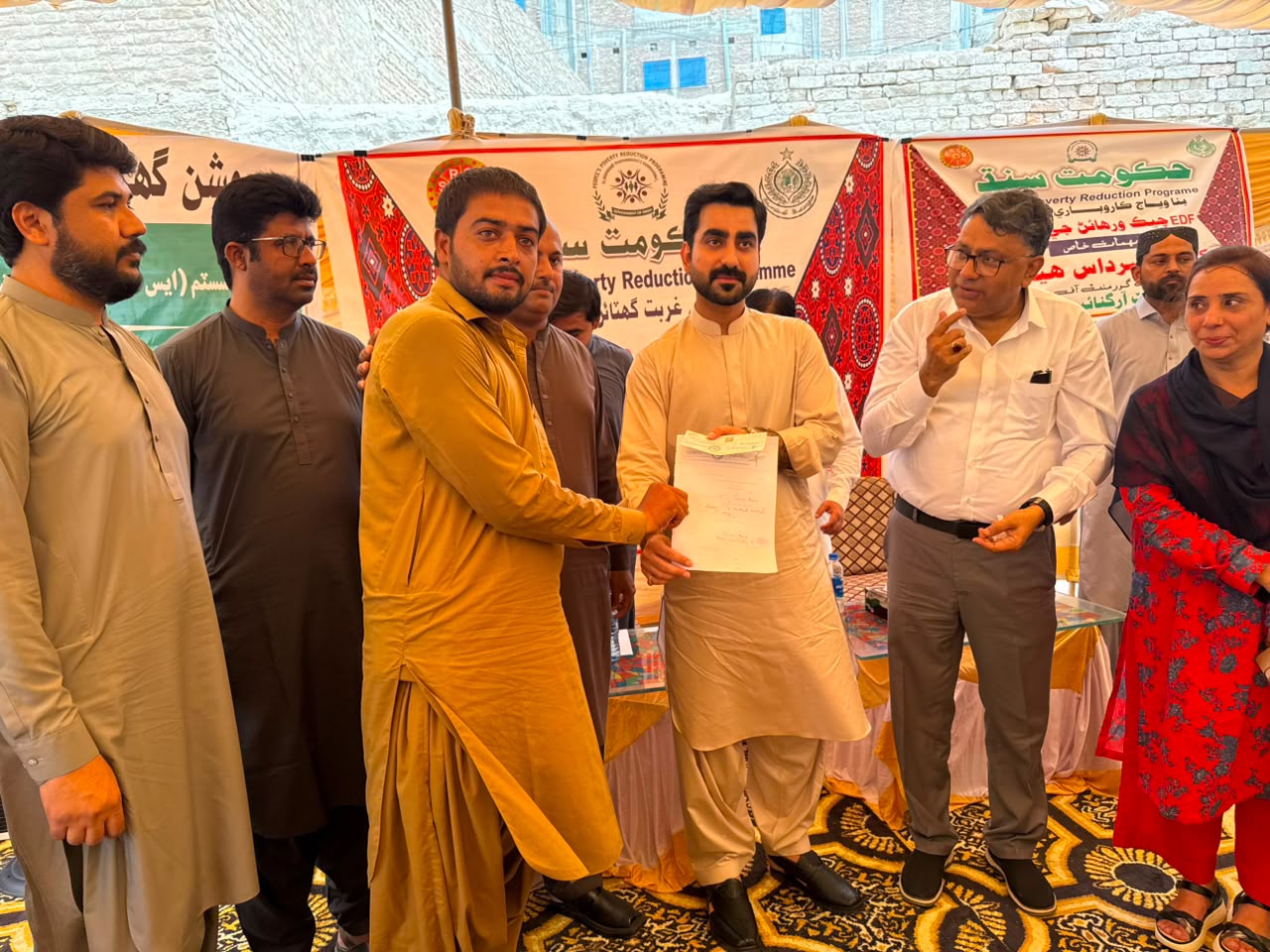
Sindh government spokesperson Sukhdev Hemnani distributed interest-free loan cheques worth Rs10 million among more than 50 deserving people in Ghotki on Tuesday, August 25. The beneficiaries included women seeking funds to start businesses or strengthen existing sources of income. Hemnani also distributed solar kits and plants during the ceremony held under the Peoples Poverty Reduction Programme, or PPRP. Sindh government pushes economic independence Hemnani attended the event as chief guest and handed over loan cheques to the selected beneficiaries. The financing will support businesses, livestock farming, small enterprises and other livelihood activities. One beneficiary received Rs2.5 million to expand a scrap business. Other recipients secured different amounts based on their business plans and economic needs. Read More: Sindh School Crisis: 6,220 Buildings Found Unsafe for Students “We do not want to make people dependent on aid,” Hemnani said. “Our objective is to give them opportunities to stand on their own feet, pursue dignified livelihoods and achieve sustainable economic independence.” The Sindh government funds PPRP, while the Sindh Rural Support Organization implements it in participating districts. SRSO says the programme combines interest-free financing with community organization, vocational training and income-generating support. Focus on women and community-led growth “PPRP is a practical example of PPP Chairman Bilawal Bhutto Zardari’s people-friendly and human-centred development vision,” Hemnani said. “It also reflects the PPP philosophy of roti, kapra aur makaan.” “The PPP believes in empowering people, particularly women, so they can stand on their own feet and play an effective role in improving their families’ economic wellbeing,” he said. “When people receive resources to earn, start businesses and expand their livelihoods, they become able to decide their own future. This is the foundation of sustainable development.” Hemnani said PPRP has benefited more than 1.5 million families across Sindh. The programme supports communities through local participation, employment opportunities, economic activity and interest-free loans. Women remain a central focus of the initiative. Publicly available programme material shows that PPRP uses community institutions and financial inclusion to help rural women enter economic decision-making. The programme expanded to Ghotki in 2021. Earlier PPRP-supported enterprises in the district have used interest-free financing for garments, solar equipment manufacturing and plant nurseries, according to the Associated Press of Pakistan. Solar kits, plants and housing rights Hemnani said the same empowerment approach also guides Sindh Peoples Housing for Flood Affectees, known as SPHF. Under the housing initiative, women receive ownership rights to reconstructed homes. He said those rights improve women’s economic security and strengthen their position within families and society. World Bank project documents also identify women’s ownership and secure housing rights as important parts of resilient reconstruction in Sindh. Read More: Sindh to Cancel Vehicle Registrations Over Unpaid Tax Hemnani reaffirmed that the provincial government would continue expanding sustainable livelihoods and women’s economic participation. He also pledged more opportunities for deprived and disadvantaged communities across Sindh.

NBP Appoints Insider Abdul Wahid Sethi to Its Top Position
Abdul Wahid Sethi has assumed charge as acting President and Chief Executive Officer of the National Bank of Pakistan, ensuring leadership continuity at the state-owned lender. The appointment took effect on August 21, 2026, after Rehmat Ali Hasnie completed his tenure as NBP president and CEO. A separate NBP filing with the Pakistan Stock Exchange confirmed that Hasnie’s tenure expired on the same date. Government approves interim arrangement The Finance Division assigned Sethi the acting charge in line with the Corporate Governance Regulatory Framework. Its notification authorises him to manage NBP’s day-to-day affairs for three months. The arrangement will end sooner if the government appoints a permanent president and CEO before that period expires. The official appointment notice submitted to the PSX confirms the interim arrangement. NBP said: “Mr. Sethi’s assumption of the acting charge provides leadership continuity at NBP as the government proceeds with the process of appointing a permanent President & CEO.” More than three decades of experience Sethi brings more than three decades of public and private sector experience to the position. His core areas include financial management, audit, risk, governance and internal controls. He joined NBP in November 2009 and has since held several senior leadership roles. Alongside his acting assignment, he serves as Senior Executive Vice President and Chief Financial Officer. He has held the CFO position since September 2017. Read More: NBP Marks August 14 With Focus on Digital Transformation Earlier, Sethi led NBP’s Audit and Inspection Group as SEVP and group chief. He also worked as secretary to the Board Audit and Compliance Committee. Those assignments gave him experience across the bank’s financial, operational and governance functions. Before joining NBP, Sethi served as an internal audit specialist with the Punjab Government’s Education Department. The position formed part of a World Bank initiative focused on public financial management and internal control. He later headed Business Risk Services at Grant Thornton AASR. His earlier career also included roles at Sui Southern Gas Company Limited, New Allied Electronics, associated with LG, and Harvest Smartend Securities. Governance role at a major state-owned bank Sethi has been a Fellow Member of the Institute of Chartered Accountants of Pakistan since 2001. He also holds an MBA in Finance from Imperial College of Business Studies in Lahore, completed in 1995. NBP’s official management page now identifies Sethi as its acting president and CEO. The bank operates under the National Bank of Pakistan Ordinance, 1949. It provides commercial banking services and handles government treasury transactions as an agent of the State Bank of Pakistan. Read More: NBP Expands Digital Payment Push With Raast P2M Launch The leadership transition follows a strong financial year for NBP. PSX data shows the bank reported profit after tax of Rs85.9 billion for 2025, while earnings per share reached Rs40.38. Sethi will oversee continuing operations, financial management and sound governance during the interim period. The government, meanwhile, will proceed with the appointment of a permanent president and CEO.

Pakistan Oxygen Names Zubair Siddiqui as New CEO
Pakistan Oxygen Limited (PAKOXY) has appointed Zubair Siddiqui as its new chief executive officer, effective September 1, 2026. The company disclosed the appointment to the Pakistan Stock Exchange on Tuesday. The official company notice carries an August 24 date. “Mr. Zubair Siddiqui has been appointed as Chief Executive Officer of the Company with effect from September 01, 2026,” Pakistan Oxygen said in the notice. Read More: Systems, Sazgar and Murree Brewery Join Forbes Asia’s Elite 200 Siddiqui will replace Shaikh Farried Aman, who has served as interim chief executive officer. PSX records show that Pakistan Oxygen named Aman interim CEO in June 2026. The company had earlier reappointed Matin Amjad as chief executive in February for a term extending to August 2. Zubair Siddiqui has held senior role at Pakistan Oxygen Siddiqui already has experience in senior management at Pakistan Oxygen. The company’s 2023 annual report listed him as chief operating officer. Earlier company records also show that he served as head of operations during the Linde Pakistan era. His appointment therefore brings an executive with previous operational experience at the company into the top leadership position. The PSX currently lists Pakistan Oxygen under the chemical sector. Its shares trade under the symbol PAKOXY. Read More: Al Baraka CEO Among Forbes Middle East Top 100 CEOs 2026 The company’s leadership change comes as it continues to serve customers across Pakistan’s industrial and healthcare sectors. Pakistan Oxygen operates across industrial and medical sectors Pakistan Oxygen began as a private limited company in 1949. It became a public limited company in 1958. Its main businesses include the production of industrial and medical gases and welding electrodes. The company also markets medical equipment. Pakistan Oxygen says it supplies products to more than 4,000 customers across several industries. These include chemicals, petrochemicals, steel, food and healthcare. The company manages round-the-clock operations at 10 major industrial locations across Pakistan. Its gas portfolio includes oxygen, nitrogen and argon. Pakistan Oxygen operates three air separation units for these products. It also operates facilities that produce hydrogen, carbon dioxide, nitrous oxide and dissolved acetylene at different locations. The company has a significant presence in the healthcare sector as well. It supplies medical oxygen, nitrous oxide and other medical gas mixtures. Read More: Dawood Lawrencepur Appoints Hussain Dawood as Chairman, Retains CEO Pakistan Oxygen also designs and installs medical gas pipeline systems for hospitals. Its portfolio includes medical engineering services and related healthcare equipment. The company also manufactures welding electrodes and supplies welding machines, wires and other related equipment. Siddiqui will formally take charge as CEO on September 1, replacing Aman after his brief period as interim chief executive. The appointment marks another leadership change at Pakistan Oxygen as the listed company continues its operations across healthcare, manufacturing and other major sectors of Pakistan’s economy.

Raising Successful Kids: 5 Phrases Parents Should Use
Parents often tell children, “If you put your mind to it, you can accomplish anything.” Psychologist Juli Fraga says this popular encouragement can create unrealistic expectations and make setbacks feel like personal failures. Fraga has worked with parents for more than 20 years. She argues that hard work alone cannot guarantee rare outcomes, such as becoming a pop star or entering an Ivy League university. Constant focus on praise, grades and trophies can also strengthen external motivation. Children may then pursue activities mainly for rewards that remain partly outside their control. Validate Fear and Teach Patience Fraga recommends replacing unrealistic promises with: “Try new things, even if it feels scary.” Parents can name fear before a child rides a bicycle, performs in a play or applies to college. They might say: “I know this is scary, and there’s nothing wrong with feeling this way.” This emotional understanding creates what psychologists call attunement. Research links supportive parenting with stronger self-efficacy, motivation and academic resilience. Read More: New Parental Controls Could Change How Kids Use WhatsApp Her second suggested phrase is: “Sometimes, it takes time for hard work to pay off.” Social media can make success appear immediate. Parents should explain that progress usually develops over time. A growth mindset helps children believe they can improve abilities through effort, better strategies and continued learning. Turn Disappointment Into Learning Fraga’s third alternative is: “Disappointment is a learning opportunity.” Children often admire famous musicians and athletes without understanding the talent, timing and luck behind exceptional success. Fraga cited becoming the next Olivia Rodrigo as one example of an unlikely ambition. Parents should encourage children to try while remaining honest about possible outcomes. They can frame disappointment as an invitation to learn and try again. Adults can also discuss their own setbacks. Examples could include missing a promotion or failing to earn an A despite studying hard. Such stories remind children that struggle and disappointment affect everyone. Research on growth mindset supports treating setbacks as part of learning. However, experts caution that effort works best alongside useful strategies, constructive feedback and support. Encourage Persistence With Realistic Expectations Fraga suggests changing the familiar promise to: “If you put your mind to it, you can keep going.” Persistence does not guarantee a trophy or first place. However, tenacity can support self-discipline, optimism, empathy and self-compassion. These qualities may protect mental health as children approach adolescence and adulthood. They can also strengthen intrinsic motivation, which allows children to enjoy an activity regardless of praise or results. Her final recommendation is: “You won’t be good at everything, and that’s OK.” Read More: YouTube Lets Parents Limit Teens’ Shorts Time; Here’s How It Works Children who understand their limits can set more realistic goals. Fraga says this honesty can make them feel more capable and reduce excessive expectations of themselves and others. Fraga co-authored “Parents Have Feelings, Too” and teaches workshops for expectant parents at the University of California, San Francisco. Her central message is that encouragement should build courage and resilience without promising outcomes that no parent can guarantee.

The 3 AI Rules Separating Smart Founders From the Rest
Many founders now ask: “How much AI should already be built into this business?” Yet experts warn that speed alone does not produce better businesses. JPMorganChase Institute research based on small-business banking data shows how quickly adoption has accelerated. Companies launched in 2019 took 77 months to reach a 10 percent AI adoption rate. Businesses launched in 2025 reached the same milestone in about six months. AI now helps new companies draft customer emails, manage accounts and handle routine work before they take their first order. However, founders who automate without structure may simply scale existing weaknesses. Build Accountability Into AI Systems Marko Kling, vice-president of solution architecture at financial automation company Serrala, has advised global enterprises for 17 years. He argues that businesses must treat oversight as a system-design requirement instead of relying only on workplace culture. “Trust erodes quickly when accountability cannot keep pace with automation,” Kling said. Read More: Nvidia Warns Customers of Major AI Server Price Increase Companies should identify who owns the outcome of every automated process before they activate it. They also need clear reviews, data controls and audit trails. Without these safeguards, errors can damage trust among customers, regulators and investors. The principle applies to both new companies building AI into operations and established businesses adding it to older systems. Reward Human Judgment Over Output AI has weakened the advantage that once came from producing more content, campaigns and operational tests. When every company can access similar tools, output alone no longer separates one business from another. “In AI-powered organizations, value is shifting away from volume and toward discernment,” said Kathleen Ulrich, managing director of marketing at Brillio. “It’s no longer about producing more assets or running more tests. The value comes from knowing when to deploy technology, how to adapt strategies in real time, and how to keep a human lens on every decision.” Entrepreneurs can encourage this approach by rewarding employees for sound decisions, not just speed or production. Performance reviews should examine which tasks employees chose not to automate and why. Use AI to Strengthen Customer Relationships The strongest automation removes routine work while giving employees more time for difficult or sensitive customer interactions. Zendesk says its AI agents can autonomously resolve up to 80 percent of customer interactions. That leaves human teams to handle the remaining cases, which often involve emotion, unusual problems or higher risks. Businesses can automate scheduling, follow-ups and routine questions. Employees can then focus on rebuilding trust, solving complicated problems and making customers feel heard. Read More This approach can make service feel more personal because technology handles repetitive work quietly in the background. Founders should therefore measure AI success by more than the number of automated tasks. A more useful measure is how much additional attention employees can give to customers and decisions that matter. As Power concluded, “The entrepreneurs I’d bet on are choosing better, and letting bigger follow.”

New Diabetes and Weight Loss Pill Arrives in UK Pharmacies
A new daily diabetes and weight loss pill has launched in selected UK pharmacies. Foundayo offers an alternative for eligible patients who cannot or do not want to use injections. The Medicines and Healthcare products Regulatory Agency approved orforglipron, sold as Foundayo, on August 10. US pharmaceutical company Eli Lilly developed the GLP-1 medicine. UK Becomes First European Market “The UK is the first country in Europe where Foundayo is now available,” said Khalil Asmar, vice-president of cardiometabolic health at Lilly Northern Europe. “We’re pleased that this means there is another oral treatment option for eligible UK patients alongside licensed injectable treatments.” Patients can initially obtain Foundayo through a private prescription. Eli Lilly is also working with the National Institute for Health and Care Excellence on an assessment for possible NHS use in England. Adults qualify for weight management if they have a BMI of 30 or higher. Those with a BMI between 27 and 30 may qualify if they have at least one weight-related health condition. Read More: Fatty Liver Can Damage Your Body Before Symptoms Appear Patients should combine the treatment with a reduced-calorie diet and increased physical activity. Doctors can also prescribe Foundayo to improve blood sugar control in patients with insufficiently controlled type 2 diabetes. Patients take one tablet daily at any time, without food or water restrictions. The MHRA says the medicine mimics the GLP-1 hormone. It helps people feel fuller, reduces hunger and supports lower food intake. Common side effects include nausea, constipation, diarrhoea, vomiting, indigestion and abdominal pain. Pharmacists Welcome Non-Injectable Option Henry Gregg, chief executive of the National Pharmacy Association, welcomed the launch. “This is another significant day with a second weight loss pill available from today in certain pharmacies. This is particularly significant for patients who cannot or do not want to take an injectable medicine and could make weight-loss treatment available to a wider range of patients.” Read More: Enjoying Food Could Be the Secret to Losing Weight The MHRA approved Britain’s first GLP-1 weight loss pill, a tablet form of Novo Nordisk’s Wegovy, on June 11. Foundayo now gives patients another oral option. Gregg urged the government and NHS to widen access through community pharmacies. “There must now be a redoubling of efforts within government and the NHS to use pharmacies to make sure more eligible patients in clinical need can get weight loss treatments on the NHS, rather than the current postcode lottery that exists for weight management services via GPs.” Counterfeit GLP-1 Warning Issued Pharmacists also warned that criminals may find tablets easier to copy than injectable medicines. Fake products may contain incorrect doses, contaminants or undeclared ingredients. The MHRA seized £250,000 worth of unlicensed weight loss pens and ingredients from a Northampton factory last year. Eli Lilly has also sued suppliers that it accuses of participating in an illegal market for its medicines. Regulators urged patients to obtain GLP-1 treatments only from registered pharmacies after a proper clinical assessment and valid prescription. The MHRA will continue monitoring Foundayo’s safety and effectiveness.
Mobilink Bank Launches New Financing Support for Yango Drivers
Mobilink Bank and Yango Pakistan have partnered to expand financial services for eligible partner drivers and couriers across Pakistan. The partnership will offer Shariah-compliant vehicle and handset financing. It will also provide Takaful protection, digital banking and payment solutions. The initiative aims to improve financial inclusion among workers in Pakistan’s growing gig economy. It focuses on financial products linked directly to drivers’ livelihood needs. Read More: Yango Makes History With First Ride-Hailing License in Punjab The two companies will treat vehicles as productive assets that help drivers generate income. Their joint ecosystem will combine financing, protection, banking, payments and connectivity. Financing of up to Rs5 Million Eligible Yango partner drivers can access Car Diminishing Musharakah financing of up to Rs5 million. Mobilink Bank will also offer Murabaha financing for motorcycles, e-bikes, rickshaws and handsets. Yango Pakistan will identify eligible drivers for the programme. The companies will also offer rickshaw, motorcycle and handset financing under applicable Corporate Guarantee arrangements. Read More: Mobilink Bank Becomes Microfinance Leader with Historic PKR 3.62B Profit The partnership goes beyond standalone vehicle financing. It aims to support drivers throughout their earning journey. This approach could help drivers acquire the tools they need without relying entirely on informal financing. Takaful Protection Included Eligible financed customers will receive complimentary embedded Takaful coverage throughout the financing period. The coverage includes income protection and hospitalisation benefits. Eligible women borrowers can also receive maternity benefits. The package also includes protection against accidental death or permanent disability. Customers will have access to vehicle Takaful and other asset-protection options under the programme. Haaris Mahmood Chaudhary, President and CEO of Mobilink Bank, said the partnership targets a major gap in financial access. Read More: inDrive Reports 54% Surge in Pakistan Summer Travel “Pakistan’s gig economy is creating a new generation of entrepreneurs, yet many remain outside formal financial services. Through this partnership, we are giving ride-hailing drivers access to Shariah-compliant financing, protection and digital banking tools that can strengthen their livelihoods and support sustainable growth.” Digital Payments and Banking Access Eligible drivers and couriers will also gain access to Mobilink Bank’s digital banking ecosystem. They can use digital account onboarding and Business Plus Account benefits. The package also includes Raast QR payments. A dedicated Driver QR will allow drivers to collect fares digitally. Selected connectivity and handset benefits will also form part of the partnership. Miral Sharif, Country Head for Yango Pakistan, said a vehicle plays a central role in a driver’s earning capacity. Read More: Systems, Sazgar and Murree Brewery Join Forbes Asia’s Elite 200 “For a driver, a vehicle is not simply an asset, it is the foundation of their earning potential. Access to appropriate financing and protection can therefore have a direct impact on their ability to work and grow. Our partnership with Mobilink Bank brings these solutions closer to eligible partner drivers, while giving them greater flexibility to invest in the tools they rely on every day. We see this as an important part of building a stronger and more sustainable driver ecosystem.” The partnership reflects growing efforts to bring gig workers into Pakistan’s formal financial system. By combining financing with digital payments and protection, the companies aim to support drivers beyond vehicle ownership. The model also seeks to strengthen long-term earning opportunities for eligible Yango partners.

Netflix, Disney+ and Amazon Prices Rise Fastest in Europe
Subscribers to Netflix, Disney+ and Amazon Prime Video in western Europe have faced the world’s biggest streaming price increases in recent years, according to Ampere Analysis. Over the past four years, the largest streaming companies have reshaped their business models. They introduced cheaper advertising tiers to attract budget-conscious users while charging more for premium, ad-free viewing. The increases have helped fund new content and drive profits. Western Europe Leads Global Streaming Price Increases Western Europe recorded an average monthly price increase of $1.86, or 16 percent, over the past three years. North America followed at $1.70, while central and eastern Europe averaged $1.68. Read More: Pakistan wants more space on Netflix and here’s why it matters Subscribers in sub-Saharan Africa faced the smallest average increase, at less than $1. Ampere said household incomes and competition among local services help shape prices in each market. Netflix posted the highest average increase across the three platforms at $1.73. Disney+ followed at $1.53 and Amazon at $1.47. Ad-free packages absorbed larger increases, averaging $1.62, against $1.21 for tiers with advertising. Netflix, Disney+ and Amazon Raise UK Costs Netflix increased US prices in March for the second time in slightly more than a year. In the UK, its last rise came in February 2025, the first since October 2023. That change added £1 to Netflix’s advertising package, taking it to £5.99 monthly. The standard ad-free package rose by £2 to £12.99. Netflix currently lists its premium UK plan at £18.99. Netflix UK’s annual revenue passed £2 billion for the first time last year. Revenue climbed 11 percent to £2.06 billion from £1.85 billion in 2024. Pre-tax profit increased from £63 million to £72.5 million. The company said growth was “driven primarily by a 7% growth in the average number of paid memberships and by higher average monthly revenue per paying membership”. Disney+ raised UK and US prices in September and October last year. Its UK advertising plan now costs £5.99 monthly. The standard ad-free tier costs £9.99 monthly or £99.90 annually. Amazon began charging UK users an extra £2.99 monthly to remove advertisements from Prime Video in February 2024. Consumers Push Back Against Bigger Rises Ampere found that average increases across the three services fell from 24 percent of the previous price in 2023-24 to 14 percent in 2025-26. In dollar terms, the average rise dropped from $1.67 to $1.54. The decline suggests platforms have less room for major increases “as consumers reach limits on willingness to pay”. Companies increasingly rely on advertising and other revenue options as streaming markets mature. Read More: Netflix Partners With Warner Music for Major Documentary Deal Jaanika Juntson, senior research manager at Ampere Analysis, said: “The decline in price increases comes as streamers diversify how they monetise their audiences. “As streaming businesses mature, revenue growth is becoming less reliant on price increases, while intense competition is also making streamers increasingly mindful of how they are positioned against rivals.” The findings suggest western European viewers still carry the heaviest price burden, but subscriber resistance may restrain future increases.

Why Singapore Is Paying Families $55,000 for Every Child
Singapore has announced a major financial support package worth almost S$70,000, or about US$55,150, for every citizen child. The move aims to ease parenting costs as the country confronts a record-low birth rate and a rapidly ageing population. Prime Minister Lawrence Wong announced the measures during his National Day Rally speech on Sunday. He said the government wanted to “make it easier for Singaporeans who want children to start and raise a family”. “We want every family to know: if you choose to have children, the government will stand with you,” Wong said. “We will provide more support and over more years.” Singapore Child Support Package Explained Under the new structure, each Singaporean child will receive almost S$70,000 in direct financial assistance from birth to age 17. The SG Child Support Package will provide up to S$62,000 per child, regardless of birth order. It includes a S$10,000 cash gift during the first year and S$32,000 in Child Credits. The government will pay these credits in annual S$2,000 instalments from ages one to 16. Read More: Punjab Workers’ Children Can Now Study Free at GCU Lahore Parents will also receive a S$5,000 Child Development Account grant and up to S$5,000 in government matching contributions. At age 17, the child will receive S$10,000 in a post-secondary education account. Existing MediSave and Edusave support takes the overall value close to S$70,000. Singapore will also expand childcare leave, particularly for larger families. The government plans to cover more of the related costs for employers. Families with children will also receive greater support when buying their first subsidised home. Fertility Rate Falls to 0.87 Singapore’s fertility rate fell to a record 0.87 children per woman in 2025. It stood at 0.97 in 2024 and now sits close to South Korea’s rate of 0.8. Demographers generally consider 2.1 children per woman necessary to maintain a stable population without immigration. The country has also entered the “super-aged” category, with more than 21 percent of citizens aged 65 or above. By 2030, one in four Singaporeans may be in that age group. Wong acknowledged that financial support alone might not reverse the trend. Many young adults delay parenthood while seeking financial security, while others decide not to have children. “Despite all that we do to support families, we have to be realistic: our total fertility rate is still likely to fall far short of replacement,” he said. Immigration Will Continue at a Measured Pace Wong said Singapore would continue using immigration to supplement domestic population growth. “If we relied only on births, our citizen population will shrink. We would age more rapidly. And there would be fewer younger Singaporeans to support a growing number of seniors.” Read More: Why England Is Banning Energy Drinks for Children In 2024, Singapore granted permanent residence to 35,264 people and citizenship to 22,766 people. However, immigration remains sensitive because residents link it with higher property prices and increased job competition. Wong said newcomers would arrive “at a measured and sustainable pace” so that “Singaporeans remain the majority in our own country”. “All this means that in the coming years our overall population will grow more slowly. And our labour force will grow more slowly too,” he added.

Nishat Group Set to Launch iCAUR V23 and V27 SUVs in Pakistan
Nishat Group is preparing to introduce two iCAUR new-energy SUVs in Pakistan, expanding its presence in the country’s growing electric vehicle market. The company plans to bring the iCAUR V23 and V27 through its automotive subsidiary NexGen Auto. Local reports suggest both models could enter the Pakistani market this year. However, the company has not yet announced official prices or exact launch dates. The V23 will target buyers seeking a fully electric SUV. The larger V27 uses range-extended electric vehicle technology, commonly known as REEV. Read More: Rs1.09 Crore Nevo Hunter Arrives in Pakistan With 900km Range Both vehicles have recently appeared in Pakistan ahead of their formal introduction. Their arrival suggests that testing, homologation and other preparations are moving forward. iCAUR V23 brings dual-motor AWD setup The iCAUR V23 is a compact electric SUV with a boxy design and off-road-focused styling. International markets offer the V23 with rear-wheel-drive and all-wheel-drive configurations. Nishat reportedly plans to introduce the dual-motor AWD version in Pakistan. The AWD model uses an 81.76 kWh NMC lithium battery. Its two electric motors generate a combined 208 horsepower and 292 Nm of torque. The SUV can accelerate from zero to 100 km/h in 7.5 seconds. It offers a claimed driving range of 430 km under the NEDC testing cycle, according to specifications reported for the version expected in Pakistan. Official iCAUR specifications from Malaysia confirm the dual-motor setup, 292 Nm torque and 7.5-second acceleration time. The international model also supports up to 104 kW DC fast charging and 6.6 kW AC charging. Read More: Inverex GO Launches 8 Electric Bikes and Scooters in Pakistan The V23 also offers regenerative braking and Vehicle-to-Load functionality. V2L allows owners to use the vehicle’s battery to power external electrical equipment. Drivers can choose from six driving modes through iCAUR’s intelligent all-wheel-drive system. V23 designed for rough roads and off-road driving The V23 combines its electric powertrain with features aimed at rough-road and recreational driving. The SUV offers up to 210 mm of ground clearance in its unladen configuration. It also has a 43-degree approach angle and a 41-degree departure angle. Its claimed water-wading depth reaches 600 mm. These figures give the V23 stronger off-road credentials than many conventional urban electric crossovers. The vehicle measures around 4,220 mm long, 1,915 mm wide and 1,845 mm high. Its wheelbase stretches to 2,735 mm. Read More: Ferrari’s First Electric Car Sells for Record $40 Million The international AWD version also uses 21-inch wheels with 265/45 R21 tyres. Inside, the V23 offers a large 15.4-inch central display in international specifications. It also supports wireless Apple CarPlay and Android Auto in selected markets. Level 2 ADAS among key safety features Safety technology forms another major part of the V23 package. The expected specification includes six airbags and a Level 2 Advanced Driver Assistance System. Its driver assistance features include adaptive cruise control, autonomous emergency braking and blind spot detection. The system also includes lane departure prevention and traffic jam assist. A 540-degree 3D camera system helps drivers monitor the vehicle’s surroundings and areas directly beneath it. Front and rear parking sensors further assist during tight manoeuvres. Electronic stability control and traction control also feature in the safety package. Official iCAUR material for the international V23 confirms Level 2 ADAS availability. It lists adaptive cruise control, lane departure warning and autonomous emergency braking among the key functions. The V23 will form part of a broader push by Nishat Group into Pakistan’s new-energy vehicle segment. Read More: Kia Raises Hybrid Prices by Up to Rs1.2 Million in Pakistan NexGen Auto and Chery announced their partnership to introduce iCAUR vehicles in Pakistan in April 2026. The companies said the collaboration would bring electric and range-extended vehicles to the country. The upcoming V27 will take a different approach. Instead of relying only on battery power, it uses a petrol engine as a range extender while electric motors drive the vehicle. For now, Nishat has not announced final Pakistan specifications, booking details or prices for either SUV. Their recent arrival, however, indicates that iCAUR’s entry into Pakistan has moved closer to the commercial launch stage.
