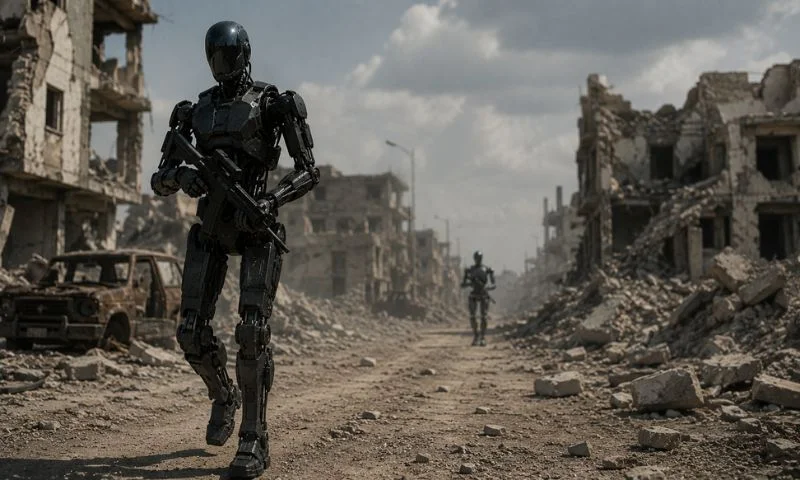
A California technology startup is betting that humanoid robots could one day become a common sight on future battlefields, taking on dangerous military tasks that currently place human soldiers at risk.
Foundation Robotics, a two-year-old company based in San Francisco, is developing a humanoid robot called Phantom for both civilian and military applications. While many robotics firms focus on warehouses, factories and household assistance, Foundation says it is the only US company building humanoid robots specifically for defence operations.
The company’s founder and chief executive, Sankaet Pathak, envisions robots carrying out supply missions, reconnaissance, casualty recovery and hazardous inspections. He also sees a future where they take on combat roles.
“Frontline weaponisation” is how Pathak describes that possibility.
He argues that robotic soldiers could reduce risks to human troops and lower collateral damage by operating with greater precision in complex environments such as urban warfare.
Foundation’s current robot, Phantom MK-1, remains a prototype. The machine weighs around 80 kilograms and can walk, balance and interact with objects. However, it lacks a battery, cannot withstand harsh weather and cannot recover after falling.
The company is now building Phantom MK-2, which Pathak says will operate for up to six hours, survive difficult environmental conditions and regain its footing after a fall.
Military Testing and Technological Challenges
Foundation has secured $24 million in research contracts linked to military projects. The company says the US military is testing its technology for handling tasks, while the Ukrainian military is evaluating two units.
According to Pathak, the US programme does not involve firing weapons. Ukraine’s testing includes weaponisation studies.
The robot operates through an artificial intelligence system called Cortex. Cameras mounted in its helmet provide 360-degree vision and help the machine assess its surroundings.
A reasoning model interprets assigned goals, while a world model predicts how the environment may respond.
Pathak believes countries must invest in the technology to remain competitive.
He argues that China is pursuing similar capabilities and says Western nations cannot afford to fall behind.
The startup also attracted attention earlier this year when Eric Trump joined as an investor and adviser.
Despite the enthusiasm, robotics experts remain cautious.
Dean Fankhauser, founder of robotics advisory firm Robozaps, says military organisations clearly see potential in humanoid systems. However, he believes the technology still faces major obstacles.
“If there was a war in Taiwan today, the likelihood that China is going to militarise these humanoids and fight effectively is fanciful,” he said.
Experts note that current commercial humanoid robots still struggle with basic tasks that humans perform easily.
Ethical Concerns and Global Debate
Beyond technical challenges, ethical concerns continue to fuel debate.
Nicole van Rooijen, executive director of the campaign group Stop Killer Robots, warns that autonomous weapons could lower the threshold for conflict and make accountability harder to establish.
“The answer to the current technological arms race,” she argues, is stronger international regulation.
Researchers also question whether humanoid robots represent the best solution for military operations. Some experts believe quadruped robots and drones may perform many battlefield tasks more efficiently.
Robert Griffin of the Florida Institute for Human and Machine Cognition says unpredictable environments remain a major challenge.
“You get an impression of human-level capability by seeing the human form… but [these autonomous systems] don’t know how to handle open-ended uncertainty yet,” he said.
For now, humanoid robot soldiers remain largely experimental. Yet growing military investment and rapid advances in artificial intelligence suggest that the debate over robots in warfare is moving from science fiction toward reality.