

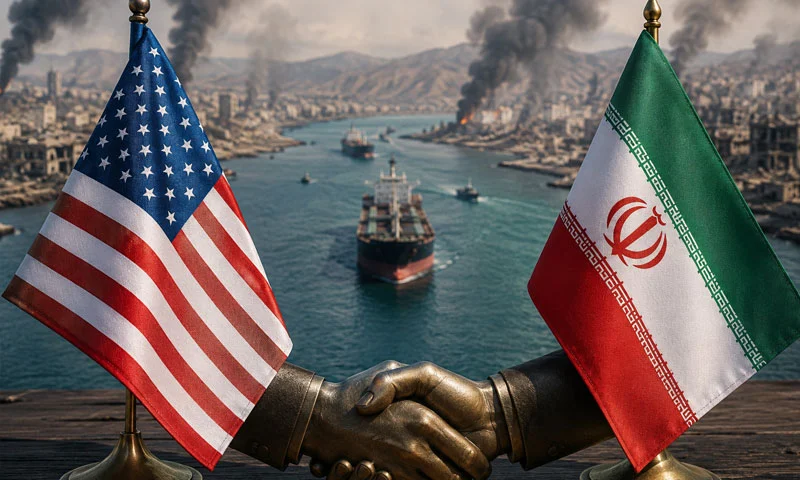
US President Donald Trump said on Monday that the United States and Iran had signed a preliminary agreement aimed at ending a conflict that has shaken the Middle East for nearly four months, though both sides acknowledged that negotiations on a permanent peace settlement remain unfinished. Speaking after arriving in France for the Group of Seven summit, Trump said the agreement would extend a fragile ceasefire announced in April and create a framework for broader negotiations. “The deal’s all signed,” Trump told reporters. He added that Vice President JD Vance would attend a formal signing ceremony in Geneva on Friday. The agreement marks the most significant diplomatic breakthrough since the conflict erupted in late February, when US and Israeli forces launched strikes on Iran. The war has since killed more than 7,000 people, most of them in Iran and Lebanon, according to regional estimates. Under the preliminary arrangement, the ceasefire will continue for another 60 days while negotiators work on unresolved issues, including Iran’s nuclear programme, sanctions relief and regional security concerns. Strait of Hormuz Reopening Brings Relief to Global Energy Markets One of the agreement’s most closely watched provisions involves the Strait of Hormuz, a strategic shipping route through which roughly one-fifth of global oil supplies pass. Iran has effectively restricted traffic through the waterway since the conflict began, contributing to sharp volatility in global energy markets. Following news of the agreement, oil prices fell to their lowest level since March 10, reflecting investor optimism that energy supplies could stabilize. Trump said the Strait of Hormuz would reopen under the agreement. “Ships of the world, start your engines. Let the oil flow!” he wrote earlier on social media. US officials said the memorandum includes significant sanctions relief for Iran. Vice President Vance described the document as brief but important. “The signed memorandum was only about 1-1/2 pages and so it is a very general document,” Vance told CNN. Officials said details would become public within days. .@VP on Iran: "There hasn't been a single dollar of sanctions relief or unfrozen assets, either from the United States or any of our allies in the Gulf… They only get that benefit if they meet their obligations under the agreement." https://t.co/hg0NRSxDuK pic.twitter.com/9eHgjOLrRF— Rapid Response 47 (@RapidResponse47) June 15, 2026 According to US and Iranian sources, the deal could eventually unlock frozen Iranian assets, ease sanctions and establish a reconstruction fund worth up to $300 billion financed by Gulf states. Key Issues Remain Unresolved Despite the breakthrough, major disagreements remain. Iranian President Masoud Pezeshkian described the memorandum as an “important step” but stressed that a permanent settlement still requires further negotiations. “A final agreement for a lasting truce has yet to take shape,” he wrote on social media. آنچه تفاهم شده، گامی مهم برای توقف جنگ و شروع مذاکره است و هنوز توافق نهایی شکل نگرفته است.جمهوری اسلامی ایران خود را برای همه گزینهها آماده کرده است و تمرکز دولت با یا بدون توافق خدمت صادقانه به مردم است. ملت ایران از امام شهیدش آموخته که زیر بار ذلت نرود.— Masoud Pezeshkian (@drpezeshkian) June 15, 2026 US officials insist that Iran must permanently abandon any effort to develop nuclear weapons and reduce support for armed regional groups before receiving the full economic benefits outlined in the agreement. The future of Iran’s enriched uranium stockpile also remains unresolved. Lebanon continues to represent another major obstacle. Iran has called for a complete end to hostilities involving Hezbollah, while Israeli Prime Minister Benjamin Netanyahu said Israeli forces would remain in southern Lebanon. “Iran wanted us to withdraw from it, but I stood firm,” Netanyahu told reporters. Although fighting has decreased since the announcement, security sources reported that clashes and military operations have not stopped entirely. Diplomats nevertheless view the agreement as the strongest opportunity yet to prevent further escalation and restore stability to a region battered by months of conflict.
7 Fabrics, 1,410kg and 11 Months of Work: New Kiswa Revealed
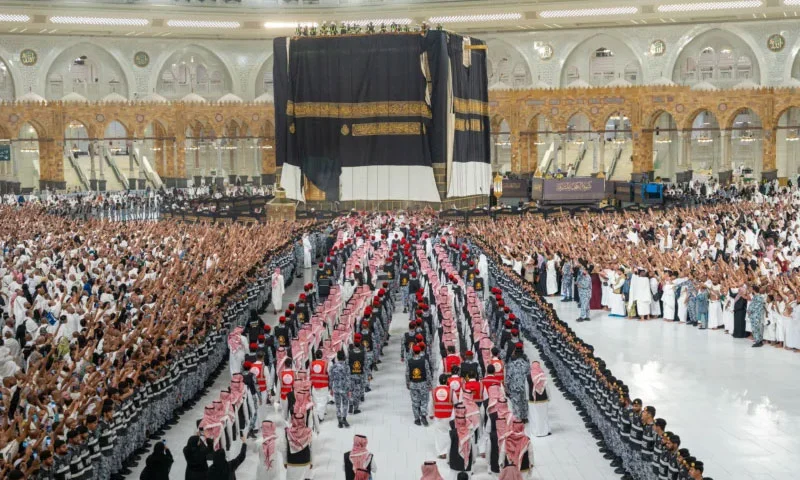
The Holy Kaaba was adorned with its new Kiswa for 1448 AH at the start of the Islamic New Year, continuing a centuries-old tradition that remains one of the most significant annual events at Islam’s holiest site. The replacement ceremony showcased Saudi Arabia’s continued care for the Holy Kaaba and highlighted the craftsmanship behind one of the world’s most distinguished examples of Islamic art. According to Saudi authorities, 150 Saudi artisans and specialists spent 11 months producing the new Kiswa, which consists of 47 separate pieces of luxurious black silk embroidered with 30 Quranic verses. The Kiswa weighs approximately 1,410 kilograms and features silver threads plated with 24-karat gold. The production process passed through seven specialised stages, including water desalination, silk washing, weaving, printing, embroidery, assembly and final inspection. After completion, workers transported the Kiswa on a specially designed trailer that protected the intricate fabric until it reached the Mataf courtyard at the Grand Mosque. Only once a year. 150 skilled hands. Pure silk 120kg of gold and silver threads Witnessing the annual changing of the Kiswa is a reminder of how timeless and beautiful this sacred tradition truly is pic.twitter.com/0PpEay5cR3 — Koshur newton (@KoshurNewton) June 16, 2026 The annual replacement ceremony draws the attention of Muslims worldwide, who view the Kiswa as a symbol of reverence, craftsmanship and devotion. More Than a Century of Saudi Stewardship Saudi Arabia has overseen the production and development of the Holy Kaaba’s Kiswa for more than a century. Modern Saudi production began in 1345 AH when King Abdulaziz bin Abdulrahman Al Saud ordered the creation of a new Kiswa made from broadcloth reinforced with durable lining. A year later, he established the first Saudi workshop dedicated to producing the Kiswa in the Ajyad district of Makkah. Successive Saudi kings continued expanding and modernising the process. King Saud bin Abdulaziz maintained oversight of production, while King Faisal bin Abdulaziz renovated and upgraded the Kiswa factory. King Khalid bin Abdulaziz continued improving production capabilities, and King Fahd bin Abdulaziz modernised the factory with advanced technical equipment. During the reign of King Abdullah bin Abdulaziz, authorities expanded operations through the King Abdulaziz Complex for the Holy Kaaba Kiswa in Umm Al-Joud. Under the Custodian of the Two Holy Mosques, King Salman bin Abdulaziz Al Saud, the complex has introduced further improvements to materials, production techniques and quality control systems. These developments transformed Kiswa production from a small workshop into one of the Islamic world’s most specialised manufacturing facilities. Seven Fabrics Form One of Islam’s Greatest Masterpieces Although many people view the Kiswa as a single garment, specialists describe it as a highly sophisticated structure made from seven different types of fabric. Black silk forms the outer covering and creates the Kaaba’s iconic appearance. Embossed black silk carries the Islamic inscriptions and decorative motifs woven into the cloth. Tawaf stops as a delegation and workers escorted by security bring in the 4 pieces of the Ka’bah Kiswa and the door cover.#الكعبة pic.twitter.com/lUAJfuNNBy— Haramain Archive (@muslimmakkah) June 15, 2026 Manufacturers use off-white cotton and white cotton as internal linings that strengthen the structure and improve durability. Red silk appears in decorative sections and specialised components, while green silk sits behind the curtain of the Kaaba’s door. Embossed green silk covers parts of the Kaaba’s interior. Experts say this combination of materials reflects both artistic excellence and engineering precision. The Kiswa’s design ensures durability throughout the year while preserving its appearance despite constant exposure to environmental conditions. For millions of Muslims, the annual replacement of the Kiswa remains a powerful reminder of the care devoted to the Holy Kaaba and the enduring legacy of Islamic craftsmanship.
