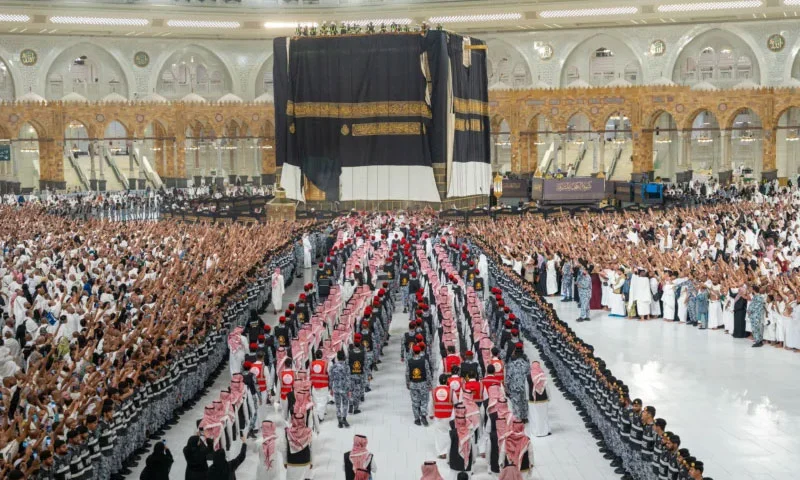
The Holy Kaaba was adorned with its new Kiswa for 1448 AH at the start of the Islamic New Year, continuing a centuries-old tradition that remains one of the most significant annual events at Islam’s holiest site.
The replacement ceremony showcased Saudi Arabia’s continued care for the Holy Kaaba and highlighted the craftsmanship behind one of the world’s most distinguished examples of Islamic art.
According to Saudi authorities, 150 Saudi artisans and specialists spent 11 months producing the new Kiswa, which consists of 47 separate pieces of luxurious black silk embroidered with 30 Quranic verses.
The Kiswa weighs approximately 1,410 kilograms and features silver threads plated with 24-karat gold.
The production process passed through seven specialised stages, including water desalination, silk washing, weaving, printing, embroidery, assembly and final inspection.
After completion, workers transported the Kiswa on a specially designed trailer that protected the intricate fabric until it reached the Mataf courtyard at the Grand Mosque.
Only once a year. 150 skilled hands. Pure silk 120kg of gold and silver threads Witnessing the annual changing of the Kiswa is a reminder of how timeless and beautiful this sacred tradition truly is pic.twitter.com/0PpEay5cR3
— Koshur newton (@KoshurNewton) June 16, 2026
The annual replacement ceremony draws the attention of Muslims worldwide, who view the Kiswa as a symbol of reverence, craftsmanship and devotion.
More Than a Century of Saudi Stewardship
Saudi Arabia has overseen the production and development of the Holy Kaaba’s Kiswa for more than a century.
Modern Saudi production began in 1345 AH when King Abdulaziz bin Abdulrahman Al Saud ordered the creation of a new Kiswa made from broadcloth reinforced with durable lining.
A year later, he established the first Saudi workshop dedicated to producing the Kiswa in the Ajyad district of Makkah.
Successive Saudi kings continued expanding and modernising the process.
King Saud bin Abdulaziz maintained oversight of production, while King Faisal bin Abdulaziz renovated and upgraded the Kiswa factory.
King Khalid bin Abdulaziz continued improving production capabilities, and King Fahd bin Abdulaziz modernised the factory with advanced technical equipment.
During the reign of King Abdullah bin Abdulaziz, authorities expanded operations through the King Abdulaziz Complex for the Holy Kaaba Kiswa in Umm Al-Joud.
Under the Custodian of the Two Holy Mosques, King Salman bin Abdulaziz Al Saud, the complex has introduced further improvements to materials, production techniques and quality control systems.
These developments transformed Kiswa production from a small workshop into one of the Islamic world’s most specialised manufacturing facilities.
Seven Fabrics Form One of Islam’s Greatest Masterpieces
Although many people view the Kiswa as a single garment, specialists describe it as a highly sophisticated structure made from seven different types of fabric.
Black silk forms the outer covering and creates the Kaaba’s iconic appearance.
Embossed black silk carries the Islamic inscriptions and decorative motifs woven into the cloth.
Manufacturers use off-white cotton and white cotton as internal linings that strengthen the structure and improve durability.
Red silk appears in decorative sections and specialised components, while green silk sits behind the curtain of the Kaaba’s door.
Embossed green silk covers parts of the Kaaba’s interior.
Experts say this combination of materials reflects both artistic excellence and engineering precision.
The Kiswa’s design ensures durability throughout the year while preserving its appearance despite constant exposure to environmental conditions.
For millions of Muslims, the annual replacement of the Kiswa remains a powerful reminder of the care devoted to the Holy Kaaba and the enduring legacy of Islamic craftsmanship.