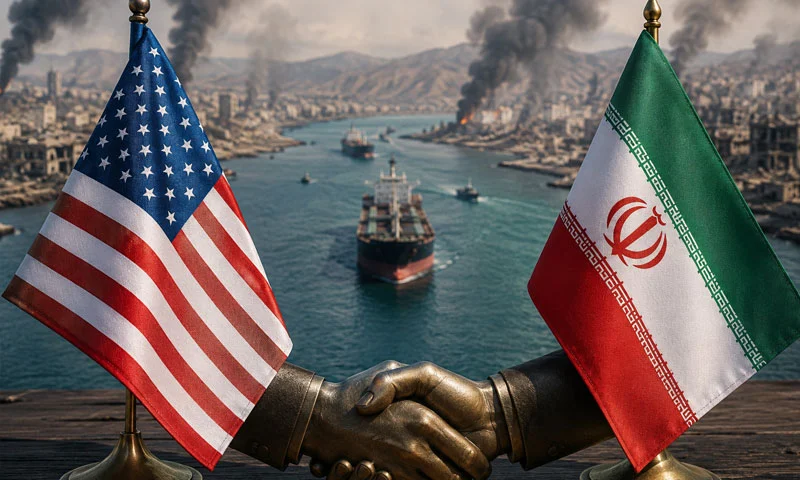
US President Donald Trump said on Monday that the United States and Iran had signed a preliminary agreement aimed at ending a conflict that has shaken the Middle East for nearly four months, though both sides acknowledged that negotiations on a permanent peace settlement remain unfinished.
Speaking after arriving in France for the Group of Seven summit, Trump said the agreement would extend a fragile ceasefire announced in April and create a framework for broader negotiations.
“The deal’s all signed,” Trump told reporters.
He added that Vice President JD Vance would attend a formal signing ceremony in Geneva on Friday.
The agreement marks the most significant diplomatic breakthrough since the conflict erupted in late February, when US and Israeli forces launched strikes on Iran. The war has since killed more than 7,000 people, most of them in Iran and Lebanon, according to regional estimates.
Under the preliminary arrangement, the ceasefire will continue for another 60 days while negotiators work on unresolved issues, including Iran’s nuclear programme, sanctions relief and regional security concerns.
Strait of Hormuz Reopening Brings Relief to Global Energy Markets
One of the agreement’s most closely watched provisions involves the Strait of Hormuz, a strategic shipping route through which roughly one-fifth of global oil supplies pass.
Iran has effectively restricted traffic through the waterway since the conflict began, contributing to sharp volatility in global energy markets.
Following news of the agreement, oil prices fell to their lowest level since March 10, reflecting investor optimism that energy supplies could stabilize.
Trump said the Strait of Hormuz would reopen under the agreement.
“Ships of the world, start your engines. Let the oil flow!” he wrote earlier on social media.
US officials said the memorandum includes significant sanctions relief for Iran. Vice President Vance described the document as brief but important.
“The signed memorandum was only about 1-1/2 pages and so it is a very general document,” Vance told CNN.
Officials said details would become public within days.
According to US and Iranian sources, the deal could eventually unlock frozen Iranian assets, ease sanctions and establish a reconstruction fund worth up to $300 billion financed by Gulf states.
Key Issues Remain Unresolved
Despite the breakthrough, major disagreements remain.
Iranian President Masoud Pezeshkian described the memorandum as an “important step” but stressed that a permanent settlement still requires further negotiations.
“A final agreement for a lasting truce has yet to take shape,” he wrote on social media.
US officials insist that Iran must permanently abandon any effort to develop nuclear weapons and reduce support for armed regional groups before receiving the full economic benefits outlined in the agreement.
The future of Iran’s enriched uranium stockpile also remains unresolved.
Lebanon continues to represent another major obstacle.
Iran has called for a complete end to hostilities involving Hezbollah, while Israeli Prime Minister Benjamin Netanyahu said Israeli forces would remain in southern Lebanon.
“Iran wanted us to withdraw from it, but I stood firm,” Netanyahu told reporters.
Although fighting has decreased since the announcement, security sources reported that clashes and military operations have not stopped entirely.
Diplomats nevertheless view the agreement as the strongest opportunity yet to prevent further escalation and restore stability to a region battered by months of conflict.