

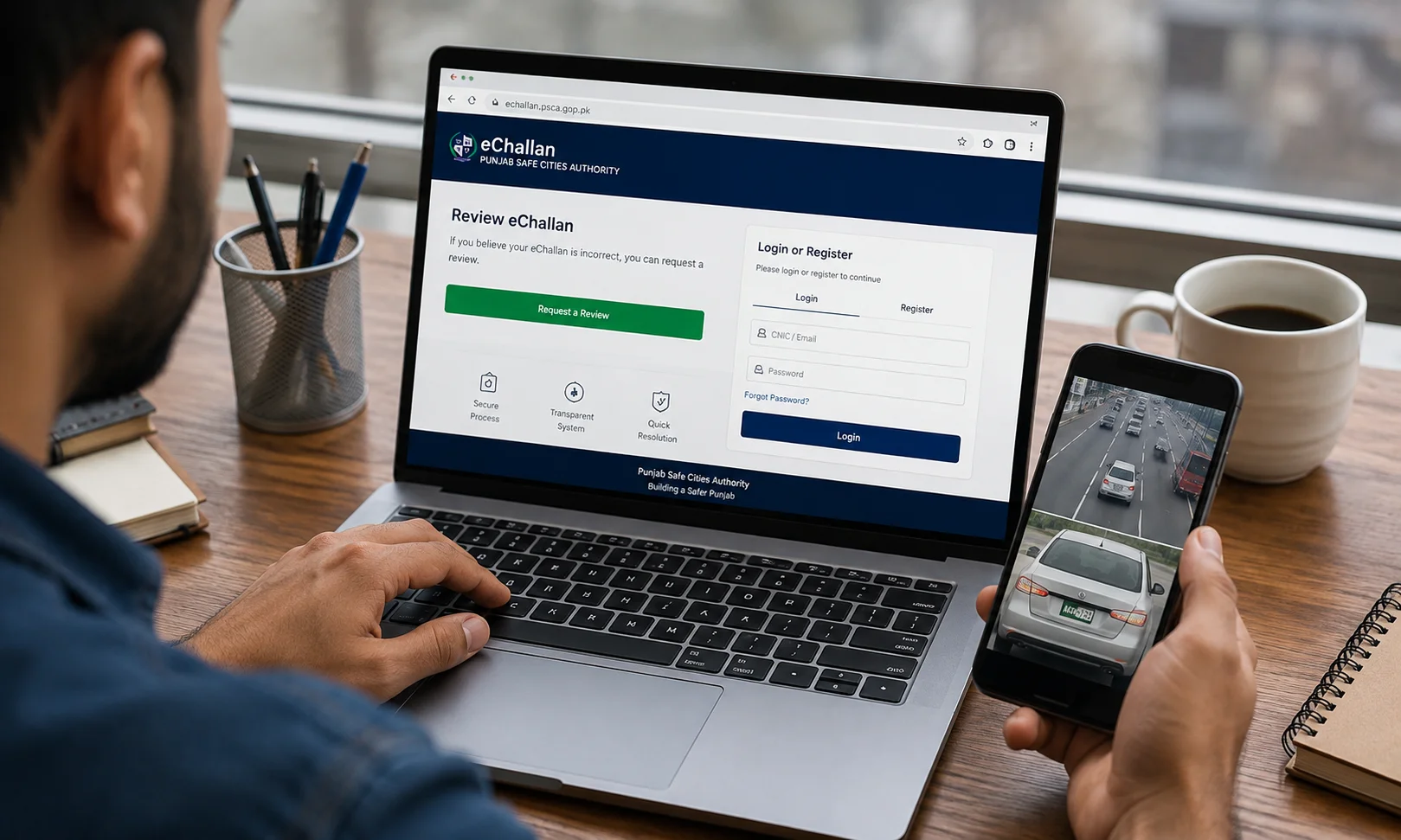
Punjab motorists can now challenge an incorrectly issued e-challan online without visiting an office. The Punjab Safe Cities Authority has highlighted a digital review facility that allows citizens to submit evidence through its official portal. “Was an e-challan issued incorrectly? No need to worry now,” Punjab Police said in a public awareness message. Motorists should visit echallan.psca.gop.pk, create an account or log in, open the review section and submit supporting evidence. The portal lets users view the disputed challan, explain the complaint and upload photographs or other proof. PSCA officials then examine the information. “If the challan is proven incorrect, it will be canceled within 24 hours,” the message said. How to Request an E-Challan Review A motorist must first open the official PSCA e-challan portal. The user can register a new account or sign in to an existing one. After opening the review section, the complainant must select the relevant challan and provide evidence. Earlier PSCA guidance said users could submit a review reason, contact details and an explanation of the dispute. Supporting material may include vehicle photographs or documents that help officials confirm an error. The online option also reduces reliance on email complaints. “There is no longer any need for citizens to send emails for e-challan corrections,” a PSCA spokesperson said when the online feature became available. The authority asked people to use the service only for genuine complaints. “Be a responsible citizen,” the message said, urging motorists to “use the review facility only in cases of genuine complaints.” The facility does not offer a way to escape a valid penalty. It gives motorists a formal channel to challenge duplicate tickets, incorrect vehicle identification or other verifiable errors. PSCA Uses Cameras and AI for Traffic Enforcement PSCA runs an electronic enforcement system that uses surveillance cameras and automated technology to identify traffic violations. Its official material lists red-light offences, wrong turns, one-way breaches, lane violations and vehicles crossing stop lines or zebra crossings. The PSCA website also allows motorists to verify e-challans. Its Public Safety mobile application lets users check, download and manage tickets from their phones. Google Play shows more than one million downloads. The app received an update in June 2026. Automated enforcement can improve consistency, but disputes may arise when cameras misread registration plates. Problems can also occur when vehicle records contain outdated ownership details. Such issues have previously caused challans to reach former vehicle owners. The review mechanism gives citizens a direct route to correct errors before paying a fine. Punjab Police also linked the initiative with road safety and responsible citizenship. Officials urged drivers to follow traffic laws and avoid false claims. Motorists should use only the official PSCA portal and avoid sharing personal or banking information through unverified links. The service aims to reduce office visits, speed up corrections and strengthen trust in Punjab’s e-challan system. Citizens with genuine evidence now have a clear process for seeking cancellation within the stated timeframe.
Visa and Mastercard May Face New Challenge From PayPak
1LINK has proposed mandatory PayPak cards for government salary accounts, subsidies and public sector payment programmes. The plan seeks to reduce Pakistan’s dependence on international card networks, including Visa and Mastercard. The proposal would cover government employees, subsidy recipients and beneficiaries of social safety-net programmes. It would also extend PayPak use to mass-transit payment systems, according to details shared by the State Bank of Pakistan. PayPak Push Targets Government Services 1LINK wants tax relief for PayPak purchases made through point-of-sale terminals and e-commerce platforms. It has also recommended financial incentives to encourage consumers and merchants to use the domestic card scheme. The company proposed PayPak-compatible terminals at all major public-facing government offices. These would include NADRA centres, Excise departments and Passport Offices. The plan also recommends discounts, cashback and loyalty rewards on selected PayPak transactions. It specifically identifies utility bills, fuel purchases, public transport fares and other government payments. Read More: Pakistan Records Mysterious 6x Surge in Credit Card ATM Use 1LINK operates Pakistan’s largest banking payment switch and manages PayPak, the country’s domestic card scheme. The company introduced PayPak to route more local transactions through national infrastructure and reduce reliance on foreign networks. The proposal has not yet become mandatory government policy. However, it supports the central bank’s wider effort to expand domestic digital payment channels. SBP Expands PayPak and Raast Ecosystem The SBP has introduced several measures to strengthen PayPak’s reach and functionality. These include co-badged cards, wider e-commerce acceptance, promotional incentives and public awareness campaigns. Faysal Bank launched Pakistan’s first PayPak-Mastercard co-badged debit card in December 2025. The product allows customers to use PayPak locally while accessing Mastercard’s international network abroad. The central bank says these measures have increased merchant acceptance and transaction volumes. It has also accelerated the expansion of Raast Person-to-Merchant payments. Read More: Faysal Bank Introduces Pakistan’s First Cardless ATM Withdrawal via Mobile Raast allows individuals, businesses and government bodies to make real-time digital payments. The government allocated Rs3.5 billion for a Raast QR-code subsidy during the 2025-26 financial year. The SBP set the subsidy at 0.5 percent of each eligible transaction or Rs100, whichever was lower. The programme covered transactions from September 1, 2025, until June 30, 2026. Daily Raast P2M transactions climbed from about 60,000 in June 2025 to nearly 1.1 million by June 2026. The increase highlights the rapid adoption of QR-based payments across Pakistan. The SBP plans to keep onboarding merchants and expanding QR payments. It also wants more transactions to move through PayPak and Raast instead of international payment rails. For consumers, mandatory PayPak issuance could offer wider local acceptance and lower-cost digital payments. Its success, however, will depend on reliable service, strong merchant coverage and meaningful rewards.
Apple and Samsung Want You to Stop Owning Your Phone
Apple, Samsung and rental startups are promoting smartphone leasing as premium devices become more expensive. The strategy offers monthly payments, predictable upgrades and a supply of used phones for resale. Apple launched Apple Upgrade in the United States with Klarna this week. Customers can lease an iPhone, Mac, iPad or Apple Watch, then upgrade, return or purchase it later. Tim Cook said regular upgraders and Apple’s strong resale values make the plan suitable. Samsung’s Galaxy Forever programme follows a similar path in India. Buyers pay half the cost of a Galaxy S26 Ultra or S26 Plus through 12 no-cost instalments. After one year, they can return, retain or upgrade the device. Samsung guarantees a 50% buyback and includes Samsung Care+ protection. Longer Replacement Cycles Change the Market Consumers now keep phones longer as prices and component costs rise. Smaller hardware improvements also keep older devices useful. Counterpoint expects the global replacement cycle to reach four years in 2026, up from 3.5 years in 2025. IDC says US premium-phone owners now keep devices for 42 months, compared with 38 to 40 months previously. “These programs fundamentally do not work unless a secondary market exists,” Creative Strategies analyst Max Weinbach said. “The only way to sustain a used or refurbished market is to make sure devices enter that market, and leasing and guaranteed buyback programs make that possible.” LendingTree analyst Matt Schulz said, “Leasing definitely isn’t for everyone, but it can make sense, especially for someone who upgrades often.” Buyers who keep phones for three to five years usually save more through outright ownership. Weinbach added, “It’s important to stress the fact this is an upgrade program that’s done via a lease, rather than just a leasing program.” Frequent upgraders may pay roughly the same or less, particularly on high-storage models. Phone Makers Chase Loyalty and Resale Value “The real driver isn’t shorter upgrade cycles; it’s protecting margin and retention as pricing pressure mounts,” IDC analyst Navkendar Singh said. IDC’s Nabila Popal said, “It’s the interest-free financing of 36 months and aggressive trade-ins of up to $1,100 that have made the U.S. the region with the highest smartphone average selling prices.” Apple and Samsung hold more than 80% of the US market. India’s BytePe says more than 80% of its customers choose subscriptions over purchases or traditional instalment plans. Its users are young professionals seeking premium phones without large upfront payments. Raylo in Britain and Grover in Germany also lease electronics. Counterpoint’s Tarun Pathak said companies want “improving retention, creating predictable upgrade cycles and securing a steady pipeline of trade-in devices for certified refurbishment and resale.” He expects financing to remain the main affordability tool. Cashify CEO Mandeep Manocha expects leasing, subscriptions and purchases to coexist. “All three business models have a place to exist, and they will continue to do so,” he said. “There is a natural transition that may happen from complete ownership to leasing, but it’s a long journey.” For frequent upgraders, leasing can offer convenience and predictable costs. People who keep phones for years will usually gain more value from ownership.
Paid Zoox Rides Are Coming as America Debates Robotaxi Safety
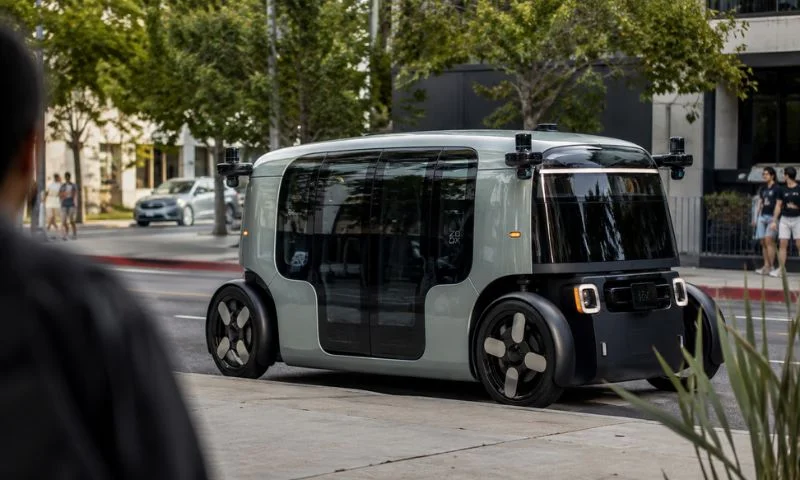
The US AV industry is moving in two directions as federal regulators accelerate deployment and local officials seek stronger safeguards. The National Highway Traffic Safety Administration granted Amazon-owned Zoox an exemption from eight federal safety standards. The decision lets Zoox commercially deploy up to 2,500 purpose-built robotaxis annually for two years. Paid rides will begin in Las Vegas. NHTSA also launched a three-year, $5 million partnership with SAE Industry Technologies Consortia. The programme will support the first federal AV performance standards. Officials also plan to streamline exemptions and update guidance on emergency response and post-crash behaviour. Emergency Failures Intensify Safety Debate The federal push comes as Waymo and other operators face scrutiny over emergency incidents. San Francisco Mayor Daniel Lurie sought tougher rules after Waymo vehicles stalled in heavy July 4 traffic. Some lost power and blocked key streets. Representative Kevin Mullin introduced the AV Emergency Response Coordination Act on July 28. It would require standard emergency protocols, a 24-hour hotline and national minimum safety rules. Officials could also issue geofence notices to keep robotaxis away from dangerous areas. Read More: Uber, Lucid & Nuro Unveil Futuristic Robotaxi Set to Hit Streets in 2026 “We have seen disturbing, and frankly, an unacceptable number of incidents where autonomous vehicles inadvertently interfere with emergency responders,” Mullin said. His office cited vehicles blocking ambulances and fire trucks, entering crime scenes and missing flares, smoke or traffic cones. Waymo has started restoring freeway routes after a pause of more than two months. It updated scene recognition and routing after at least 13 vehicles entered closed construction areas. The company recalled nearly 4,000 robotaxis in June, with no reported injuries or crashes. Mobility Investment and Expansion Continue Saudi Prince Al Waleed bin Talal bought more than 19 million Lucid shares, or about 5 percent. The Boring Company entered talks to raise $4 billion at a $20 billion valuation. Toronto fleet-data company Terminal raised $20 million in a Battery Ventures-led Series A. Intact Private Capital, Penske, Y Combinator and Wayfinder Ventures also participated. Alaska Airlines chief Ben Minicucci joined Lyft’s board. Walmart and Wing launched drone delivery in Central Florida, while Flytrex partnered with Nash. DoorDash is developing its own aircraft for a future service inside its app. Ferrari reached its annual Luce sales target in two months. Florida will use $200 million in federal charging funds for 32 eVTOL landing pads. Rivian spinoff Also plans to begin delayed e-bike deliveries next week. Read More: AI Startup Records Every Corner of Homes to Train Future Robots London is becoming a robotaxi battleground. Baidu began testing with Lyft and Freenow before public rides planned for 2027. Waymo started supervised tests in April. Uber and Wayve aim to launch this year. Tesla reportedly considered selling its China business before a possible SpaceX merger, while producing its 10 millionth EV. TechCrunch and Hudson Labs also found that GM and Ford discuss EVs less often than before the pandemic, despite keeping new models. The week showed a sector gaining money, markets and federal support while safety failures keep pressure on operators.

Moroccan Footballer Dies While Trying to Swim to Spain
Moroccan women’s football is mourning 20-year-old Faten Ben Omar El Azizi, who drowned while trying to swim from northern Morocco to Ceuta. The Spanish enclave forms one of the European Union’s two land borders with Africa. Local outlet Al Chamal 24 reported that El Azizi died during the dangerous crossing. Reports linked her to Maghreb Atlético Tétouan, where she had previously played women’s football. The Moroccan Union of Professional Footballers, or UMFP, also referred to Moghreb de Tanger in its condolence message. Hundreds attended her burial, according to Al Jazeera. Her family said officials approved her Schengen visa on the same day she died. That detail deepened the grief around a young player who had hoped to find better opportunities in Spain. Tributes Pour In for Young Moroccan Player Friends, former teammates and members of Morocco’s football community described El Azizi as dedicated, hardworking and kind-hearted. Her club said she was not seeking fame or adventure. She simply wanted “a new door” in life and believed a better future waited across the border. The UMFP expressed condolences to her relatives and the wider sporting community. “At this difficult time, UMFP President Mustapha El Hadaoui, together with all members of the Union, extends its sincere condolences and deepest sympathies to the late player’s family, loved ones, teammates, Moghreb de Tanger, and the entire Moroccan football community. Read More: Spain Rewrites Football History by Winning Both Men and Women FIFA Titles “We share in their grief and pray that the Almighty welcomes her into His infinite mercy, grants her the highest place in Paradise, and gives her family patience, strength, and comfort during this time of loss,” the statement read. Her death sparked tributes across social media. Supporters remembered a promising footballer whose sporting journey ended while she searched for a safer future. Death Highlights Human Cost of Ceuta Migration Crisis El Azizi died during an unprecedented surge in crossings from Morocco into Ceuta. More than 50,000 people entered the territory by land and sea after the movement began on July 30, Spanish authorities said. Reuters reported that at least 72 people had died by August 2. Some drowned, while crowds crushed others near the breakwater and border fence. More than 1,000 people also needed medical treatment. Morocco reported 11 deaths, mostly from drowning, and counted around 40,000 people in the surge. Officials blamed social media misinformation, trafficking networks and confusion over a Spanish court ruling. Spain later installed a 500-metre floating barrier and reinforced patrols. Read More: ‘Mera Lyari’ Brings Karachi’s Football Culture and Community Spirit to the Big Screen The crisis has renewed concern about young Moroccans risking their lives on irregular routes to Europe. Economic hardship and false online claims reportedly encouraged many people to attempt the crossing. El Azizi’s death has given that wider tragedy a deeply personal face. Her loss has united Morocco’s football community in grief. It has also raised urgent questions about why young people see the sea as their only path to opportunity.
Pakistan’s Recycling Success Story Has a Dangerous Blind Spot
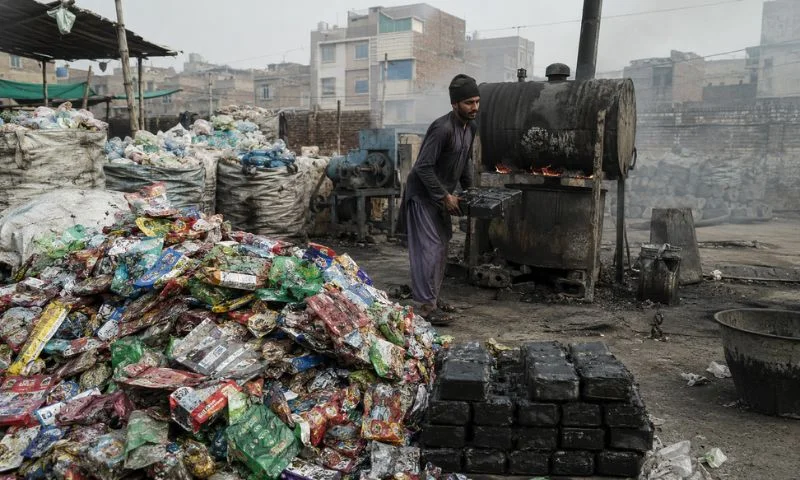
Pakistan may record South Asia’s lowest plastic-waste leakage rate, but Karachi’s informal recycling economy reveals a gap. Recyclers even import used milk jugs from Ohio and may advise Saudi Arabia on plastic street pavers. Yet thin biscuit, chips, paan and medicine wrappers often avoid landfills only to return as polluted air. Official estimates show Pakistan generates about 3.3 million tonnes of plastic waste yearly, much of it poorly managed. At small units in Paracha, a corner of Karachi’s Shershah market, workers sort household waste by colour. Machines crush usable plastic, push out black strands, cool them in water and cut them into one-millimetre pellets called dana. Factories use the pellets to make new plastic products. One unit produced green dana, while another processed cleaner, unused medical waste. But coal-like blocks also covered the floor. “What’s that on the floor?” the reporter asked. “That’s gatha,” workers replied. Why Multi-Layered Plastic Has Little Value Gatha comes from multi-layered plastic, or MLP, one of the least valuable forms of packaging waste. Manufacturers use an outer BOPP or PET printing layer, adhesive and an inner CPP or LDPE sealant. Some add aluminium or metallised film for longer shelf life or extra shine. This gives MLP its local name, “chamak patti.” Metatex director Hasan Khanani said some packaging contains up to seven layers. Read More: From Farm Waste to Fashion: Pakistan Launches Banana Fiber Initiative Those materials protect food, but they make recycling costly. Different polymers have different properties and melting points, while the layers resist separation. Research confirms that multilayer packaging remains difficult to recycle through conventional systems. A plastic bottle can sell for up to Rs150 per kilogram, Irverde CEO Angel Imdad said. Mixed MLP fetches only about Rs6. One PET bottle also weighs roughly as much as 100 wrappers, so waste pickers favour bottles. “It isn’t viable to spend Rs20,000 to transport MLP, as its volumetric weight is a lot more than its physical weight,” Imdad said. “People don’t even reach breakeven.” Recycling Waste Into a New Health Threat Informal operators often burn MLP in open karahi-like containers. The melted sludge cools into hard gatha blocks. Textile dyeing units, small steel re-rolling mills and kilns reportedly buy them as cheap fuel. Safer methods exist. Mechanical compaction uses pressure below the plastic’s flashpoint. Pyrolysis heats waste between 450°C and 650°C in an oxygen-deprived chamber, breaking polymers into petroleum derivatives rather than openly burning them. Poorly controlled burning can release acid gases, chlorine, heavy metals, dioxins and other toxic pollutants. Research also shows that small community fires may create greater exposure risks than large dumps because smoke stays closer to residents. Read More: From Waste to Wonder: Beaconhouse Students Redefine Sustainable Art Regulated economies classify similar material as solid recovered fuel and control its use in high-temperature industry. Karachi’s off-the-books production and use face little visible oversight. Sources told Dawn that some operators move locations to avoid detection. Pakistan’s wrapper recycling story carries a grim warning. Turning MLP into fuel does not remove pollution. It simply shifts it from landfill to lungs.
Tesla Hits 10 Million EVs as Global Auto Race Intensifies
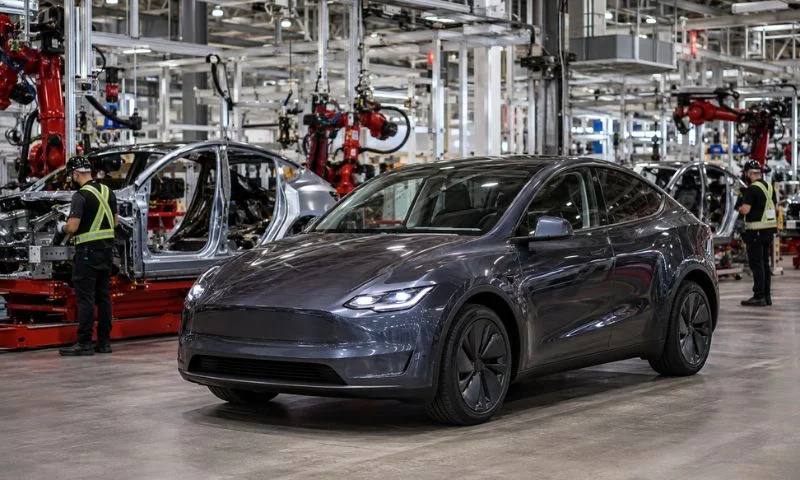
Tesla has produced its 10 millionth fully electric vehicle, 18 years after the original Roadster entered production in 2008. A black Model Y became the milestone vehicle at Tesla’s Fremont factory in California in late July. The achievement makes Tesla the first automaker to reach 10 million battery-only vehicles. BYD crossed 10 million new-energy vehicles earlier, but that total included plug-in hybrids alongside fully electric models. Tesla needed about 12 years to reach its first million vehicles in March 2020. The pace then changed sharply. It reached two million around 18 months later and three million about 11 months after that. The four-million mark followed roughly seven months later. Production crossed five million in September 2023 and doubled to 10 million by July 2026. Tesla therefore added its second five million vehicles in less than three years. In 2025 alone, the company produced 1,654,667 vehicles and delivered 1,636,129. Scale, Software and Charging Built Tesla’s Advantage Tesla’s lead rests on more than the cars themselves. Its factories cover over 2.8 million square metres. The company employs more than 70,000 people across three continents. Tesla also built expertise in batteries, electric powertrains, thermal management and power electronics. It has pursued vertical integration while localising supply chains and cutting manufacturing costs. Software created another major difference. Tesla designed vehicles around central computing and over-the-air updates instead of treating software as an accessory. That approach lets it change features after delivery. It also links cars with navigation, charging and paid digital services. Its charging network strengthened that ecosystem. Tesla says more than 80,000 Supercharger stalls delivered 6.7 terawatt-hours of electricity in 2025. AlixPartners warned in April that Western manufacturers were losing ground in software-defined vehicles. Himanshu Khandelwal said, “Software-defined vehicles are the very future of the global auto industry.” BYD and Chinese Rivals Turn Up the Pressure Tesla’s milestone does not guarantee future dominance. BYD sold 2.26 million battery-electric vehicles in 2025, ahead of Tesla’s 1.64 million deliveries. Global electric-car sales exceeded 20 million and reached one-quarter of all new cars sold. Chinese manufacturers now compete on price, batteries, software, design, production speed and supply-chain control. A Gulf News analysis captured Tesla’s changing position: “The disruptor eventually becomes the incumbent.” Traditional automakers have paid heavily for misjudging the shift. Reuters initially counted about $55 billion in EV-related writedowns. It later raised the total above $70 billion after further industry resets. Stellantis booked €22.2 billion, or $26.5 billion, while Ford recorded $19.5 billion. GM took a $6 billion charge. Porsche’s overhaul cost Volkswagen about $6 billion. Tesla now wants another transformation. It is investing in Full Self-Driving, robotaxis, AI, Optimus robots and energy storage. The company deployed 46.7 GWh of storage products in 2025. The wider lesson remains clear: “Technology doesn’t need permission from an incumbent industry to redefine it.” Tesla’s 10 millionth vehicle shows that electric cars have moved from experiment to mass production. Its next challenge is proving it can lead the software, autonomy and robotics era too.
Ghandhara Tyre Wins Approval for Saudi Arabia and UAE Exports
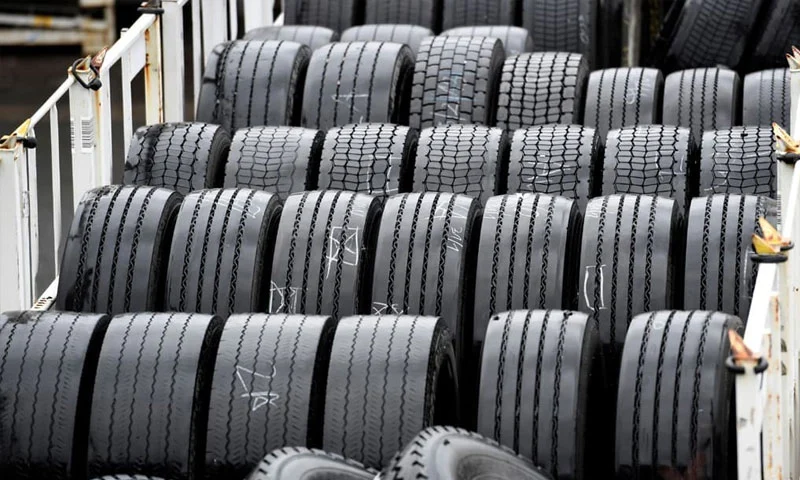
Ghandhara Tyre & Rubber Company Limited has secured Gulf Standardisation Organisation certification, opening six Gulf markets to its tyre exports. The company disclosed the approval in a material information notice submitted to the Pakistan Stock Exchange on Monday. “We are pleased to inform our valued shareholders that GTR Tyres has been officially approved and certified by the Gulf Standardization Organization (GSO),” the notice read. Read More: MG Pakistan to Export 5,800 Vehicles to Bangladesh The certification allows Ghandhara Tyre to export products to Bahrain, Kuwait, Oman, Qatar, Saudi Arabia and the United Arab Emirates. These six states form the Gulf Cooperation Council. Certification Opens Major Gulf Markets GSO operates a common conformity system for new vehicles and tyres sold across Gulf markets. The process checks compliance with regional technical rules designed to protect users and the environment. Ghandhara Tyre said the approval supports its strategy to expand exports and enter new international markets. “This development marks an important milestone for the company and reflects its ongoing commitment to expanding its export portfolio, exploring new international markets, and strengthening its position in the global tyre industry,” it added. The company said it remains focused on strengthening its international presence and supplying products that comply with global standards. Read More: Pakistan Wants Samsung to Export Locally Made Phones to Africa The approval follows another export breakthrough in July. Ghandhara Tyre secured registration with the US Department of Transportation, clearing a key requirement for exports to the United States. The company said its locally manufactured tyres meet applicable US Federal Motor Vehicle Safety Standards. Together, the US and Gulf certifications give the manufacturer access to major overseas markets. Actual export volumes will depend on commercial agreements, distributors and demand. Company Expands Products and Export Strategy Ghandhara Tyre started in 1963 as a private limited company before becoming a public company. It previously operated as The General Tyre & Rubber Company of Pakistan Limited. The company manufactures and trades tyres and tubes for automobiles and motorcycles. Its range covers passenger cars, SUVs, crossovers, light trucks, buses, tractors and off-road vehicles. Ghandhara Tyre has added products for the expanding SUV and crossover segments. It also wants to increase export sales through wider product diversification. The company entered a seven-year technical assistance agreement with China’s Shandong Huasheng Rubber Company in September 2024. The partnership aims to improve manufacturing through advanced technical expertise and proprietary knowledge. Read More: Pakistan’s IT exports keep breaking records with $4.5bn in FY26 The two companies have also explored cooperation in passenger car radial and truck and bus radial tyres. Ghandhara Tyre identified exports as a central priority for the proposed collaboration. The new certification could improve the company’s competitiveness in Gulf markets, where conformity approval is required for tyre access. It may also support Pakistan’s efforts to increase value-added industrial exports and earn foreign exchange. Ghandhara Tyre has not disclosed expected shipment volumes, launch dates, target distributors or projected revenue from the six GCC markets.
Oxford Offers Fully Funded MBA Scholarship to Pakistan Applicants
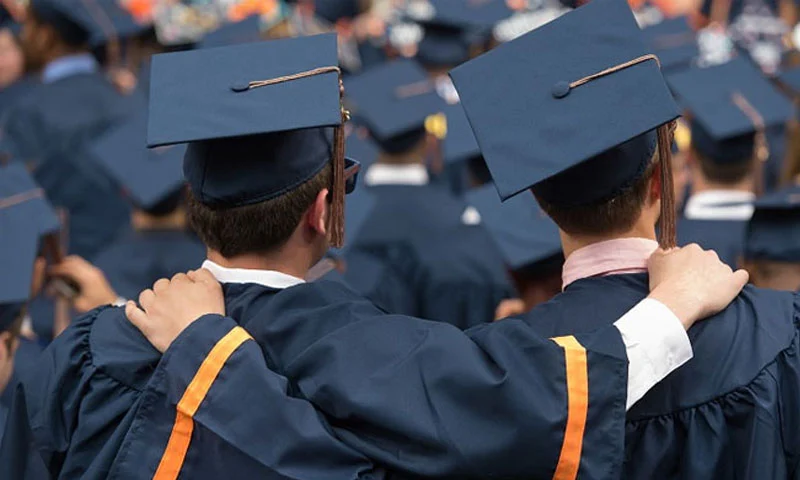
The Skoll MBA Scholarship 2027 is accepting applications from social entrepreneurs seeking a fully funded MBA at the University of Oxford’s Saïd Business School. The award supports founders and impact leaders who use entrepreneurial approaches to address social or environmental challenges. Oxford says the scholarship covers full MBA course fees and provides a living-cost stipend of at least £21,805. The university may award up to four scholarships for the 2027-28 class. Successful applicants also join the Skoll Scholar community, a global network of innovators, mentors and peers. Read More: Japan Announces MEXT Teachers Training Scholarship 2026 for Pakistani Educators “The Skoll Scholarship is a prestigious opportunity for social entrepreneurs to pursue an Oxford MBA with full financial support and access to the Skoll community,” the Skoll Centre says. The network provides lifelong learning, collaboration and leadership development. Who Can Apply for the Skoll MBA Scholarship Candidates must have at least three years of experience building and leading a social venture or initiative. They must also show evidence of significant social or environmental impact. The initiative may operate as a business, non-profit organisation or programme within a larger institution. Oxford defines eligible work as an entrepreneurial effort that tackles a serious challenge and seeks sustainable systems change. The selection committee looks for leadership, persistence, humility and a clear understanding of the issue. Applicants should show lived experience or long-term engagement with affected communities. They must explain how an Oxford MBA would help expand their impact. Candidates also need a career plan focused on long-term change. They must demonstrate financial need based on their circumstances, career path or previous work. Read More: Pakistan Wants One Million AI-Skilled Workers by 2030 There is no age restriction. The programme welcomes applicants worldwide and encourages women, underrepresented groups and candidates from the Global South. Applicants must meet Oxford MBA admission requirements before the scholarship committee can consider them. Application Process and January 2027 Deadline Candidates must apply directly to the Oxford MBA during one of the first four admissions stages. They must upload answers to the Skoll Scholarship essay questions through the funding section of the MBA application. Oxford has set January 8, 2027, as the scholarship deadline. The MBA admissions team first decides whether to offer the candidate a place. Applications from admitted candidates then move to the Skoll Scholarship Selection Committee, provided they include the required essays. Shortlisted applicants must complete a logistics and reference form. They will attend first-stage online interviews, followed by a final interview for successful candidates. Oxford expects final shortlisting in late March, with interviews in April or May. Read More: Pakistan Bets Big on AI: $1 Billion Plan That Could Change the Economy Candidates need an unconditional MBA offer to reach the final scholarship stage. Those holding only a conditional offer at that point will not remain eligible. The scholarship supports Oxford’s one-year MBA and adds access to the Skoll Centre’s impact-focused programmes. The centre says 91% of Skoll Scholars later started a new social venture or initiative. More than 100 social entrepreneurs have joined the network since the first scholars arrived in 2004.
