

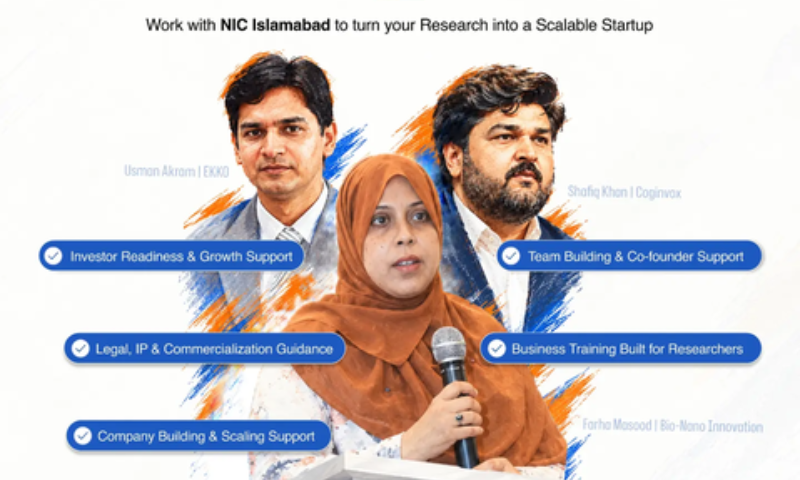
The National Incubation Center (NIC) Islamabad has invited academics and researchers to explore whether their work could become a $100 million company. The call targets people who have spent years studying problems, testing ideas and developing specialist knowledge. NIC Islamabad wants them to consider whether that work can solve real-world problems through products, services or new technology. “Can your research become a $100 million company?” the centre asked while promoting applications for Cohort 6. The figure signals ambition, not a guaranteed valuation. The programme focuses on converting promising research into scalable businesses with measurable impact. Research commercialisation takes knowledge beyond papers, conferences and laboratories. It connects an invention or finding with users, validates demand and builds a model that can attract customers and investment. Three Research-Led Ventures Show Commercial Potential NIC Islamabad highlighted three ventures that have already started this transition. Shafiq Khan’s Cognivox uses artificial intelligence to support responsible use of generative AI in education. The platform aims to help teachers and students improve learning without ignoring concerns around reliability and appropriate use. Farha Masood, PhD, leads work at Bio-Nano Innovation. Her venture is developing a nanomaterial-based patch designed to help wounds heal faster. Earlier official NIC material identified Masood as Bio-Nano Innovation’s commercialisation and technology lead. It said the team had advanced its NanoHeal concept from laboratory research to a working health technology prototype. Usman Akram’s EKKO focuses on children with speech delays. The AI-powered device aims to strengthen speech and cognitive skills while supporting parents and therapists. Pakistan’s Higher Education Commission has described EKKO as a portable, data-driven therapy solution. HEC said the NUST researcher designed it to help parents support children with speech-related difficulties. The three projects show the path from knowledge to application, then from application to product. A successful product can eventually become a company that creates impact at scale. Cohort 6 Offers Business, IP and Investor Support Researchers selected for Cohort 6 can access business training tailored to their needs. The programme also offers team-building assistance and support in finding co-founders. Participants will receive business mentorship, investor-readiness training and guidance for future growth. NIC Islamabad will also provide legal, intellectual property and commercialisation support. The programme extends into company building and scaling, areas that many academic teams have not previously navigated. Researchers do not need to abandon their academic careers to test the commercial potential of their work. NIC Islamabad operates within Pakistan’s wider National Incubation Center network. The Ministry of Information Technology and Telecommunication and Ignite National Technology Fund support the national initiative. A Founder Institute case study says the network combines public infrastructure with structured venture-building methods and access to mentors. NIC Islamabad said researchers with solutions to genuine problems should examine what their work could become outside the laboratory. “Your research could be the beginning of something much bigger,” the centre said.
Muslims in US Midterms Become Major Campaign Flashpoint
Muslims and Islam have become a prominent campaign issue ahead of the November 3 US midterm elections. Republican candidates say they are raising concerns about security, extremism and religion in public life. Critics accuse them of unfairly targeting Muslim Americans. Vice President JD Vance intensified the debate at a Michigan rally last week. He called Abdul El-Sayed, a Muslim Democrat running for the US Senate, “very, very evil.” Vance accused El-Sayed of defending terrorism after a March attack on a suburban Detroit synagogue. El-Sayed condemned the attack but said of the assailant that “hurt people hurt people.” He noted that an Israeli airstrike had recently killed some of the man’s relatives in Lebanon. El-Sayed later apologised and said people may have misconstrued his remarks. If elected, the American-born doctor would become the first Muslim US senator. Texas and Alabama Campaigns Target Sharia Concerns Texas Governor Greg Abbott has also focused on Islam while seeking another term in a close contest. He attacked a proposed Muslim-led development and requested an investigation into alleged efforts to establish “sharia courts.” The developers and civil rights organisations dispute that claim. Abbott campaign spokesman Eduardo Leal said the governor targeted alleged illegal conduct, not religious beliefs. Abbott also sought a federal investigation into Islamic ritual washing facilities at two Texas airports in August. Houston Mayor John Whitmire said the ablution and prayer rooms remained open to all travellers and employees, regardless of religion. Read More: Trump Secures Majority Control of Vast Venezuelan Oilfields In Alabama, Republican Senator Tommy Tuberville has taken a similar approach during his campaign for governor. He warned that “the enemy is inside the gates,” while referring to what he called radical Islam. Muslims represent less than 0.5% of Alabama’s population. Pew Research Center estimates that about 5.5 million Muslims live in the United States. That figure has risen from 2.4 million in 2007 and now represents roughly 1.6% of the population. Muslim Political Gains Draw National Attention Muslim Americans have reached several political milestones in recent years. New York City elected Zohran Mamdani as its first Muslim mayor last year. Virginia voters elected Ghazala Hashmi as lieutenant governor, making her the first Muslim woman to win statewide office in the country. The debate has also reached House campaigns. Texas Republican Representatives Keith Self and Chip Roy established the “Sharia Free America Caucus” in December 2025. Florida Republican Representative Randy Fine has introduced legislation that he says will “tackle the rise” of sharia law in America. Fine’s aides did not respond to Reuters requests for comment. Read More:Why Trump’s Approval Rating Has Dropped to Just 33% University of Rochester professor Aaron Hughes described the Republican focus as “fear-mongering.” He argued that it diverts attention from living costs, the Iran war and immigration. Republicans reject accusations that the campaign amounts to anti-Muslim politics. They frame their actions as efforts to protect constitutional law and national security. The November vote will decide whether Democrats can take control of Congress from President Donald Trump’s Republican Party.

Suicide Is the Third Leading Killer of Young People, WHO Warns
More than 720,000 people die by suicide every year, while many more attempt it, according to the World Health Organization. WHO’s latest estimates put the annual toll at about 727,000 deaths. For every suicide, the agency estimates there are about 20 attempts. The impact reaches far beyond the person who dies. Suicide affects families, communities and entire societies. Each loss is one too many. “Suicide is a public health issue, and together, we can prevent it,” the prevention message says. Young People and Poorer Countries Carry Heavy Burden Suicide ranked as the third leading cause of death among people aged 15 to 29 worldwide in 2021. It ranked second among young women and third among young men in that age group. Low- and middle-income countries recorded 73% of global suicides, WHO data shows. That concentration places much of the burden on health systems that often have limited mental health staff and services. More than half of all suicide deaths, or 56%, occurred before age 50. A previous attempt remains an important risk factor, making follow-up care especially important. The causes are complex and differ across people and settings. WHO links risk to social, cultural, biological, psychological and environmental factors across the course of life. Read More: Google Tightens Gemini Safeguards After Suicide Lawsuit Sparks Global Alarm Depression and alcohol use disorders have established links with suicide. However, many suicides happen impulsively during moments of crisis. Financial trouble, relationship disputes, chronic pain, illness and bereavement can overwhelm a person’s ability to cope. Conflict, disaster, violence, abuse, discrimination and isolation can also increase risk. WHO says timely, evidence-based and often low-cost interventions can prevent suicide. Its LIVE LIFE approach calls for restricting access to lethal means and promoting responsible media coverage. The framework also urges countries to build emotional and social skills among adolescents. Health services should identify, assess, manage and follow up people affected by suicidal behaviour early. What to Do When Someone May Be at Risk People who worry that someone may be suicidal should start a calm, direct conversation about how that person feels. Listening without judgment can open a path to support. They should encourage the person to seek help from a mental health professional, counsellor, doctor or crisis service. Regular check-ins matter, particularly after a recent crisis or suicide attempt. If the person faces immediate danger, contact local emergency services at once and do not leave them alone. Reduce access to anything they could use for self-harm, if this can be done safely. Read More: New AI-Powered Sarco ‘Suicide’ Pod Designed for Couples to Die Together Stigma and taboo still stop many people from seeking care. WHO says only 38 countries report having a national suicide prevention strategy. The agency argues that health care alone cannot solve the problem. Education, labour, agriculture, justice, business, politics and media all have roles in a coordinated national response. Anyone struggling now should contact local emergency services or a crisis hotline, or reach out to a trusted person and health professional.

Government Puts Private Sector in Charge of Pakistan’s Economy
Pakistan has renewed its drive to mobilise private capital through public-private partnerships and privatisation as fiscal constraints limit the government’s ability to fund infrastructure. The government outlined its strategy at the National Strategic Dialogue on PPPs and Privatisation in Islamabad. Officials also launched the Pakistan PPP Monitor to give investors clearer information about completed and proposed projects. Finance Minister Senator Muhammad Aurangzeb, Privatisation Adviser Muhammad Ali and Asian Development Bank Vice President Yingming Yang attended the event. Senior federal and provincial officials, financial institutions, development partners and private investors also participated. Private Sector to Lead Growth Aurangzeb said the government wants to create conditions that encourage business activity and private investment. “The private sector must lead Pakistan’s next phase of growth. PPPs and privatisation can help bring in investment, improve efficiency and create greater space for private sector participation. Our focus is on building a strong pipeline of investable opportunities and turning these opportunities into real investment and growth,” the finance minister said. Muhammad Ali said public spending alone cannot meet Pakistan’s future development and infrastructure needs. The private sector must assume a larger role in financing, constructing and managing economic assets, he added. He described PPPs and privatisation as complementary tools. PPPs can introduce private capital and expertise into infrastructure and public services. Privatisation can improve ownership, management, investment and service delivery in commercial enterprises. PPP Projects Attract Nearly $36 Billion The Pakistan PPP Monitor shows that 154 projects have reached financial close since the 1990s. These projects represent investment of nearly $36 billion. Pakistan’s current federal PPP pipeline contains 38 projects worth about $6.5 billion. The projects cover roads, railways, aviation, healthcare and industrial infrastructure. The monitor consolidates information on Pakistan’s PPP record, investment activity and upcoming opportunities. The government expects it to improve transparency and help investors assess the market. ADB’s Yang said: “Mobilizing private capital and expertise is essential. Well-structured PPPs can complement constrained public resources, bring private sector efficiency, support lifecycle maintenance, and improve services for citizens.” Pakistan’s federal PPP framework operates under the Public Private Partnership Authority Act, 2017, which Parliament amended in 2021. Provincial governments also maintain their own PPP laws and institutions. Government Advances 27 Privatisation Transactions The government is pursuing a 27-transaction privatisation programme involving power distribution companies, major airports, insurance companies and specialised banks. Officials cited the privatisation of Pakistan International Airlines with management control as evidence of progress. The government transferred PIACL’s management control to the investor consortium after completing the first financial closing in June 2026. Authorities also continue work on power distribution companies and airport concessions. “We have already started to give the reins of economic growth to the private sector. We need to continue on this path, complete our privatisation agenda, significantly expand our PPP pipeline, and start completing projects to demonstrate that the Government means business,” Muhammad Ali said. Privatisation Commission Secretary Usman Bajwa pledged to maintain momentum through better coordination, transparency and a predictable interface for investors. The participation of provincial PPP institutions also highlighted the need for federal-provincial cooperation. The government said its immediate priority involves converting the growing project pipeline into completed, investment-backed transactions.

Askari Bank Becomes First to Connect Directly With SECP Registry
The Securities and Exchange Commission of Pakistan and Askari Bank Limited have completed an API integration to accelerate corporate bank account opening for newly incorporated companies. The system will allow eligible businesses to open accounts with fewer documentation requirements. It will also help them begin commercial operations sooner after completing their incorporation. The initiative connects Askari Bank directly with SECP’s corporate registry. It forms part of the regulator’s wider digitalisation programme and its reforms linked to the World Bank’s Business Ready framework. Askari Bank Becomes First Commercial Bank to Integrate Askari Bank has become the first commercial bank to connect its system with the SECP corporate registry under the initiative. SECP Commissioner Muzaffar Mirza and Askari Bank Group Head Retail Banking Shaikh Rashid Rauf signed the integration agreement. Participants at the ceremony included SECP Chairman Dr Kabir Ahmed Sidhu and Commissioner Zeeshan Khattak. SECP Executive Director Mubashir Saddozai and Registrar of Companies Arsalan Zafar also attended. Read More: SECP and VEON Expand Pakistan Digital Financial Services Askari Bank President and CEO Zia Ijaz joined the ceremony alongside Group Executive Operations Aslam Sadaruddin and other officials. The collaboration creates a digital connection between the bank’s onboarding system and the regulator’s authenticated company records. This connection should reduce reliance on documents submitted separately by customers. API Access to Cut Repeated Documentation Through the API, Askari Bank can securely obtain verified corporate information directly from the SECP registry. The integration will reduce manual verification, repeated document submissions and customer onboarding time. It will also limit delays that companies often face between incorporation and the start of banking operations. New companies require operational accounts to receive investment, pay employees, process supplier transactions and begin regular commercial activity. Faster account opening can therefore shorten the period between legal registration and the launch of a business. “This integration is part of SECP’s ongoing digitalization and B-READY reforms aimed at simplifying business processes, improving access to reliable corporate information and making it easier to establish and operate businesses in Pakistan,” Dr. Kabir Ahmed Sidhu said. SECP already offers an end-to-end digital company incorporation process through its eZfile system. The regulator describes the online process as four user-friendly steps covering name reservation and incorporation. SECP Plans Integration With More Banks SECP plans to extend similar digital integrations to other banks and financial institutions. Wider adoption could establish a common system for banks to verify corporate customers against official records. The regulator registered 10,511 new companies between February and April 2026. That marked a 21% increase from 8,693 incorporations during the same period a year earlier. Read More: SECP Clears Alibaba-Backed Firm to Launch Credit Service in Pakistan The rising number of registrations increases demand for faster post-incorporation services, particularly corporate banking. The World Bank’s Business Ready programme evaluates business conditions across areas including business entry, financial services, taxation and operational efficiency. It also examines how regulatory rules and public services work together in practice. Direct access to authenticated registry information could improve both regulatory compliance and customer experience. However, participating institutions will still need to maintain security, privacy and banking due diligence requirements while using shared corporate data.

Pakistan Eyes $44 Billion Remittance Record After Strong August
Overseas Pakistanis sent $3.7 billion in workers’ remittances during August 2026, providing fresh support to the country’s external account and foreign exchange reserves. The State Bank of Pakistan reported that inflows increased by 16.5% compared with August last year. Remittances also edged up by 0.7% from the previous month. The monthly increase kept Pakistan on a strong trajectory at the beginning of fiscal year 2026-27. Remittances remain a key source of foreign currency for the country and help finance imports and external payments. Two-Month Remittances Reach $7.3 Billion Pakistan received $7.3 billion in remittances during July and August of FY27, the central bank said. This marked growth of 14.7% from the same period last year. Overseas workers had sent $6.4 billion during the first two months of FY26. The latest figures therefore show an increase of about $900 million within one year. Read More: Pakistan Nears $41 Billion Remittance Milestone After Historic May Sustained growth through formal banking channels can help improve dollar liquidity and reduce pressure on Pakistan’s balance of payments. It also supports household spending in regions that depend heavily on income from family members working abroad. The August figure followed remittances of roughly $3.6 billion in July. The latest month-on-month increase suggests that inflows maintained their momentum despite economic uncertainty in several host countries. Saudi Arabia Remains Largest Source Saudi Arabia remained Pakistan’s biggest remittance corridor in August. Pakistani workers based there sent $873.5 million during the month. The United Arab Emirates ranked second with inflows of $749.8 million. Pakistan received another $563.7 million from the United Kingdom and $308.9 million from the United States. Together, these four corridors contributed almost $2.5 billion, representing roughly two-thirds of total remittances recorded during August. The figures also underline Pakistan’s reliance on Gulf labour markets. Saudi Arabia and the UAE alone contributed more than $1.6 billion during the month. Economic conditions, employment policies and geopolitical tensions in the Gulf can therefore influence Pakistan’s remittance outlook. However, the latest data show that inflows have remained resilient so far. Pakistan Targets $44 Billion in FY27 Pakistan received more than $41 billion in workers’ remittances during FY26, according to the central bank. The SBP expects the figure to reach $44 billion in FY27. Speaking in August, SBP Governor Jameel Ahmad said that “overseas Pakistanis have expressed their confidence in the country’s economic progress through record remittances.” Read More: Exchange Companies’ Dollar Sales Jump 30% as Inflows Surge The central bank expects higher remittances and a low current account deficit to strengthen Pakistan’s reserve position. SBP-held foreign exchange reserves reached $18.4 billion at the end of FY26. The central bank expects its reserves to exceed $21 billion during FY27. Continued remittance growth will remain crucial to achieving that projection and limiting Pakistan’s dependence on external borrowing. The 14.7% increase during the first two months means Pakistan has already received nearly one-sixth of its $44 billion annual projection. Maintaining the current pace would keep the country close to that target.
Exchange Companies’ Dollar Sales Jump 30% as Inflows Surge
Dollar sales by Pakistan’s exchange companies to commercial banks rose 30% year-on-year in August, reflecting stronger foreign currency inflows through formal channels. Data from the Exchange Companies Association of Pakistan showed that exchange firms sold $248.7 million to banks during the month. They had supplied $174.9 million in August last year. The higher sales provide additional liquidity to the interbank market and support Pakistan’s foreign exchange position. The State Bank of Pakistan reported total liquid reserves of $22.53 billion as of August 28. Its own reserves stood at $17.12 billion. Dollar Sales Recover After July Decline The August performance followed a year-on-year decline in July. Exchange companies supplied $230.7 million to banks that month, compared with $290.6 million in July 2025. Despite that decline, total sales during the first two months of FY27 reached $479.5 million. The figure stood at $465.5 million in the same period of FY26. Read More: SECP and VEON Expand Pakistan Digital Financial Services The figures suggest that improved August inflows offset July’s weaker performance. Exchange companies channel surplus foreign currency collected from customers into the banking system. Such sales remain important for Pakistan, which needs dollars for imports, external debt payments and other international obligations. Rising global oil prices have increased that pressure because Pakistan relies heavily on imported energy. Kashmir Disruption Cost $50 Million ECAP Chairman Malik Bostan said political disturbances and internet restrictions in Kashmir disrupted foreign currency inflows during July and August. “There could have been $50m more inflows during July-Aug this year had the Kashmir situation not been disrupted by political conflicts,” said Malik Bostan. He said conditions had started returning to normal, leading to an increase in inflows. ECAP has officially asked the State Bank to support the restoration of internet services across Kashmir. Authorities have already restored partial internet access. However, exchange companies want full connectivity because digital verification and banking services depend on reliable internet access. Gulf Conflict Creates Remittance Risks Pakistan’s remittance inflows have so far avoided a major impact from the Gulf war. However, reports about Pakistani workers returning from Gulf countries have unsettled the currency market. The government has also taken notice of the situation. Market participants fear a prolonged conflict could weaken employment conditions for expatriates and eventually affect remittances. A currency expert said the conflict had changed economic conditions across the Middle East. Gulf economies face growing pressure because regional instability has disrupted oil trade and commercial activity. Read More: From Zero to Dollars: Freelancing Guide for Pakistanis The expert said the UAE, previously the region’s most dynamic economy, was trying to avoid expatriate expulsions that could damage Dubai’s economic outlook. Pakistan received about $41.5 billion in workers’ remittances during FY26. SBP Governor Jameel Ahmad expects the total to reach a record $44 billion in FY27. The target highlights the importance of overseas Pakistanis to the country’s external account. Any prolonged disruption in Gulf labour markets could threaten that outlook, while continued formal inflows would support reserves and exchange-rate stability.
FBR to Start Deducting 5% Tax From Social Media Revenue
The Federal Board of Revenue (FBR) will ensure a 5% withholding tax deduction from revenues that digital content creators and social media influencers receive through banking channels. The measure took effect on July 1, 2026, and applies to income received from social media platforms. Banks and non-banking financial institutions must deduct the tax when they credit or receive a qualifying payment in a person’s account. An income tax circular issued by the FBR on Tuesday explained the measure, which forms part of the changes introduced through the Finance Act, 2026. Banks Responsible for Tax Deduction The Finance Act inserted Section 154B into the Income Tax Ordinance, 2001. It requires every banking and non-banking financial institution to deduct tax when processing revenue received from social media platforms. Division IIIAB of Part III of the First Schedule sets the withholding tax rate at 5%. Read More: FBR Makes Sales Tax Registration Easier for Businesses The law defines a “digital content creator” or “social media influencer” as an individual or entity earning income from creating, publishing or monetising content on digital platforms. The definition specifically covers YouTube, Facebook, Instagram and TikTok. Its wording also allows the FBR to bring similar platforms within the tax regime. The provision has broad implications for Pakistani YouTubers, vloggers, streamers, publishers and other online creators who receive platform-generated revenue through local accounts. Remittances and Digital Payments Covered Section 154B also defines the type of “payment” subject to the deduction. It includes inward remittances, transfers and credits received through banking channels. Payments routed through intermediaries are also covered. These may include online payment service providers and digital financial platforms used to transfer creators’ overseas earnings into Pakistan. Under the mechanism, the financial institution processes the deduction when the money reaches the recipient’s account. Creators will therefore receive the remaining amount after the institution withholds the applicable tax. The provision focuses on revenue that can be identified as coming from social media platforms. The FBR may issue further rules through an official Gazette notification to govern identification, reporting and implementation. The official FBR withholding tax rate card also lists a 5% rate under Section 154B for revenues received by digital content creators and social media influencers. Different Treatment for Residents and Non-Residents The legal status of the deduction depends on whether the recipient is a resident or non-resident taxpayer. For a resident person, the amount deducted constitutes minimum tax. This means the 5% deduction establishes the minimum tax treatment for income covered by the provision. Read More: New FBR Rule Hits Digital Creators With 5% to 10% Tax For a non-resident person without a permanent establishment in Pakistan, the deduction constitutes final tax. Such a recipient generally faces no further Pakistani tax liability on that particular income after the deduction. A consequential amendment to Section 169 supports this final-tax treatment for qualifying non-residents. The separate 5% regime distinguishes social media platform revenue from certain IT and IT-enabled service exports. The Finance Act, 2026 extended the reduced 0.25% rate for eligible Pakistan Software Export Board-registered exporters through tax year 2029.
