The National Incubation Center (NIC) Islamabad has invited academics and researchers to explore whether their work could become a $100 million company.
The call targets people who have spent years studying problems, testing ideas and developing specialist knowledge. NIC Islamabad wants them to consider whether that work can solve real-world problems through products, services or new technology.
“Can your research become a $100 million company?” the centre asked while promoting applications for Cohort 6.
The figure signals ambition, not a guaranteed valuation. The programme focuses on converting promising research into scalable businesses with measurable impact.
Research commercialisation takes knowledge beyond papers, conferences and laboratories. It connects an invention or finding with users, validates demand and builds a model that can attract customers and investment.
Three Research-Led Ventures Show Commercial Potential
NIC Islamabad highlighted three ventures that have already started this transition.
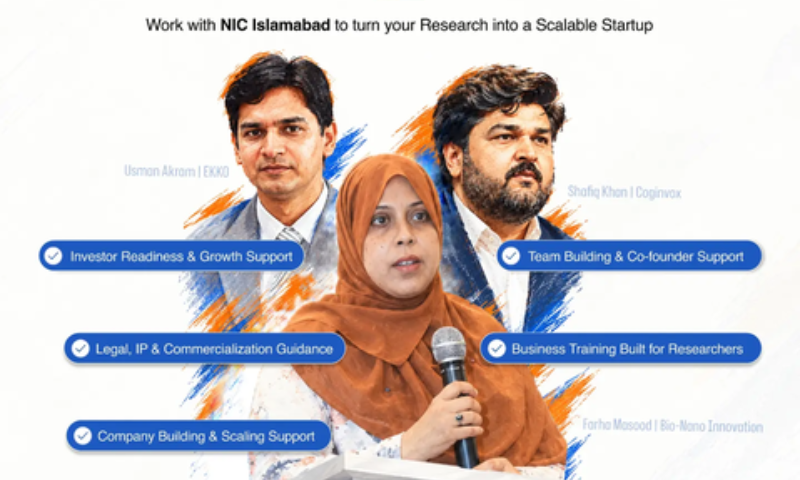
Shafiq Khan’s Cognivox uses artificial intelligence to support responsible use of generative AI in education. The platform aims to help teachers and students improve learning without ignoring concerns around reliability and appropriate use.
Farha Masood, PhD, leads work at Bio-Nano Innovation. Her venture is developing a nanomaterial-based patch designed to help wounds heal faster.
Earlier official NIC material identified Masood as Bio-Nano Innovation’s commercialisation and technology lead. It said the team had advanced its NanoHeal concept from laboratory research to a working health technology prototype.
Usman Akram’s EKKO focuses on children with speech delays. The AI-powered device aims to strengthen speech and cognitive skills while supporting parents and therapists.
Pakistan’s Higher Education Commission has described EKKO as a portable, data-driven therapy solution. HEC said the NUST researcher designed it to help parents support children with speech-related difficulties.
The three projects show the path from knowledge to application, then from application to product. A successful product can eventually become a company that creates impact at scale.
Cohort 6 Offers Business, IP and Investor Support
Researchers selected for Cohort 6 can access business training tailored to their needs. The programme also offers team-building assistance and support in finding co-founders.
Participants will receive business mentorship, investor-readiness training and guidance for future growth. NIC Islamabad will also provide legal, intellectual property and commercialisation support.
The programme extends into company building and scaling, areas that many academic teams have not previously navigated. Researchers do not need to abandon their academic careers to test the commercial potential of their work.
NIC Islamabad operates within Pakistan’s wider National Incubation Center network. The Ministry of Information Technology and Telecommunication and Ignite National Technology Fund support the national initiative.
A Founder Institute case study says the network combines public infrastructure with structured venture-building methods and access to mentors.
NIC Islamabad said researchers with solutions to genuine problems should examine what their work could become outside the laboratory.
“Your research could be the beginning of something much bigger,” the centre said.