
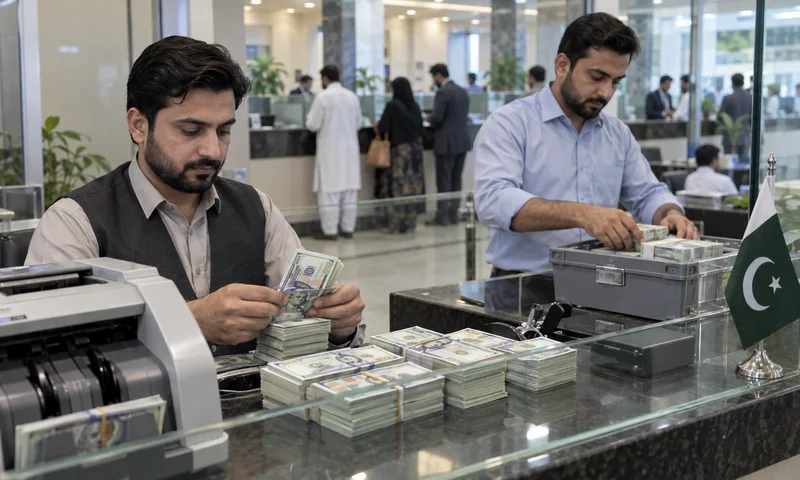
Dollar sales by Pakistan’s exchange companies to commercial banks rose 30% year-on-year in August, reflecting stronger foreign currency inflows through formal channels.
Data from the Exchange Companies Association of Pakistan showed that exchange firms sold $248.7 million to banks during the month. They had supplied $174.9 million in August last year.
The higher sales provide additional liquidity to the interbank market and support Pakistan’s foreign exchange position. The State Bank of Pakistan reported total liquid reserves of $22.53 billion as of August 28. Its own reserves stood at $17.12 billion.
Dollar Sales Recover After July Decline
The August performance followed a year-on-year decline in July. Exchange companies supplied $230.7 million to banks that month, compared with $290.6 million in July 2025.
Despite that decline, total sales during the first two months of FY27 reached $479.5 million. The figure stood at $465.5 million in the same period of FY26.
Read More: SECP and VEON Expand Pakistan Digital Financial Services
The figures suggest that improved August inflows offset July’s weaker performance. Exchange companies channel surplus foreign currency collected from customers into the banking system.
Such sales remain important for Pakistan, which needs dollars for imports, external debt payments and other international obligations. Rising global oil prices have increased that pressure because Pakistan relies heavily on imported energy.
Kashmir Disruption Cost $50 Million
ECAP Chairman Malik Bostan said political disturbances and internet restrictions in Kashmir disrupted foreign currency inflows during July and August.
“There could have been $50m more inflows during July-Aug this year had the Kashmir situation not been disrupted by political conflicts,” said Malik Bostan.
He said conditions had started returning to normal, leading to an increase in inflows. ECAP has officially asked the State Bank to support the restoration of internet services across Kashmir.
Authorities have already restored partial internet access. However, exchange companies want full connectivity because digital verification and banking services depend on reliable internet access.
Gulf Conflict Creates Remittance Risks
Pakistan’s remittance inflows have so far avoided a major impact from the Gulf war. However, reports about Pakistani workers returning from Gulf countries have unsettled the currency market.
The government has also taken notice of the situation. Market participants fear a prolonged conflict could weaken employment conditions for expatriates and eventually affect remittances.
A currency expert said the conflict had changed economic conditions across the Middle East. Gulf economies face growing pressure because regional instability has disrupted oil trade and commercial activity.
Read More: From Zero to Dollars: Freelancing Guide for Pakistanis
The expert said the UAE, previously the region’s most dynamic economy, was trying to avoid expatriate expulsions that could damage Dubai’s economic outlook.
Pakistan received about $41.5 billion in workers’ remittances during FY26. SBP Governor Jameel Ahmad expects the total to reach a record $44 billion in FY27.
The target highlights the importance of overseas Pakistanis to the country’s external account. Any prolonged disruption in Gulf labour markets could threaten that outlook, while continued formal inflows would support reserves and exchange-rate stability.