

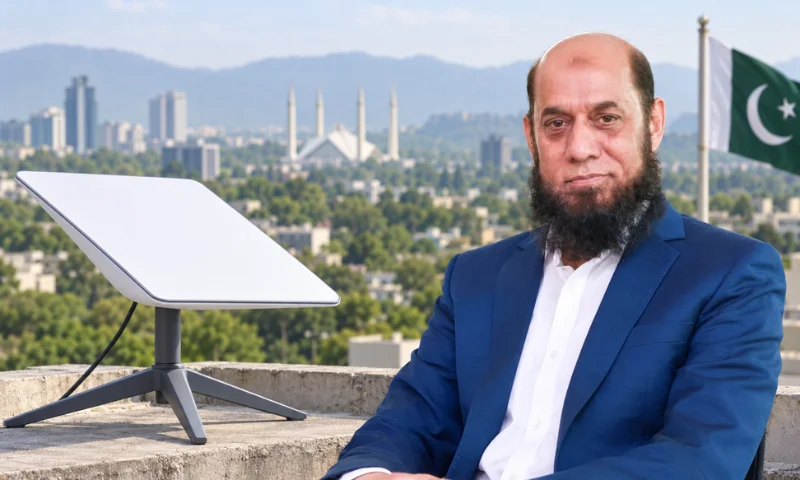
Starlink’s Pakistan launch depends on completing four regulatory steps, including approvals from corporate, space and security authorities before final telecom processing. Pakistan Telecommunication Authority Chairman Major General (retd) Hafeez Ur Rehman outlined the requirements during a Senate committee meeting on Monday. He told the Senate Standing Committee on IT and Telecom that four to five satellite internet companies wanted to offer services in Pakistan. However, authorities must complete the regulatory framework before operators can receive licences. The briefing addressed continued delays in launching Starlink and other satellite internet services. Rehman also disclosed that Starlink first approached the PTA for a licence in February 2022. The four steps before launch According to the PTA chairman, a satellite internet company must first obtain approval from the Securities and Exchange Commission of Pakistan. It must then secure a licence from the Pakistan Space Regulatory Board, formally called the Pakistan Space Activities Regulatory Board. Approval from the Ministry of Interior forms the third requirement. Once a company completes these stages, its case moves to the PTA for further processing. Read More:Elon Musk Backs Venezuelans as Starlink Offers Free Internet After Maduro’s Removal The sequence places PTA processing at the end of a broader approval chain involving several government bodies. Rehman said no satellite internet case currently awaited action before the authority. He explained that the space regulator was still developing the framework governing these services. His remarks indicated that completing this framework remains essential before satellite internet companies can secure operating licences. The supplied account of the meeting did not include a firm launch date. Earlier permission did not complete the process Starlink’s efforts to enter Pakistan have already passed an initial regulatory milestone. In March 2025, Pakistan granted the SpaceX satellite internet company temporary registration. The report said the company was seeking a full operating licence. The Ministry of IT and Telecom also announced a provisional no-objection certificate from the space regulator. That announcement represented progress towards market entry, rather than confirmation that customers could begin using an authorised commercial service. Monday’s briefing shows why earlier permission and a commercial launch remain separate milestones. Companies still need to satisfy the approval process outlined by the PTA chairman. Why the launch matters Starlink uses satellites in low Earth orbit to deliver broadband internet. The company says its network supports activities including streaming and online communication. Satellite broadband could provide another connectivity option for communities and businesses in areas with limited conventional internet infrastructure. Read More: Why Is Satellite Internet Still Not Available in Pakistan? However, the committee briefing offered no details on Pakistan-specific subscription prices, equipment costs or initial coverage plans. For prospective customers, the immediate development concerns regulatory progress. Starlink’s February 2022 approach to the PTA began the process, but the chairman’s latest account leaves commercial operations dependent on further approvals.
SBP Interest Rate Held at 11.5% as Inflation Rises
The State Bank of Pakistan kept its interest rate unchanged at 11.5% on Monday as Middle East tensions threatened further inflation. Seven of the Monetary Policy Committee’s ten members backed the September 14 decision. Escalating conflict has raised commodity prices and prolonged supply disruptions. “However, recent domestic macroeconomic data turned out broadly in line with the MPC’s expectations,” the statement said. Headline inflation climbed to 11.1% in August from 9.2% in July, while “core inflation was slightly lower than expectations”. Read More: HugoBank Gets SBP Approval to Begin Pilot Operations “External account pressures remained contained, supported by robust workers’ remittances and higher financial inflows.” Economic activity strengthened “as reflected by recent high-frequency indicators”. The committee considered the rate “appropriate to guide inflation towards target range of 5-7pc over the medium term”. “However, uncertainty regarding the outlook has increased, particularly from the worsening geopolitical environment.” Reserves rise as confidence weakens Moody’s upgraded Pakistan’s sovereign credit rating to B3 with a stable outlook. Pakistan also tapped international markets to “raise $3bn through Eurobonds,” lifting foreign reserves above $21 billion. “Third, inflation expectations of both businesses and consumers increased in September, while their confidence weakened,” the statement read. Large-scale manufacturing output fell 3.5% in June, bringing “cumulative FY26 growth to 5pc”. “Fifth, fiscal consolidation turned out higher than the budgetary target during FY26,” the committee said. Federal Board of Revenue collections remained “on-target” during July and August of FY27. “While SBP transferred higher profit of Rs1.9 trillion than the budgeted amount of Rs1.4tr to the government. “Lastly, central banks have become more cautious amidst challenging global economic conditions.” Reuters separately reported that economists expected the Bank of England to hold rates despite rising oil prices, reflecting wider policy caution. Oil pressures cloud the outlook Renewed US-Iran hostilities and risks to shipping through the Strait of Hormuz have increased energy-dependent Pakistan’s exposure to higher import costs. Weekly inflation, measured through the Sensitive Price Index, rose 8.62% year-on-year in the week ending September 10. Costlier onions and petroleum products contributed significantly. Read More: SBP Introduces Rs.1 Per Litre Incentive for Digital Fuel Payments The MPC reaffirmed its commitment to “achieving price stability with close monitoring of incoming data and the ongoing situation in the Middle East”. More frequent geopolitical shocks and weather disruptions threaten the outlook. The committee urged a “prudent monetary and fiscal policy mix and further buildup of buffers to absorb supply shocks”. Bankers had expected unchanged rates, although some analysts anticipated a 50-basis-point increase. The SBP has held rates steady since April’s 100-basis-point rise, its first increase in nearly three years. Higher global energy prices and supply-chain risks prompted that move. Previously, it held the rate at 10.5% in January and March following December 2025’s surprise 50-basis-point cut. The current rate stands 1,050 basis points below June 2023’s record 22%. The easing cycle began in mid-2024 as inflation retreated from multi-decade highs.
Scan and pay: NBP makes passport fee payments easier
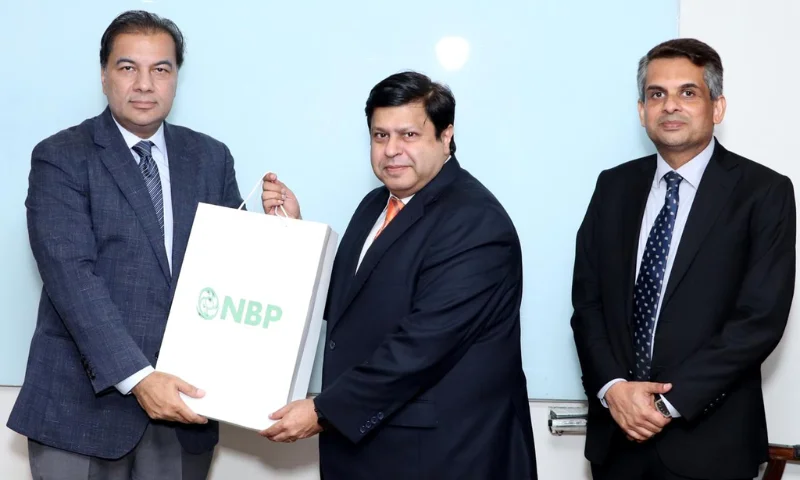
National Bank of Pakistan has enabled digital passport fee payments through Raast Person-to-Merchant QR codes, allowing citizens to pay using participating banks’ mobile applications. The initiative supports the government’s Cashless Pakistan agenda, which aims to expand digital transactions and digitise government payments and receipts. NBP described the service as another step in its digital transformation programme. The payment facility gives passport applicants a digital channel for settling fees through their banking apps. Its availability depends on participation by the customer’s bank. Passport officials review implementation Director General Immigration and Passports Ch. Muhammad Ali Randhawa visited NBP’s head office in Karachi with his team to review implementation. He met Abdul Wahid Sethi, senior executive vice president and group chief/CFO of the Financial Control Group. Faisal Topra, senior executive vice president and group chief of the Operations Group, also attended. Other participants included Adnan Nasir, chief digital officer and group chief of the Digital Banking Group. Senior officials from NBP’s Digital Banking and Operations teams joined the discussions. The meeting reviewed the performance of the Raast-based passport fee collection service and explored opportunities for further collaboration. Officials also discussed a Payment Slip ID, or PSID-based, alternative payment mechanism. They considered the option to improve convenience and maintain continuity of passport fee collections. The statement described that alternative as a subject of discussion, without announcing its launch or implementation timetable. NBP backs cashless public services Sethi said the bank viewed technology as a way to improve access to public services. “At NBP, we see digital transformation as an important enabler of more accessible, efficient and customer-centric public services. We are pleased to support the Government of Pakistan’s digital payments and cashless economy agenda and remain committed to leveraging technology to make financial services simpler and more accessible for citizens.” Randhawa appreciated NBP’s efforts and cooperation in advancing digital transformation and improving public service delivery. The engagement brought together the bank’s financial control, operations and digital banking leadership to assess the payment arrangement. How Raast fits into passport payments The State Bank of Pakistan describes Raast as the country’s instant payment system for individuals, businesses and government entities. Its P2M framework supports QR codes, Raast aliases, IBANs and Request to Pay transactions. SBP’s launch instructions require participating institutions to provide immediate transaction confirmation or rejection notifications. Those instructions also prohibit charging customers a fee for making Raast P2M payments. This concerns the payment transaction charge, rather than the passport fee itself. Separately, the Directorate General of Immigration and Passports already offers the Passport Fee Asaan application. Its official listing allows users to calculate fees, generate PSIDs, check payment status and lodge payment complaints. The existing app provides context for the PSID alternative discussed at NBP. The bank’s statement did not explain how the proposed mechanism would connect with that service.

Arif Habib’s identity misused to seek funds, company tells NCCIA
Arif Habib Corporation Limited (AHCL) has approached Pakistan’s cybercrime agency over alleged investment scams using Arif Habib’s identity. The company says fake accounts, telephone calls and AI-generated videos are targeting investors and members of the public. In a September 14 public notice, AHCL said it lodged a formal complaint with the National Cyber Crime Investigation Agency on September 4. It sought case registration, an investigation and the removal or blocking of fraudulent content. The company said it was also pursuing available legal remedies against those responsible. Fake accounts and calls target investors AHCL alleged that unidentified individuals had created fraudulent accounts and pages on TikTok, Facebook and other online platforms. It said the material misused the name, photograph, voice and likeness of Arif Habib. He chairs Arif Habib Group and serves as AHCL’s chief executive officer. According to the company, those behind the content used AI-generated or deepfake videos to solicit money for unauthorised investment schemes. The alleged activity extended beyond social media. AHCL said fraudulent callers also contacted group clients and members of the public. Read More: PIA Enters a New Era as Arif Habib Consortium Takes Control The company denied any connection with the solicitations. It said neither Arif Habib, AHCL nor another group entity had launched, endorsed or sponsored the schemes. That denial covered the associated platforms, accounts, pages and telephone approaches. The announcement did not confirm whether NCCIA had registered a case or begun an investigation. It also did not identify suspects or disclose any financial losses. Earlier warning rejected Rs500,000 weekly earnings claim AHCL described the latest incidents as part of a broader pattern involving misuse of Arif Habib’s name. It referred to a July 31 warning from its listed subsidiary, Arif Habib Limited (AHL). That notice addressed a fabricated news article circulating online and on social media. The article falsely claimed Arif Habib had launched an AI investment platform guaranteeing earnings of up to Rs500,000 a week. AHL rejected the claim and denied any affiliation with the publication or platforms promoting it. The company filed that warning with the Pakistan Stock Exchange. AHCL said it had also published a caution notice on its official website before approaching NCCIA. Company directs public to official channels AHCL urged investors and the public not to engage with unauthorised online content or act on suspicious telephone solicitations. It identified AHL as the group’s only authorised entity for investment-related information and services. Official announcements come through the respective companies’ websites and the Pakistan Stock Exchange, it said. Read More: No Layoffs, Safety First: Arif Habib Outlines PIA’s One-Year Turnaround Plan The complaint reflects a wider impersonation problem facing investors internationally. The North American Securities Administrators Association warns that deepfake scams recreate prominent individuals’ faces and voices to promote supposed investment opportunities. Its advisory notes that convincing videos can make fraudulent endorsements difficult to recognise.
Pakistan eyes Hong Kong expertise to boost three key services sectors
Pakistan and Hong Kong have explored stronger business ties in finance, aviation and digital technology. Commerce Minister Jam Kamal Khan urged regular corporate exchanges to turn commercial opportunities into partnerships. Khan met the chairman and leading business representatives of the Hong Kong General Chamber of Commerce during his September 13 visit. Their discussions covered trade, investment, services and closer engagement between the two business communities. The minister also met Pakistani entrepreneurs and diaspora members at the Pakistan Club. He encouraged them to promote Pakistan’s economic potential through their professional and commercial networks. Business exchanges and chamber partnerships During the chamber meeting, both sides examined ways to increase direct contact between businesses. Khan called for regular interaction among leading companies and more frequent exchanges of trade delegations. He said such engagement could help businesses identify new commercial opportunities and develop stronger relationships. The discussion also covered institutional cooperation between the Hong Kong chamber and three major Pakistani trade bodies. These included the Federation of Pakistan Chambers of Commerce and Industry, Karachi Chamber of Commerce and Industry, and Lahore Chamber of Commerce and Industry. Read More: BYD Shares Slide Despite a Surprising Profit Recovery The proposed links would give the outreach both a national platform and connections with businesses in Karachi and Lahore. Both sides also discussed the Belt and Road Initiative’s potential to improve connectivity, mutual cooperation and transit routes. The meeting explored these possibilities without announcing a specific infrastructure project or investment commitment. Services expertise offers scope for cooperation Khan said Pakistan could benefit from Hong Kong’s experience in services, particularly finance, aviation and digital technology. The focus reflects the structure of Hong Kong’s economy. Services accounted for 93.6% of its gross domestic product in 2024, according to the Hong Kong Trade Development Council. That provides context for Pakistan’s interest in commercial cooperation extending beyond the exchange of goods. Hong Kong also maintains a business platform dedicated to Belt and Road opportunities. HKTDC’s portal connects users with investment projects, service providers, expert advice and financing information. These resources offer a practical reference point for businesses exploring the initiative. The visit’s reported outcomes centred on identifying opportunities and encouraging follow-up engagement. The account did not specify financial commitments or a timetable for formal chamber partnerships. Diaspora urged to attract investment At the Pakistan Club dinner, Khan highlighted opportunities in Hong Kong for Pakistani entrepreneurs and professionals. He urged community members to use their business networks to attract investment, build commercial partnerships and improve awareness of Pakistan’s economic potential. Read More: US imposes new tariffs on 60 trade partners, including Pakistan The minister said the government remained committed to facilitating overseas Pakistanis. He also emphasised their role in strengthening trade, investment and wider economic cooperation between Pakistan and Hong Kong. His appeal placed diaspora contacts alongside formal business delegations and chamber cooperation as channels for developing closer commercial ties.
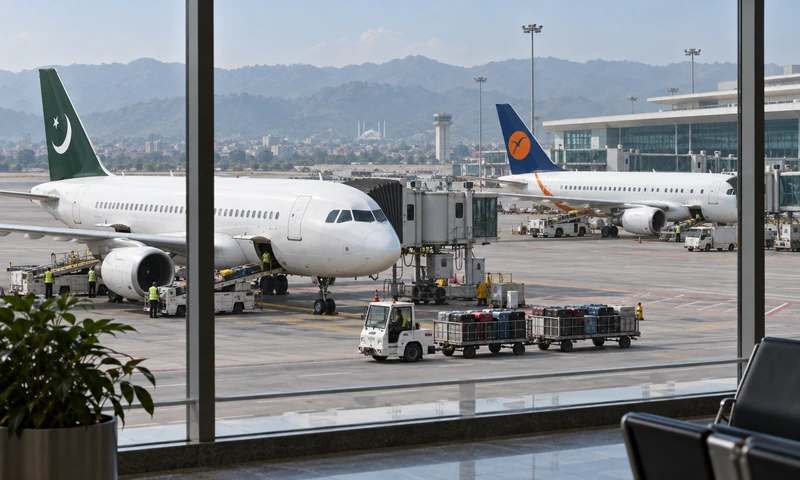
Islamabad becomes transit link under PIA-Kam Air agreement
Pakistan International Airlines and Afghanistan’s Kam Air have signed an interline agreement to simplify travel between Afghanistan and the Middle East. The first phase connects Kabul with Dammam in Saudi Arabia through Islamabad. The arrangement allows passengers to book their complete journey under one reservation. It also provides baggage transfers between the airlines and airside transit at Islamabad International Airport. PIA spokesman Abdullah Hafeez Khan said the cooperation would link Kam Air’s Afghanistan operations with PIA’s Middle Eastern services. Afghan travellers and workers heading to eastern Saudi Arabia form part of the initial route’s intended market. One booking and direct baggage transfers Under the PIA-Kam Air agreement, passengers can arrange both flight sectors through a unified reservation. They will no longer need separate tickets for each leg of the participating itinerary. Kam Air will carry passengers from Kabul to Islamabad, where they will connect with a PIA flight to Dammam. The airlines will also coordinate checked baggage handling. Staff at Islamabad airport will transfer luggage checked in at Kabul directly to the connecting PIA service. Read More: PIA Adds Three More London Flights as Travel Demand Grows Passengers will therefore avoid collecting their bags and checking them in again during the stopover. The arrangement combines booking and baggage handling across the two carriers while retaining Islamabad as the connection point. An interline agreement allows separate airlines to coordinate journeys involving their respective flights. In this case, the announced passenger benefits centre on a single reservation and onward baggage transfer. Kam Air already advertises Kabul-Islamabad services on its official website. The agreement adds coordinated onward travel through PIA to that connection. Afghan passengers can remain airside Afghan passengers continuing to Gulf destinations will not need to clear Pakistani immigration, provided they remain airside during transit, the spokesman said. Airside transit means staying within the airport’s controlled international transit area while waiting for the next flight. The announcement ties the immigration arrangement specifically to passengers who remain in that area. Read More: Canva Offers Big Prize Money for PIA Rebranding For travellers on the participating Kabul-Islamabad-Dammam itinerary, the transfer process will therefore cover both their onward flight and checked luggage. Dammam provides access to Saudi Arabia’s Eastern Province. PIA identifies King Fahd International Airport near Dammam as a gateway to the region. Further Middle East connections planned The airlines plan a second phase covering additional destinations, including Madinah, Muscat and Al Ain, according to Business Recorder. Those connections would serve religious travellers, workers and business passengers. The reports identify these destinations as planned additions. They do not provide a launch timetable, flight frequencies or fares for the expanded arrangement. Read More: Air India Hires Aviation Veteran Once Considered for PIA’s Top Job “This partnership expands regional connectivity for Afghan travelers while utilizing Islamabad as an operational air transit hub for South and West Asia,” Khan said. The initial Dammam connection establishes the operating model for that expansion, bringing the two airlines’ services together through Islamabad.
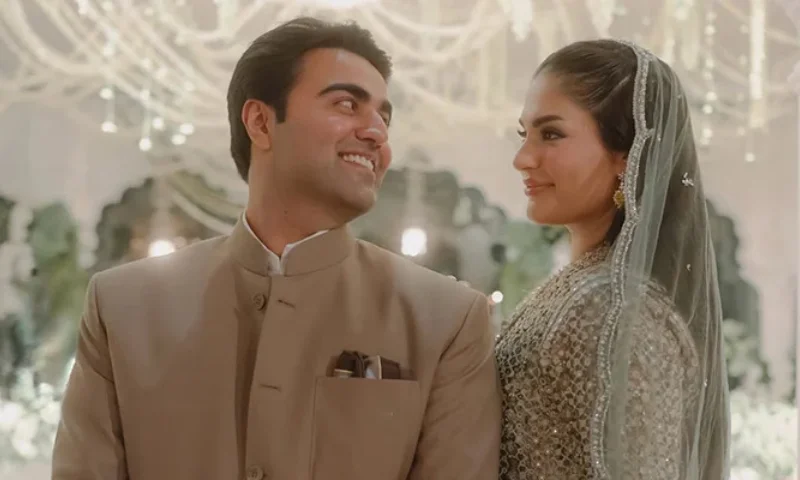
Who wore what at Mahnoor Safdar and Azan Jabbar’s nikkah?
Mahnoor Safdar chose a metallic sage bridal outfit by Nida Azwer for her nikkah to Azan Jabbar on Saturday. Her mother, Punjab Chief Minister Maryam Nawaz Sharif, also wore a Pakistani designer, selecting a custom silk kurta with heirloom lacework. Mahnoor, the daughter of Maryam and Captain Muhammad Safdar Awan, married at the Sharif family’s Jati Umrah estate. Her grandfather, former prime minister Nawaz Sharif, and Prime Minister Shehbaz Sharif attended the intimate gathering. Photographs shared by Sara Idrees on Instagram offered a closer look at the family’s outfits, jewellery and accessories. Mahnoor pairs traditional embroidery with Mouawad jewellery The bride wore Nida Azwer’s Mughal-e-Azam peshwas, featuring mirror work, hirmuch, gota and zardozi embellishments. A matching silk dupatta completed the ensemble. Its border combined mirror work with zardozi and gota embroidery, continuing the traditional detailing across the outfit. Mahnoor added a bucket bag from Jimmy Choo’s Bon Bon collection, pairing the embroidered Pakistani ensemble with an international luxury accessory. Her jewellery came from Lebanese jewellery house Mouawad’s Le Soleil, or The Sun, suite, according to the supplied fashion report. Harper’s Bazaar Arabia profiled the suite when it launched in 2017, describing it as among Mouawad’s most valuable creations. Its report detailed five significant Fancy Intense Yellow diamonds, ranging from 20.10 to 62.34 carats, alongside white diamonds. The publication reported a total diamond weight of 211.03 carats for the suite. That figure describes the complete jewellery suite, rather than independently establishing the weight of the pieces Mahnoor wore. Maryam chooses heirloom lace, groom wears Faraz Manan Maryam selected a custom silk kurta from Parniyaan by Ayesha Jawad. According to the designer, the outfit incorporated heirloom Chantilly lace, Swarovski crystals, marori and jamdani embroidery, and real gems. She paired it with a necklace featuring red gemstones and matching earrings. The pieces appeared to include diamond embellishments, although the report did not confirm their gemstone composition. View this post on Instagram A post shared by Parniyaan (@parniyaanbyayesha) Azan wore a prince coat by Faraz Manan. The designer also dressed Mahnoor’s brother, Junaid Safdar, in a sherwani for his wedding reception in January. Azan is the son of industrialist Jabbar Khalid, whose business interests include flour milling. Family members, close friends and relatives attended the ceremony, a family source told Dawn Images. Shanzeh wears Manish Malhotra Mahnoor’s sister-in-law, Shanzeh Ali Rohale, chose a wine-coloured georgette lehenga by Indian designer Manish Malhotra. The outfit featured gold taban sequins and a matching embroidered dupatta. She accessorised it with what appeared to be a diamond necklace. View this post on Instagram A post shared by Saad Sami (@saad.samie) Shanzeh, who married Junaid in January, had also chosen an Indian designer for her own mehendi. For that occasion, she wore a heritage lehenga by Sabyasachi. The family has not announced a formal reception or further wedding functions. For now, the photographs document a nikkah wardrobe combining Pakistani craftsmanship, Indian couture and international accessories.
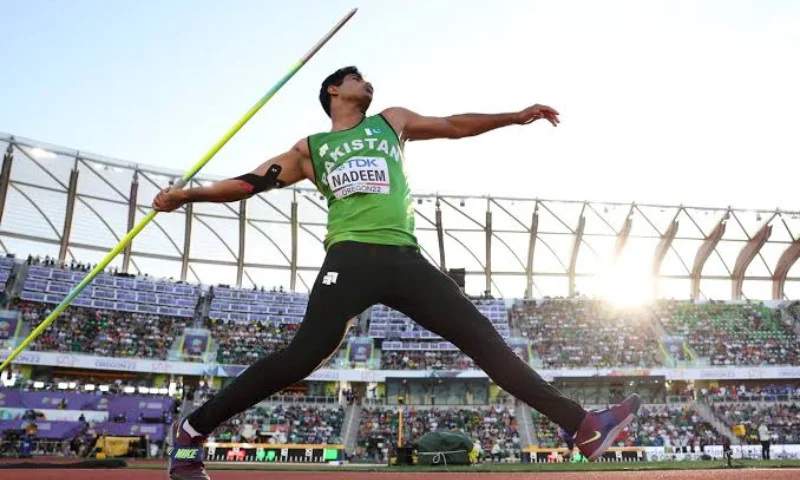
Arshad Nadeem settles for fifth as Sri Lankan rival dominates
Pakistan’s Arshad Nadeem finished fifth at the inaugural World Athletics Ultimate Championship in Budapest despite recording a season-best throw of 81.49m. Sri Lanka’s Rumesh Tharanga Pathirage won the men’s javelin title on Sunday with a commanding 91.09m effort. Grenada’s Anderson Peters took silver with 86.18m, while Germany’s Julian Weber secured bronze with 85.89m. The result offered Arshad some improvement after a difficult season. However, the Olympic champion fell short of the top-four qualification requirement for the decisive fourth round. Arshad improves through three attempts The Mian Chunnu-born athlete opened with 74.42m before improving to 79.66m on his second attempt. He then produced his best effort, 81.49m, with his third and final throw. His series showed steady progress, adding 7.07m between his opening and closing attempts. But the competition format left him without another opportunity to challenge for a medal. Read More: Arshad Nadeem Joins Star-Studded Lausanne Javelin Lineup Only the leading four athletes advanced after three rounds. Arshad’s fifth-place finish therefore ended his campaign before the final throws. His season-best performance still fell 11.48m short of the Olympic record of 92.97m he achieved while winning gold at Paris 2024. That gap underlined the challenge facing the Pakistani star as he prepares for another major competition later this month. Pathirage takes control of medal contest Weber established the early lead with an opening throw of 84.09m. Peters moved ahead in the second round with 86.18m, while Pathirage recorded 85.69m. Weber subsequently improved to 85.89m, keeping himself in medal contention. Pathirage then moved into first place with 87.11m on his third attempt. The Sri Lankan delivered the competition’s standout moment in the fourth round, extending his lead with 91.09m. His winning mark exceeded Peters’ best by 4.91m. Peters managed 82.63m on his final attempt, while Weber finished with 78.75m. Neither threatened Pathirage’s lead. The victory continued Pathirage’s strong run after his Commonwealth Games gold in Glasgow. He also won the Diamond League Final in Brussels earlier this month with 89.04m. Asian Games offer next test Arshad has struggled this season to reproduce the distances that brought him Olympic gold. His 2026 campaign began with a ninth-place finish in Switzerland. He then endured a disappointing Commonwealth Games appearance in Glasgow, where 77.41m failed to carry him into the final round. His Budapest best improved on that Glasgow mark by 4.08m. Even so, the performance left him outside the medals against several leading international rivals. Read More: What Went Wrong for Arshad Nadeem in Glasgow? Attention now turns to the Asian Games in Aichi-Nagoya, Japan. The men’s javelin final is scheduled for September 28. Pathirage’s recent titles and latest throw beyond 90 metres make him a strong favourite. Arshad will seek a further improvement as he attempts to regain his place among the leading contenders.

Pakistani Doctors Prescribe Over Twice WHO-Recommended Medicines
Doctors across healthcare facilities studied in Pakistan prescribed an average of 4.2 medicines per prescription, more than twice the WHO/INRUD benchmark. A new review also found excessive antibiotic use and low generic prescribing. Health Services Academy (HSA), Islamabad, researchers examined 15 studies published between 2013 and 2024. They covered Punjab, Khyber Pakhtunkhwa, Sindh, Balochistan and Islamabad. Discover Public Health published the review on September 11. Its averages give each study equal weight, regardless of sample size, rather than representing a nationwide patient survey. Prescriptions exceed recommended benchmarks The review compared the 4.2 average with an optimal range of 1.6 to 1.8 medicines. These indicators assess prescribing patterns; individual patients’ treatment needs vary. A Peshawar tertiary hospital recorded 10.56 medicines per prescription, nearly six times the benchmark’s upper end. Even the lowest figure, from a Bahawalpur emergency department, exceeded the range. Read More: Doctors Are Secretly Turning to AI Chatbots, But Should Patients Worry? Doctors prescribed about 25% of medicines by generic name against a 100% target. Some hospitals recorded almost zero, while only two studies exceeded 50%. Antibiotics appeared in 45% of prescriptions, against a 20% to 26.8% benchmark. Injection prescribing exceeded 27%, compared with 13.4% to 24.1%, and ranged from zero to 98% across facilities. Only 72% of prescribed medicines came from Pakistan’s essential medicines list, against a 100% target. Patient pressure and antibiotic misuse HSA Vice Chancellor Prof Shahzad Ali Khan, a study author, said the pattern stretched from primary clinics to teaching hospitals. “This is not the problem of one hospital or one city. It is happening across the country, at every level of healthcare,” Prof Khan said. He said doctors sometimes prescribed antibiotics and injections without appropriate testing. Read More: Doctors Say Heart Attacks Give Silent Warnings We Often Ignore “Patients think an injection or an antibiotic will cure them quickly. Doctors, under pressure and short of time, often give in,” he said. Pakistan has introduced a National Priority Pathogen List to guide action against resistant infections. WHO has cited projections of more than 262,000 resistance-associated deaths by 2050. DRAP previously directed sellers to require prescriptions from registered doctors for antibiotics. Reports cited Rs135 billion in antibiotic consumption during 2022, with 70% to 80% unnecessary use. Researchers demand enforcement Khan linked low generic prescribing to pharmaceutical marketing and perceptions that generic medicines were inferior, a belief he disputed. “The problem is not a lack of policy. The problem is that the policy is never followed on the ground,” he said. The review recommends prescription audits, feedback and action against repeat violations. It calls for cooperation among government, drug companies, hospitals and doctors’ associations. Read More: Doctors Say Many Cancers Are Preventable: New Global Data Explains Why Khan urged the federal health ministry, provincial departments and medical profession to act together. “Until this happens, patients will keep taking more medicines than they need, and antibiotics will keep losing their effect against disease,” he said.
