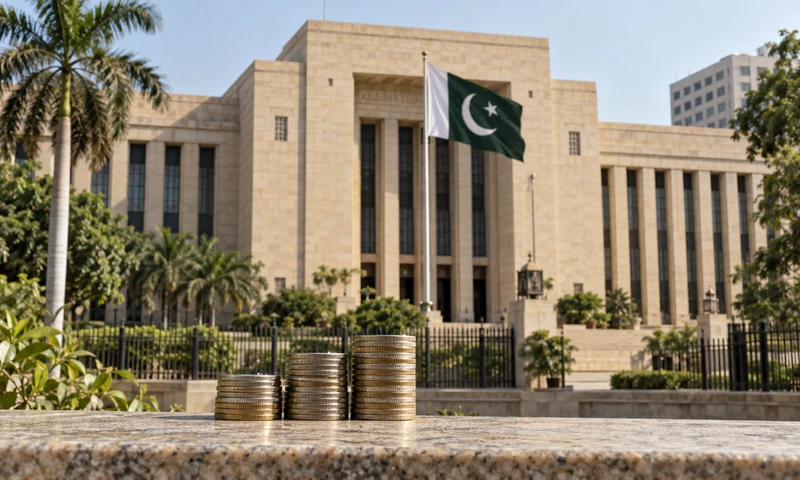
The State Bank of Pakistan kept its interest rate unchanged at 11.5% on Monday as Middle East tensions threatened further inflation.
Seven of the Monetary Policy Committee’s ten members backed the September 14 decision. Escalating conflict has raised commodity prices and prolonged supply disruptions.
“However, recent domestic macroeconomic data turned out broadly in line with the MPC’s expectations,” the statement said.
Headline inflation climbed to 11.1% in August from 9.2% in July, while “core inflation was slightly lower than expectations”.
Read More: HugoBank Gets SBP Approval to Begin Pilot Operations
“External account pressures remained contained, supported by robust workers’ remittances and higher financial inflows.”
Economic activity strengthened “as reflected by recent high-frequency indicators”. The committee considered the rate “appropriate to guide inflation towards target range of 5-7pc over the medium term”.
“However, uncertainty regarding the outlook has increased, particularly from the worsening geopolitical environment.”
Reserves rise as confidence weakens
Moody’s upgraded Pakistan’s sovereign credit rating to B3 with a stable outlook. Pakistan also tapped international markets to “raise $3bn through Eurobonds,” lifting foreign reserves above $21 billion.
“Third, inflation expectations of both businesses and consumers increased in September, while their confidence weakened,” the statement read.
Large-scale manufacturing output fell 3.5% in June, bringing “cumulative FY26 growth to 5pc”.
“Fifth, fiscal consolidation turned out higher than the budgetary target during FY26,” the committee said.
Federal Board of Revenue collections remained “on-target” during July and August of FY27.
“While SBP transferred higher profit of Rs1.9 trillion than the budgeted amount of Rs1.4tr to the government.
“Lastly, central banks have become more cautious amidst challenging global economic conditions.”
Reuters separately reported that economists expected the Bank of England to hold rates despite rising oil prices, reflecting wider policy caution.
Oil pressures cloud the outlook
Renewed US-Iran hostilities and risks to shipping through the Strait of Hormuz have increased energy-dependent Pakistan’s exposure to higher import costs.
Weekly inflation, measured through the Sensitive Price Index, rose 8.62% year-on-year in the week ending September 10. Costlier onions and petroleum products contributed significantly.
Read More: SBP Introduces Rs.1 Per Litre Incentive for Digital Fuel Payments
The MPC reaffirmed its commitment to “achieving price stability with close monitoring of incoming data and the ongoing situation in the Middle East”.
More frequent geopolitical shocks and weather disruptions threaten the outlook. The committee urged a “prudent monetary and fiscal policy mix and further buildup of buffers to absorb supply shocks”.
Bankers had expected unchanged rates, although some analysts anticipated a 50-basis-point increase.
The SBP has held rates steady since April’s 100-basis-point rise, its first increase in nearly three years. Higher global energy prices and supply-chain risks prompted that move.
Previously, it held the rate at 10.5% in January and March following December 2025’s surprise 50-basis-point cut.
The current rate stands 1,050 basis points below June 2023’s record 22%. The easing cycle began in mid-2024 as inflation retreated from multi-decade highs.