


Artificial intelligence investment is keeping global growth around 3%, IMF Managing Director Kristalina Georgieva said Monday. However, she warned of a “slow-moving tsunami” threatening jobs, education and taxation. Speaking at the IMF-World Bank annual meetings, she described a “demand shock, an investment shock” benefiting Asia. Advanced Asian economies could gain 0.5 to one percentage point of growth. Emerging Asian economies could gain 0.2 to 0.8 percentage point. AI spending offsets energy shock “AI, love it, hate it. It’s already here,” Georgieva said. “That shift into higher gear is what is keeping the world economy growing at around 3%, despite the fact we are being dragged down by the energy supply shock,” she said. Read More: Pakistan Tells IMF Gulf War Has Cost Rs144 Billion in Revenue The IMF’s July forecast put 2026 global growth at 3%. It will publish updated projections Tuesday. The weeklong Bangkok meetings expect 18,000 participants, including officials from the IMF’s 191 members. US Treasury Secretary Scott Bessent and Spanish Finance Minister Arcadi España will skip them for domestic priorities. Georgieva identified the US, China and India as leading AI supply-chain producers. Asian hardware suppliers, including those in host Thailand, also stand to benefit. Jobs, skills and taxation face change IMF research suggests AI could augment, downgrade or eliminate 40% of jobs globally, rising to 60% in advanced economies. Those figures measure exposure rather than predicted job losses. Earlier IMF research found that roughly half of exposed jobs in advanced economies could benefit through higher productivity. Georgieva said an initial study showed 10% of US jobs already required AI skills. Routine jobs were shrinking, while lower-paying employment expanded in construction and data centres. A shift from labour towards capital would also reshape government tax revenues. “It is a transformative technology. It so completely changes how we work, how we live,” she said. Her own AI assistant now delivers a daily 30-second schedule briefing. Graduate opportunities divide leaders Singapore President Tharman Shanmugaratnam urged governments to confront falling demand for graduates. “There is a particular problem that we have to address very soon … and that is that, the first rung in employment, your first job upon graduation, is now seeing less demand,” he said. He warned of a “new divergence” in growth and employment between developing and advanced economies. Read More: Pakistan’s $7bn IMF Programme Faces Next Review as Leaders Meet “AI is going to widen the divergence if we are too passive about it,” he said. “So we’ve got to do everything we can to first use AI to create good jobs and to create jobs that can be done well by human beings, can allow them to ride up a career ladder despite AI.” World Bank President Ajay Banga, whose agenda prioritises jobs, questioned whether AI would destroy entry-level employment. He expected disruption mainly in advanced economies building large models. “In the emerging markets, we are not into large language models,” he said. Instead, the bank favours “small AI” requiring less computing power to improve productivity for farmers, health clinics and teachers.
After PIA, Pakistan Plans Five to Six More Privatisation Deals
Pakistan aims to raise more than $1 billion by privatising five to six entities this fiscal year, Finance Minister Muhammad Aurangzeb said. He also forecast economic growth above 4% despite elevated oil prices. Speaking to Reuters in Bangkok on Monday, October 12, Aurangzeb outlined plans to expand private ownership while pursuing additional external financing. He attended the annual meetings of the International Monetary Fund and World Bank. Privatisation pipeline includes power companies Following last year’s privatisation of Pakistan International Airlines, the government has around another dozen entities in its pipeline. These include state-owned power distribution companies and the outsourcing of airport operations. “I expect about five or six of these to go through during this fiscal year,” Aurangzeb said. He estimated potential proceeds at more than $1 billion. Privatisation remains a key test of Pakistan’s reform commitments to the IMF. Officials have warned that retaining loss-making state firms could renew pressure on public finances. “We are quite clear that we want the private sector to lead the country,” said Aurangzeb. “So our role is to help support, assist any way we can in terms of the ecosystem.” The IMF’s programme also prioritises state-enterprise restructuring, stronger governance and measures to reduce energy-sector costs. Pakistan continues $10bn US financing talks Meanwhile, Pakistan continues negotiations with the United States over a proposed $10 billion exchange stabilisation facility. Aurangzeb gave no deadline for concluding discussions. “If it comes through, this will be a great help for us,” he said. “If it doesn’t come through, this does not, you know, create any problem for us in terms of access to market.” The proposed facility would supplement ongoing talks with the Export-Import Bank of the United States and the US International Development Finance Corporation. Separately, Pakistan reached a staff-level agreement with the IMF last week that could unlock approximately $1.21 billion. The financing covers the Extended Fund Facility and a climate programme, with disbursement subject to IMF Executive Board approval. Growth outlook faces oil-price pressure Aurangzeb said Pakistan had secured sufficient fuel supplies and avoided shortages. Agriculture and other critical sectors continued to hold up. “So I’m still quite clear that we should clock north of 4%,” he said, referring to FY2027. “And on the inflation side, obviously, we are keeping a very close eye because it does have a knock-on impact in terms of the commodity prices.” The country of 255 million depends heavily on Gulf energy supplies, remittances and financial support. It also needs external financing to strengthen foreign-exchange reserves and meet debt repayments. The US-Israeli-led war with Iran has entered its eighth month, intensifying inflation and hardship. Those pressures dominate the Bangkok meetings, which return outside Washington after three years. Pakistan’s recovery follows severe economic turmoil aggravated by COVID-19. A $7 billion, 37-month IMF programme agreed in 2024 supports stabilisation, alongside difficult reforms including higher tax collection from agricultural income.

World Bank in Crisis Aid Talks With 30–40 Countries as Energy Costs Rise
The World Bank is discussing potential crisis aid with 30–40 countries facing energy shocks and rising prices linked to the Middle East war, President Ajay Banga said. Speaking to Reuters in Bangkok, Banga warned that higher diesel and fertiliser prices were increasing pressure on developing economies. He also flagged risks from a looming super El Niño weather event. Crisis financing could reach $100 billion The Bank initially offered $25 billion when the war began in late February. Few countries sought that funding, Banga said, citing economic resilience supported by AI investment and oil supply-and-demand adjustments. “There is pressure, and so I think maybe over the coming months, more countries will come for some slice of that first $50 to $60 billion,” he said. That includes the initial allocation and another $35 billion available through redirecting approved projects. Read More: ABHI Bank, RCCI Partner to Expand SME Financing “We’ll see, but we’re ready. We’re engaged. We’re having conversations with a number of them, you know, 30 to 40 countries are in dialogue with us,” Banga said. More countries preferred adapting existing projects to accessing immediate crisis financing. If conditions worsened, the Bank could provide up to $100 billion, exceeding its $70 billion pandemic disbursement. Developing countries face about $400 billion in external debt payments during 2026. Interest represents roughly one-third. Higher borrowing costs compound fiscal pressures left by pandemic spending and inflation following Russia’s invasion of Ukraine. Private capital reaches record levels The Bank mobilised $112 billion in private capital during the year ending June, compared with $69 billion a year earlier. That exceeded three times the 2022 total, before the former Mastercard chief became president. Its own resources contributed another $123 billion, bringing combined financing to $235 billion amid sharp Western cuts to bilateral development aid. “There is no one answer that fits when the world has these kinds of issues. What you need to do is figure out how to cut your coat to suit your cloth,” Banga said. Read More: Aurangzeb NBP Meeting Focuses on Digital Banking, SMEs He expects expanded Multilateral Investment Guarantee Agency political-risk guarantees, local-currency financing and regulatory reforms to attract further investment. Upper-middle-income countries drew $50 billion; lower-middle-income countries attracted $37 billion. Low-income countries received roughly $3 billion. “In the smaller countries, it hasn’t multiplied enough, and there are challenges,” he said. New initiatives will seek better capital access for micro, small and medium-sized businesses. Regional totals included Latin America and the Caribbean’s $36.3 billion, Africa’s $22 billion, Europe and Central Asia’s $21.3 billion, and South Asia’s $19.2 billion. The leading recipients were Brazil, India, Turkiye, Romania, Nigeria, Argentina, South Africa, Bangladesh, Mexico and Chile. Debt guarantees target development spending The Bank and IMF are also supporting domestic revenue collection and debt initiatives. Existing arrangements include swaps for Angola and Ivory Coast, plus an Argentine portfolio guarantee. “We’ve got 14 or 15 in the pipeline, helping them rotate out higher-priced old debt for newer-priced debt with our guarantees,” Banga said. Savings would support education, healthcare, water or nature programmes. The discussions precede the institutions’ October 12–18 annual meetings in Bangkok.
Punjab Air Pollution: LUMS Launches CAPE to Trace Sources
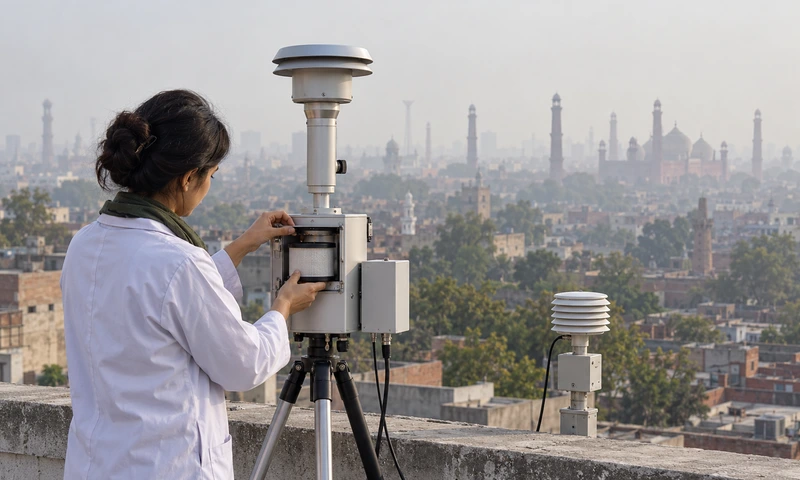
The Lahore University of Management Sciences has launched the Centre for Air Pollution and Environment (CAPE) to investigate Punjab’s pollution sources. Its research will measure how much different sources contribute to particulate pollution and help authorities develop targeted interventions. A major grant from Coefficient Giving will fund a multi-year study across multiple locations in Punjab. The project also includes a laboratory for chemical analysis of air pollutants. Dr Qasim Imtiaz, from LUMS’ Department of Chemistry and Chemical Engineering, leads CAPE as founding director. Dr Farah Said, Dr Shahana Khurshid and Dr Walther Schwarzacher form part of the team. Chemical analysis to trace pollution sources CAPE will analyse the chemical composition of airborne particles collected across Punjab. This approach, known as source apportionment, will help researchers determine the contributions of different pollution sources. Read More: GCU, LUMS Win UK Funding for Pakistan’s First Sustainable Chemistry Lab “To address air pollution effectively, we need systematic measurements that tell us which sources contribute to particulate pollution and by how much. CAPE will build this evidence and work with government, researchers, and communities to translate it into targeted interventions that protect public health,” Imtiaz said. The centre will also assess indoor air quality in schools and examine pollution’s impacts. Its wider programme aims to connect scientific findings with communities and government decisions. LUMS Provost Dr Tariq Mahmood Jadoon highlighted the need for stronger scientific evidence during his opening remarks. Schwarzacher discussed the centre’s establishment within the Syed Babar Ali School of Science and Engineering, which he heads. Government departments outline research priorities The launch brought together university leaders, CAPE’s Policy Advisory Board, government departments, air-quality organisations, researchers and development partners. In a session moderated by Khurshid, representatives discussed Punjab’s smog mitigation framework, monitoring networks, sectoral emissions inventories and air-quality action plans. Participants included the Environment Protection and Climate Change Department, Urban Unit and Pakistan Air Quality Initiative. They also examined citizen monitoring, advocacy and gaps in existing evidence. LUMS trustee Osman Khalid Waheed presented shields to the speakers. Read More: How Faysal Bank Is Helping Talented Students Study at LUMS A separate panel, moderated by Said, explored research priorities and ways to evaluate pollution-control measures. Participants included Provincial Transport Authority Secretary Muhammad Hassaan Ahsan and Punjab Safe Cities Authority Managing Director Muhammad Ahsan Younas. Higher Education Department Additional Secretary Zahida Azhar and Quaid-i-Azam University sociology professor Dr Muhammad Zaman also joined. The discussion covered vehicle-emissions testing and the use of Safe City systems to monitor environmental violations. Speakers stressed reliable data and coordination between researchers and public institutions. LUMS Rector Shahid Hussain concluded the event by thanking participants and partners. Cleaner air could deliver substantial health gains The launch material cited potential life-expectancy gains of 2.6 years in Karachi, 4.6 in Islamabad and 5.3 in Lahore. Those figures reflect earlier estimates. The University of Chicago’s 2025 Air Quality Life Index factsheet estimates gains of 2.7 years for Karachi and 5.8 for Lahore. These gains depend on permanently reducing particulate pollution to World Health Organization guideline levels.
Nehr-i-Khayam Construction Sparks Protest in Karachi
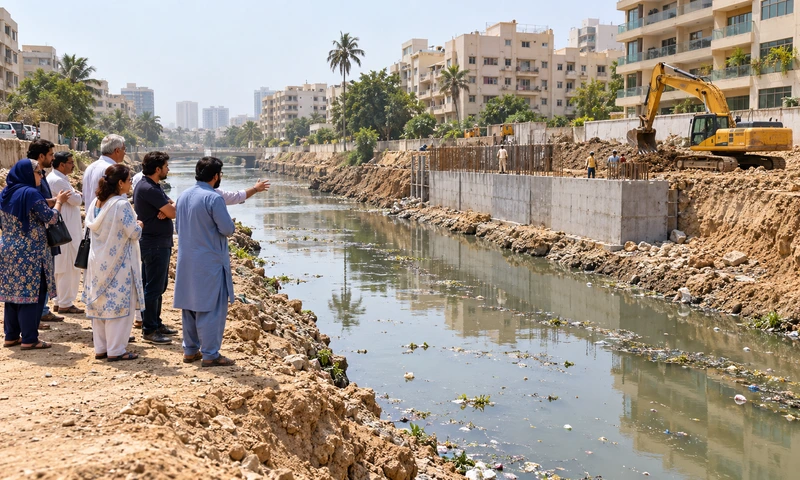
Karachi residents and environmentalists demanded an immediate halt to construction at Nehr-i-Khayam on Sunday, opposing commercial development along the Clifton waterway. They sought public disclosure of project plans, environmental approvals and spending on the reportedly Rs500 million scheme. Members of Clifton Block 5 Residents Association, Clifton Defence Community (CDC) and Karachi Residents’ Community (District South) joined the protest. Excavation and concrete-mixing machinery continued working behind them. Residents demand plans and financial transparency Placards read “No food street on Nehr-i-Khayam” and “What are you building? Share the plan publicly”. Others warned against narrowing the drain and alleged violations of Supreme Court orders. Resident Hummaa Ahmad questioned the absence of a public project information board. “We want to know exactly what is being constructed here. We want full disclosure of the approved designs, land boundaries, environmental assessments, Sepa decisions, contracts and expenditure regarding the project,” she said. Read More: Barrick Links Full Reko Diq Construction to Security Improvements Protesters also demanded the approved budget, funding sources, contract scope, contractors’ identities, payments and actual expenditure. Sheeraz Qureshi, whose family has lived in Clifton Block 5 for 40 years, called the work “illegal commercialisation”. He argued that dense commercial development would disrupt an already crowded residential neighbourhood. Dr Nadia Kiran, who lives in an overlooking apartment, raised concerns about reports of a food street above a narrowed drain. “The resulting traffic, rush and noise every day and night will destroy our peace of mind,” she said. Drainage and marine environment raise concerns Clifton Urban Forest founder and CEO Masood Lohar described Nehr-i-Khayam as a natural connection between Obhayo Lagoon and Gizri Creek. He warned against disturbing its marine ecosystem. Rasha Tarek cited activist Ardeshir Cowasjee’s September 10, 2006 column, which called the channel “one of the major lungs of the Clifton area”. She stressed that its banks, landscape and drainage function concerned all Karachi residents. Rumana Khan linked destructive flooding to decisions that obstruct natural water flows. Meanwhile, Humaira Khan criticised untreated sewage discharge into the sea and alleged commercial encroachment. CDC President Abdur Rehman recalled previous encroachment attempts. He criticised inadequate drainage planning, citing the Lyari and Malir rivers. Participants, including Elia Qazilbash, Syed Tipu Sharif and Shumaila Dawood, demanded protection of storm-water capacity and public open space. They sought sewage treatment, independent drainage and environmental scrutiny, and meaningful consultation before further work. Earlier plans included a food street An October 2025 APP report described plans for landscaping, a park, recreational facilities and a food street, with completion expected by June 2026. Officials said the project involved PANI, the People and Nature Initiative, and separate sewage drainage works. Read More: China Seawater Hydrogen Plant Produces Fuel and Fresh Water Separately, The News reported that the Sindh High Court issued notices to KMC and others over a petition challenging the conversion. The notices seek responses and do not constitute a final ruling on the project’s legality. A KMC spokesperson said the local government department was executing the project. The spokesperson denied any involvement by KMC or Karachi’s mayor.

Power Bank Fire on IndiGo Flight Puts Baggage Rules in Focus
An IndiGo flight from Delhi to Chennai diverted to Hyderabad on Sunday after a passenger’s power bank reportedly caught fire mid-air. Cabin crew contained the blaze inside an overhead compartment, and the aircraft landed safely without reported injuries. Flight 6E6115, an Airbus A321, carried around 180 passengers and seven crew members when the incident occurred on October 11. IndiGo confirmed that smoke came from a customer’s personal electronic device. However, the airline’s statement did not specifically identify the device as a power bank, as several reports did. Crew contain fire in overhead compartment Reports said cabin crew used a fire extinguisher to control the flames before the pilots diverted under established safety protocols. Passenger videos circulating online showed flames inside an overhead bin. Some travellers attempted to smother the fire using bags and pieces of cloth. Read More: PNS Hangor Fires Its First Cruise Missile, Strikes Target at Sea The footage captured alarm inside the cabin, with one passenger urging others to remain calm, according to The New Indian Express. The airline said its crew responded promptly and brought the situation under control. The aircraft subsequently landed at Rajiv Gandhi International Airport in Hyderabad. The Indian Express reported that authorities had launched an investigation into the incident. The available reports did not establish what caused the device to ignite or whether anyone was using it before the fire. Passengers continue journey on alternate aircraft FlightAware data cited in reports showed that the aircraft departed Terminal 1 of Delhi’s Indira Gandhi International Airport at about 1:30pm. Its scheduled arrival in Chennai was 4pm. Instead, the flight touched down in Hyderabad at approximately 3:59pm. All timings were local. “An alternate aircraft has been arranged to continue the journey to Chennai,” IndiGo said in its statement. The airline also apologised for the disruption and said it was providing refreshments and timely updates while arranging onward travel. The diversion interrupted the Delhi–Chennai service but allowed the crew to bring passengers safely to an alternative airport. IndiGo rules prohibit overhead storage of power banks IndiGo’s published baggage policy permits power banks and spare lithium batteries only in hand baggage. Passengers must keep them within personal reach throughout the flight. The policy lists storage under the seat, in the seat pocket or on the passenger’s person. It explicitly prohibits placing these devices in overhead compartments or checked baggage. Read More: PAL Free Rebooking: Dubai, Doha and Riyadh Flight Rules Lithium-ion batteries can overheat and undergo thermal runaway, a process associated with dangerous heat and fire, according to the US Federal Aviation Administration. The FAA advises passengers to alert cabin crew immediately if a battery or electronic device overheats, expands, smokes or burns. Its guidance also warns against carrying damaged or recalled batteries that could produce sparks or dangerous heat. These precautions address battery risks generally; investigators have not publicly established the cause of Sunday’s fire.
Pakistani Killed as Fresh Riyadh Airport Attack Leaves 11 Injured
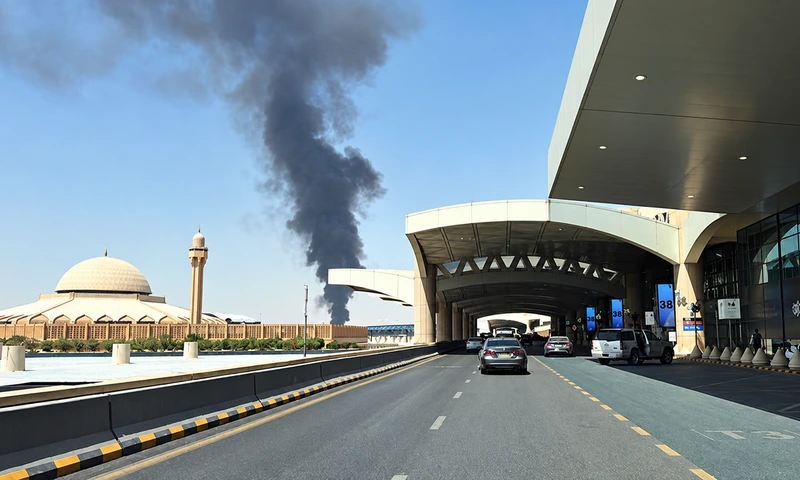
A Houthi attack on Riyadh’s King Khalid International Airport killed a Pakistani resident and injured 11 people on Sunday, Saudi authorities said. The strike followed Saturday’s deadly assault, which forced the airport to suspend operations. Saudi aviation authorities said emergency teams took the injured to hospitals. Officials continued assessing damage and checking airport facilities. #Statement | Follow-up on the attack targeting King Khalid International Airport in Riyadh. #GACA https://t.co/L7aaMrvj9P — هيئة الطيران المدني (@ksagaca) October 11, 2026 Airport closure extended after fresh strike The Saudi-led coalition said a projectile struck the airport, triggering a fire. Air defences intercepted another missile nearby. The Houthis claimed multiple attacks within 24 hours, calling Saudi transit hubs “a theatre of operations for our forces”. Authorities extended Riyadh airport’s closure by 24 hours until 2100 GMT Monday, according to Flightradar24. That corresponds to 2am Tuesday in Pakistan. Read More: Global Oil Route at Risk as Houthis Move Closer to Bab al-Mandab AFP journalists and residents heard several explosions. “The birds went into a frenzy after the sound. The whole house shook,” an Al-Aarid resident said. Saudi aviation authorities also reported an attack on Dammam airport after a projectile landed nearby the previous day. The Houthis claimed targeting it, while the coalition subsequently reported downing a drone in eastern Saudi Arabia. Early Monday, the coalition said it had “intercepted and destroyed” a ballistic missile heading towards Khamis Mushait, a major military base. Saturday’s casualties deepen international concern Saturday’s attack, the deadliest on Saudi soil in over a decade, initially killed 12 people and wounded 309, authorities said. The dead included four Saudis, two Bangladeshis, and one citizen each from America, Egypt, Jordan, Syria, Palestine and Sudan. India’s embassy said another victim, an Indian national, died Sunday. “Some had lost a hand or an arm. People were running while carrying injured people, covered in blood,” a 32-year-old witness told AFP. This video may be distressing to some viewers. CCTV footage released by Al Arabiya shows the moment of a Houthi strike on Riyadh’s international airport on Saturday. The attack killed at least 12 people and injured more than 300. https://t.co/JIp4SMIgH3 — Al Jazeera English (@AJEnglish) October 11, 2026 Thursday’s airport attack killed three people. The Houthis have also targeted Saudi oil facilities and Red Sea tankers. “Saudi air defences have been able to intercept some Houthi missile and drone attacks, but Saudi Arabia is so large that it’s simply impossible for them to consistently defend themselves,” said Ottawa University analyst Thomas Juneau. The coalition called Saturday’s strike a “full-fledged war crime” and promised to “respond decisively”. The UN and world leaders condemned it. US President Donald Trump said he was considering joining Saudi strikes. US, Canadian, German and Spanish embassies warned citizens against visiting Riyadh airport. Australia called the attacks “unacceptable” after urging citizens to “shelter in place”. Iran offers talks as Yemen fighting continues Iranian Foreign Minister Abbas Araghchi told his Saudi counterpart that “insisting on a military approach and disregarding a political solution would further complicate the current situation”. Read More: Saudi Airport Attacks Disrupt Travel: PIA Temporarily Halts Riyadh Flights Tehran offered to “initiate dialogue between Saudi Arabia and Yemen and facilitate the achievement of a political solution”, IRNA reported. Houthi media reported two Saudi strikes in Sanaa governorate Sunday. Their health ministry claimed one killed a civilian and injured five. Saudi Arabia has supported Yemen’s government militarily since 2015. Military sources reported government advances near the strategic Bab al-Mandab Strait Saturday; the Houthis claimed they repelled them. Restricted access and fast-moving fighting prevented independent verification of either account.
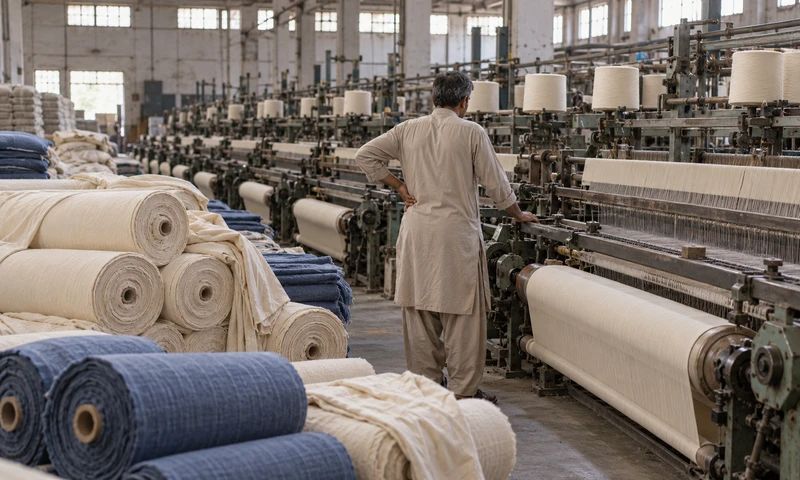
Pakistan Textile Exports Face Sharp Fall, Exporters Warn
Pakistan’s textile exporters have warned of a steep export decline in October–December as weaker Western demand and rising costs squeeze businesses. They urged government intervention to protect overseas market share during the second quarter of FY2026–27. In Sunday’s statement, Pakistan Textile Exporters Association (PTEA) Patron-in-Chief Khurram Mukhtar said mounting pressures threatened exporters’ competitiveness. Weaker demand squeezes textile manufacturers Mukhtar said Western inflation had weakened orders, while sea freight charges had increased by 1.5 to 2.5 times. Higher input and logistics costs were further eroding margins. “The decline in export trade volume is unprecedented,” he said, warning that only financially strong exporters would survive. Regaining lost markets would prove extremely difficult, he added. Read More: Pakistan Earns $3.379bn From Textiles as Knitwear Tops $1bn Weak domestic demand amid inflation had compounded difficulties across ginning, spinning, weaving, processing and knitting. The warning follows modest growth last fiscal year. Pakistan’s textile exports reached $17.932 billion in FY2025–26, rising just 0.26%, according to PBS figures reported by APP. Mukhtar sought temporary support of 6–8% through the Duty Drawback of Local Taxes and Levies scheme to retain international customers. He also demanded immediate clearance of outstanding refunds and removal of cross-subsidies from industrial energy tariffs. Export financing draws scrutiny Mukhtar said the government had yet to implement the 4.5% fixed Export Finance Scheme (EFS) rate announced in the FY27 Finance Bill. Instead, banks charged exporters between 5.5% and 8.5%, he claimed. He alleged that yarn exporters received around Rs200 billion through EFS despite yarn appearing on its negative list. He also questioned financing for sugar exporters, describing sugar as a highly regulated sector. Meanwhile, eligible textile exporters struggled to secure allocations despite strong performance, he said. Some achieved export performance of five to six times their financing, against the mandatory two-times threshold. Such allocations discouraged value addition and penalised major foreign-exchange earners, Mukhtar argued. Although he welcomed increased SME financing, he questioned whether businesses could absorb an additional Rs300 billion. This required Rs600 billion in export performance, which he said did not currently exist. The previous fiscal year’s Rs100 billion SME allocation had expired unused, he added. He sought proportionate financing for the top 100 exporters, saying they contributed up to 60% of total export volume. Rs140 billion upgrade package proposed Mukhtar proposed Rs140 billion for textile modernisation: Rs20 billion each for ginning and sizing, and Rs50 billion each for weaving and processing. Tailored short- and long-term facilities should fund machinery balancing, modernisation and replacement, alongside productivity improvements, automation and sustainable production. He urged the federal government and State Bank to design the programme jointly with industry representatives. Read more: Pakistani Rice Exporters Eye Malaysia Expansion After High-Level Talks Mukhtar also sought a 10-year textile export strategy built around existing industrial expertise, exportable surplus and structural reforms to improve competitiveness. “Historically, we have been reactive. The current situation demands a proactive approach,” he said. He warned that timely intervention would cost considerably less than recovering lost export markets.
