


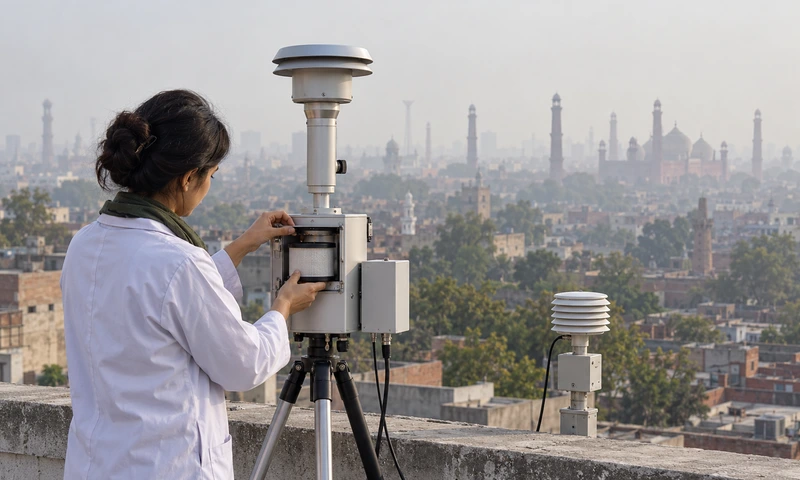
The Lahore University of Management Sciences has launched the Centre for Air Pollution and Environment (CAPE) to investigate Punjab’s pollution sources. Its research will measure how much different sources contribute to particulate pollution and help authorities develop targeted interventions.
A major grant from Coefficient Giving will fund a multi-year study across multiple locations in Punjab. The project also includes a laboratory for chemical analysis of air pollutants.
Dr Qasim Imtiaz, from LUMS’ Department of Chemistry and Chemical Engineering, leads CAPE as founding director. Dr Farah Said, Dr Shahana Khurshid and Dr Walther Schwarzacher form part of the team.
Chemical analysis to trace pollution sources
CAPE will analyse the chemical composition of airborne particles collected across Punjab. This approach, known as source apportionment, will help researchers determine the contributions of different pollution sources.
Read More: GCU, LUMS Win UK Funding for Pakistan’s First Sustainable Chemistry Lab
“To address air pollution effectively, we need systematic measurements that tell us which sources contribute to particulate pollution and by how much. CAPE will build this evidence and work with government, researchers, and communities to translate it into targeted interventions that protect public health,” Imtiaz said.
The centre will also assess indoor air quality in schools and examine pollution’s impacts. Its wider programme aims to connect scientific findings with communities and government decisions.
LUMS Provost Dr Tariq Mahmood Jadoon highlighted the need for stronger scientific evidence during his opening remarks. Schwarzacher discussed the centre’s establishment within the Syed Babar Ali School of Science and Engineering, which he heads.
Government departments outline research priorities
The launch brought together university leaders, CAPE’s Policy Advisory Board, government departments, air-quality organisations, researchers and development partners.
In a session moderated by Khurshid, representatives discussed Punjab’s smog mitigation framework, monitoring networks, sectoral emissions inventories and air-quality action plans. Participants included the Environment Protection and Climate Change Department, Urban Unit and Pakistan Air Quality Initiative.
They also examined citizen monitoring, advocacy and gaps in existing evidence. LUMS trustee Osman Khalid Waheed presented shields to the speakers.
Read More: How Faysal Bank Is Helping Talented Students Study at LUMS
A separate panel, moderated by Said, explored research priorities and ways to evaluate pollution-control measures.
Participants included Provincial Transport Authority Secretary Muhammad Hassaan Ahsan and Punjab Safe Cities Authority Managing Director Muhammad Ahsan Younas. Higher Education Department Additional Secretary Zahida Azhar and Quaid-i-Azam University sociology professor Dr Muhammad Zaman also joined.
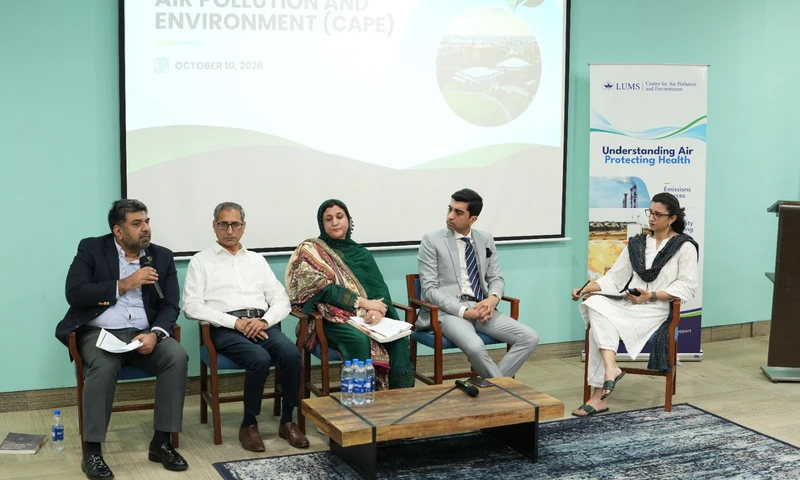
The discussion covered vehicle-emissions testing and the use of Safe City systems to monitor environmental violations. Speakers stressed reliable data and coordination between researchers and public institutions.
LUMS Rector Shahid Hussain concluded the event by thanking participants and partners.
Cleaner air could deliver substantial health gains
The launch material cited potential life-expectancy gains of 2.6 years in Karachi, 4.6 in Islamabad and 5.3 in Lahore.
Those figures reflect earlier estimates. The University of Chicago’s 2025 Air Quality Life Index factsheet estimates gains of 2.7 years for Karachi and 5.8 for Lahore. These gains depend on permanently reducing particulate pollution to World Health Organization guideline levels.

























