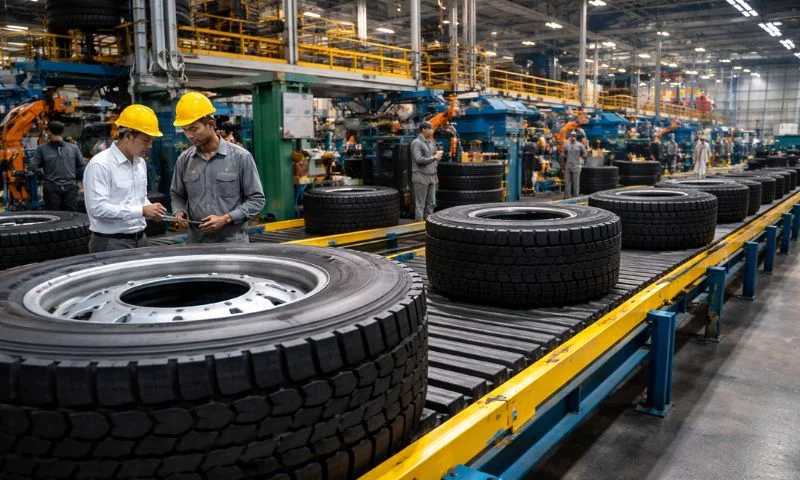
A China-backed joint venture has announced plans to invest $120 million to expand its tyre manufacturing operations in Pakistan, signaling renewed foreign investor confidence in the country’s industrial sector amid improving economic indicators.
The announcement was made by Jin Yongsheng, chairman of Service Long March Tyres (Private) Limited, during meetings with senior Pakistani officials, including Commerce Minister Jam Kamal and Prime Minister Shehbaz Sharif in Islamabad.
The company aims to scale up production capacity and increase exports to more than $100 million in the next fiscal year, reflecting a broader push to strengthen Pakistan’s manufacturing base and tap into regional and global markets.
Expansion plans and export ambitions
Officials said the investment would focus on enhancing production facilities, improving technology and increasing output to meet both domestic and export demand.
During the meeting with Prime Minister Shehbaz Sharif, the delegation discussed plans for expansion, export growth and the need for tariff policy support to strengthen Pakistan’s tyre industry.
Jin Yongsheng praised Pakistan’s “investor-friendly environment” and government policies, highlighting the country’s potential as a manufacturing hub for regional markets.
Industry analysts say the move aligns with Pakistan’s broader strategy to attract foreign direct investment, particularly from China under ongoing economic cooperation frameworks.
The tyre sector, which supports the country’s automotive and logistics industries, has seen increasing demand due to rising vehicle usage and infrastructure development. With improved production capacity, local manufacturers are also looking to reduce reliance on imports while boosting exports.
Growing industrial confidence
The announcement comes at a time when Pakistan is seeking to stabilize its economy and encourage industrial growth through foreign partnerships and export-oriented policies.
Recent data suggests that Pakistan’s manufacturing sector is gradually recovering, supported by policy reforms, exchange rate stability and targeted incentives for exporters.
Experts note that Chinese firms continue to play a key role in Pakistan’s industrial development, particularly in sectors such as energy, infrastructure and manufacturing. The latest investment is seen as part of this broader trend.
However, challenges remain, including energy costs, policy consistency and global economic uncertainty, which could affect investor sentiment and export performance.
Still, government officials have expressed optimism that such investments will help generate employment, improve industrial output and strengthen Pakistan’s position in global supply chains.
As the country looks to boost exports and reduce its trade deficit, investments like the planned expansion by Service Long March Tyres are expected to play a crucial role in driving sustainable economic growth.