
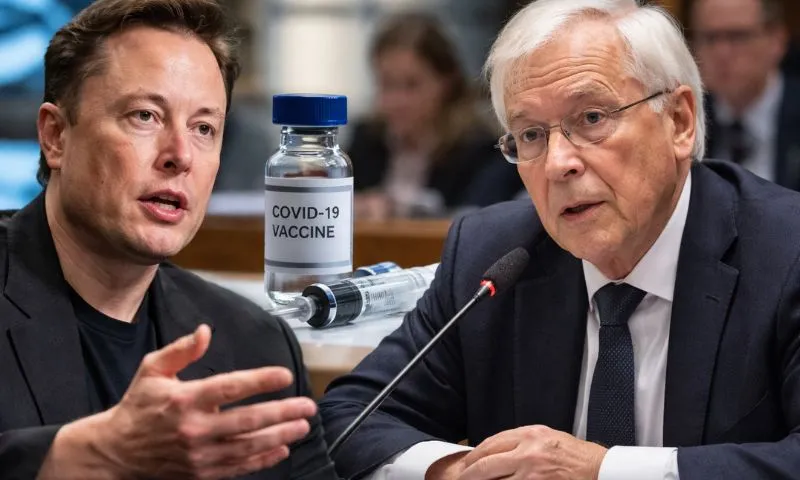
Elon Musk has reignited a global debate over Covid-19 vaccine safety after amplifying controversial claims made by a former Pfizer toxicologist during a hearing in Germany’s parliament.
The remarks follow testimony delivered at the Bundestag’s Corona Enquete Commission, where a former Pfizer toxicology expert argued that the mRNA vaccine developed by Pfizer-BioNTech should not have been approved and may have been linked to thousands of deaths.
The clip of the testimony quickly went viral, drawing millions of views online after Musk shared it with his followers, questioning why the issue was not receiving broader global attention.
Claims and counterclaims
The scientist at the centre of the controversy, Dr Helmut Sterz, previously led toxicology units at major pharmaceutical firms including Pfizer and Roche, before retiring more than a decade prior to the pandemic.
During his brief appearance before lawmakers, Sterz argued that several key preclinical safety studies were not completed before the vaccine received emergency approval. These included tests related to cancer risk and reproductive toxicity, which are typically part of standard drug development processes.
His most widely cited claim suggested that up to 60,000 deaths in Germany could be associated with Covid-19 vaccination. The figure was derived by applying a multiplier to officially reported deaths recorded after vaccination by Germany’s drug safety authority, the Paul-Ehrlich-Institut.
However, experts and officials have stressed a key distinction. The reported deaths occurred after vaccination but were not proven to have been caused by the vaccine itself.
German Health Minister Karl Lauterbach, who attended the session, rejected the claims, describing them as false and unsupported by scientific evidence.
Read More: Elon Musk’s Brain Chip Creates Real-Life Transformation for Patient
Musk’s personal claim fuels debate
Musk added to the controversy by sharing his own experience with the Covid-19 vaccine, stating that his second dose left him feeling severely unwell.
“The vaccine dosage was obviously too high and done too many times,” he wrote. “But my second vaccine shot almost sent me to the hospital. Felt like I was dying.”
His comments, combined with the viral testimony, have intensified online discussions around vaccine safety, regulatory oversight and transparency during the pandemic.
Read More: Musk Becomes Richest Person Ever With $839 Billion Fortune
Scientific context and broader evidence
Health authorities worldwide, including regulators in Europe and the United States, have consistently maintained that Covid-19 vaccines underwent rigorous evaluation, even under accelerated timelines due to the global emergency.
While rare side effects such as myocarditis have been documented, large-scale studies published in leading medical journals have found that vaccination significantly reduced severe illness and death during the pandemic.
Analysts note that Sterz’s estimate relies on extrapolation rather than direct clinical evidence, using assumptions about underreporting that may not apply uniformly across countries.
The episode highlights the growing influence of social media in shaping public perception of scientific issues, particularly when statements by high-profile figures intersect with complex medical debates.
As governments continue to review pandemic responses, including through parliamentary inquiries such as Germany’s, experts say clear communication of evidence remains critical to maintaining public trust.