

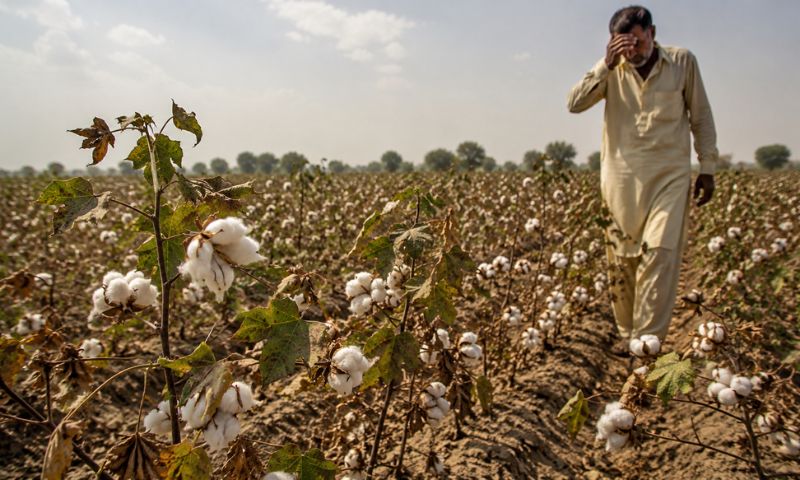
Pakistan’s cotton sector faces mounting pressure from climate change as rising temperatures, water shortages and erratic rainfall continue to reduce production, threatening one of the country’s most important export industries. Experts warn that temperatures in major cotton growing regions could remain 2 to 4 degrees Celsius above normal during May and June this season. Some areas may even record temperatures of up to 52°C during severe heatwaves, increasing the risk of flower drop, boll shedding and lower crop yields. Cotton remains the backbone of Pakistan’s textile industry, which contributes around 60 percent of the country’s exports. However, climate related challenges have significantly weakened production in recent years, raising concerns for farmers, exporters and policymakers. Cotton output falls sharply as extreme weather intensifies According to agricultural experts, Pakistan produced about 5.6 million cotton bales during the 2025 to 2026 season, almost 45 percent below the official target of 10.2 million bales. South Punjab suffered some of the worst conditions. Temperatures climbed above 45°C, while irregular rainfall created ideal conditions for boll shedding, pest attacks and disease outbreaks. Farmers also reported higher pressure from Cotton Leaf Curl Virus, which further reduced yields. The latest projections show above normal temperatures across key cotton producing districts, including Multan, Bahawalpur, Rajanpur, Dera Ghazi Khan, Rahim Yar Khan, Sukkur, Khairpur, Nawabshah, Hyderabad, Badin, Tando Allah Yar, Tando Adam, Jacobabad, Shikarpur, Larkana, Quetta’s surrounding agricultural areas, Nasirabad, Jaffarabad and Sohbatpur. Experts explain that cotton responds differently to heat stress during each stage of growth. Temperatures above 45°C can damage pollen development, reduce seed formation and cause flowers and young bolls to fall before maturity. High night temperatures also reduce plant energy, while drought limits fibre quality and boll development. Excessive rainfall and flooding create separate risks by increasing boll rot, crop lodging and viral diseases. The Food and Agriculture Organization has repeatedly warned that climate change poses one of the greatest long term threats to agricultural production in South Asia, particularly in water stressed countries such as Pakistan. Scientists promote climate smart farming Researchers say farmers can reduce climate related losses through better crop management and climate smart farming techniques. Studies show that split application of 150 to 200 kilograms of urea per acre, or fertiliser use guided by leaf colour charts, can reduce nitrous oxide emissions by 30 to 65 percent without causing major yield losses. Scientists at the Central Cotton Research Institute (CCRI) in Multan also tested deficit irrigation methods. Their research found that cotton variety BTCIM 678 achieved water use efficiency between 0.55 and 0.64 kilograms per hectare per millimetre of water when supplied with only 50 percent of available irrigation water. The method reduced yields by just 7 to 9 percent while saving nearly 37 centimetres of irrigation water. The institute continues to evaluate heat tolerant cotton varieties, including BTCIM 663, BTCIM 785, BTCIM 343, BTCIM 678, BT Cyto 535, BT Cyto 537, BTCIM 775, BT Cyto 511 and the newly approved BTCIM 990. Researchers say these varieties perform better under high temperatures, limited water supplies and viral disease pressure. CCRI has also introduced its Low Expenditure and Environment Friendly (LEEF) Technology, which aims to increase cotton productivity while lowering production costs. Call for coordinated action Experts recommend timely sowing, drip irrigation, balanced fertiliser use, reduced tillage and integrated pest management to strengthen cotton’s resilience against climate change. They stress that Pakistan must move quickly from reactive policies to long term adaptation strategies. Strong coordination between the government, researchers and farmers will remain essential to protect cotton production, textile exports and rural livelihoods from worsening climate risks.
From Iran to the US: 10 Places Running Out of Water
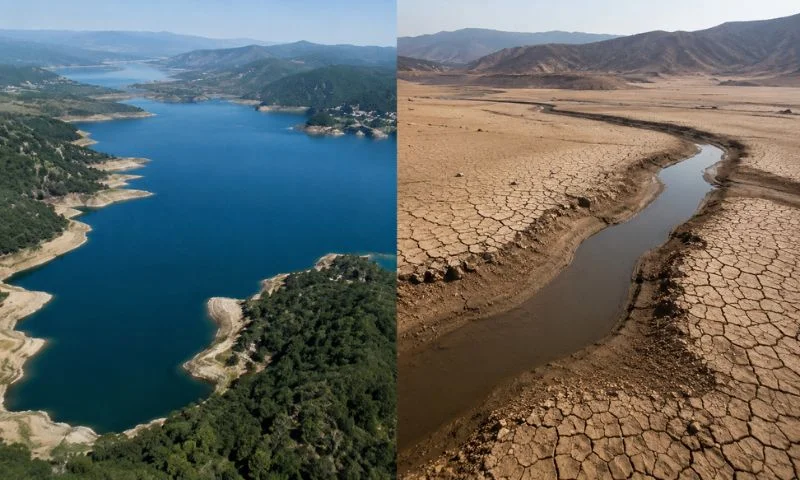
The world is losing freshwater at an alarming pace as climate change, prolonged droughts and unsustainable water use place growing pressure on rivers, lakes and wetlands. According to a 2025 World Bank report cited by Al Jazeera, the planet loses an estimated 324 trillion litres of freshwater every year. That amount is enough to meet the annual needs of about 280 million people. Read More: Scientists Create Solar Device That Turns Desert Air Into Drinking Water The phenomenon, known as “continental drying”, has become a growing concern for scientists and policymakers. To mark the World Day to Combat Desertification and Drought on June 17, Al Jazeera examined satellite imagery showing how water bodies across the globe have shrunk over recent decades. Parana River, Argentina The Parana River stretches nearly 4,900 kilometres and serves as a vital trade route connecting Brazil, Paraguay and Argentina. Satellite images comparing 1990 and 2026 show a sharp decline in water levels near Rosario. The reduction has disrupted grain exports, lowered hydroelectric output at the Itaipu Dam and exposed large areas of riverbed. Lake Poope, Bolivia Lake Poope once ranked as Bolivia’s second-largest lake, covering around 1,000 square kilometres. Satellite imagery from 1984 and 2020 shows that the lake has almost completely disappeared. Drought, rising temperatures and water diversions transformed much of the area into a salt flat, devastating fisheries and Indigenous Uru communities. Lake Ngami, Botswana Located on the edge of the Okavango Delta, Lake Ngami depends heavily on seasonal inflows. Images from 1984 and 2020 reveal dramatic fluctuations. Severe droughts and declining water inflows nearly erased the lake at its lowest point, damaging fishing grounds and livestock pastures before partial recovery occurred. Laguna de Aculeo, Chile Laguna de Aculeo, near Santiago, was once a popular recreational destination. Satellite comparisons between 2007 and 2026 show that the lake has largely dried up. Years of drought and increasing water stress have dramatically altered the landscape and affected nearby communities. Lake Urmia, Iran Lake Urmia was once the Middle East’s largest saltwater lake, spanning nearly 6,000 square kilometres during the 1990s. Today, it covers only about 581 square kilometres. Consecutive droughts, river diversion projects, agricultural demand and groundwater extraction have reduced the lake to less than 10 percent of its former size. Al Chibayish Marshes, Iraq The Al Chibayish Marshes form part of Iraq’s UNESCO-listed Mesopotamian Wetlands. Satellite imagery from 1984 and 2020 highlights extensive drying caused by drainage projects and drought. However, increased rainfall and restoration efforts have helped some parts of the marshes recover in recent years. Ambovombe, Madagascar Southern Madagascar has endured some of the country’s harshest drought conditions. Images comparing 1985 and 2020 show worsening environmental degradation around Ambovombe. Water shortages, stronger sandstorms and declining agricultural productivity have increased hardship for local communities. Lake Faguibine, Mali Near the Sahara Desert, Lake Faguibine has suffered decades of decline. Satellite images show that reduced flooding from the Niger River, combined with sediment buildup and drought, has caused the lake to shrink dramatically and accelerated desertification across the region. Lake Mead, United States Lake Mead, located on the Nevada-Arizona border, is the largest reservoir in the United States by capacity.\ Satellite imagery from 1984 and 2020 reveals a dramatic fall in water levels. Prolonged drought, rising temperatures and heavy water consumption have exposed vast stretches of previously submerged land. South Aral Sea, Uzbekistan The South Aral Sea remains one of the world’s most severe environmental disasters. Decades of river diversions for irrigation have shrunk the lake by more than 90 percent. Satellite images from 1984 and 2020 show vast expanses of exposed lakebed where water once existed. Scientists warn that continued freshwater losses could threaten food production, biodiversity, energy generation and water security for millions of people. The satellite images highlighted by Al Jazeera provide a stark reminder of how rapidly landscapes can change when water resources come under sustained pressure.
Scientists Create Solar Device That Turns Desert Air Into Drinking Water
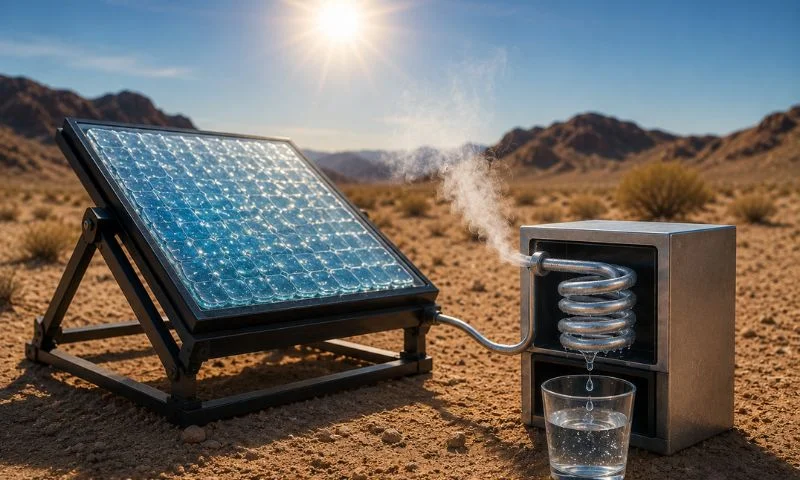
Researchers from Stanford University and Massachusetts Institute of Technology have developed a new solar-powered hydrogel capable of extracting clean drinking water directly from air, including in extremely dry desert environments. The breakthrough could offer a low-cost water solution for millions of people living in water-stressed regions worldwide. According to the World Health Organization and UNICEF, around 2.1 billion people still lacked access to safely managed drinking water in 2025, highlighting the urgent need for alternative water technologies. The newly developed hydrogel uses a sponge-like material made from lithium chloride and polyacrylamide. Lithium chloride acts as a highly absorbent salt, while polyacrylamide is a polymer commonly used in products such as diapers. The material absorbs moisture from the atmosphere during cooler periods. Sunlight later heats the hydrogel and releases the trapped water vapour, which researchers then condense into drinkable water. Earlier field tests took place in Chile’s Atacama Desert, one of the driest regions on Earth. Researchers mounted the hydrogel panel onto a black-painted aluminium sheet that absorbed solar heat and accelerated water release. Researchers Solve Major Durability Problem Although the hydrogel worked effectively in earlier experiments, scientists faced a major obstacle. The material began degrading after roughly 30 absorption and release cycles. Researchers feared the breakdown could increase costs and contaminate collected water if degraded polymer or salt entered the condenser system. After four years of laboratory testing, the team discovered that the aluminium surface beneath the hydrogel caused the issue. The metal released ions that triggered damaging radicals inside the material, breaking down the polymer chains over time. Scientists solved the problem by applying a commercial anti-corrosion coating to the metal surface. The coating blocked harmful ions from interacting with the hydrogel. With the protective layer in place, the hydrogel remained stable for more than eight months during stress testing and completed over 190 water-harvesting cycles. The findings appeared in the scientific journal Nature Communications on May 7. The study stated that the coating strategy enabled “stable moisture absorption and release for more than 190 cycles over 96 days”. Cheap Water Production Could Transform Dry Regions Carlos Diaz-Marin, assistant professor of energy science and engineering at Stanford’s Doerr School of Sustainability and co-lead author of the study, said the breakthrough could sharply reduce water production costs. According to Stanford researchers, the technology may eventually produce drinking water for less than one cent per litre. That would place the cost near tap water prices in some American cities and far below bottled water prices. The current prototype generates up to two litres of water daily using a thin material layer spread across a panel roughly the size of a bath towel. Stanford researchers said that amount roughly matches the minimum daily drinking water requirement for one person during emergencies. Diaz-Marin hopes to increase production to five litres per day to make the system more practical for rural communities in dry inland regions where desalination remains difficult or expensive. Scientists say the hydrogel remains far from large-scale deployment. However, researchers continue working to improve efficiency, durability and manufacturing costs. Experts believe atmospheric water harvesting technologies could become increasingly important as climate change intensifies droughts and water shortages worldwide.
