Researchers from Stanford University and Massachusetts Institute of Technology have developed a new solar-powered hydrogel capable of extracting clean drinking water directly from air, including in extremely dry desert environments.
The breakthrough could offer a low-cost water solution for millions of people living in water-stressed regions worldwide.
According to the World Health Organization and UNICEF, around 2.1 billion people still lacked access to safely managed drinking water in 2025, highlighting the urgent need for alternative water technologies.
The newly developed hydrogel uses a sponge-like material made from lithium chloride and polyacrylamide. Lithium chloride acts as a highly absorbent salt, while polyacrylamide is a polymer commonly used in products such as diapers.
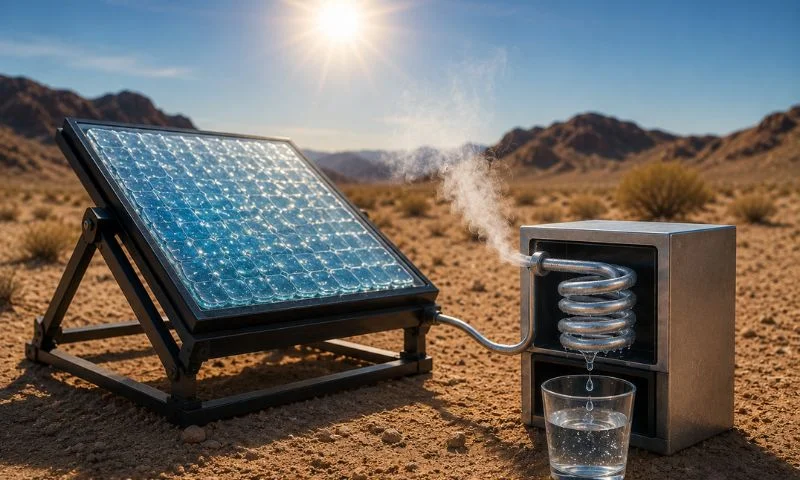
The material absorbs moisture from the atmosphere during cooler periods. Sunlight later heats the hydrogel and releases the trapped water vapour, which researchers then condense into drinkable water.
Earlier field tests took place in Chile’s Atacama Desert, one of the driest regions on Earth. Researchers mounted the hydrogel panel onto a black-painted aluminium sheet that absorbed solar heat and accelerated water release.
Researchers Solve Major Durability Problem
Although the hydrogel worked effectively in earlier experiments, scientists faced a major obstacle. The material began degrading after roughly 30 absorption and release cycles.
Researchers feared the breakdown could increase costs and contaminate collected water if degraded polymer or salt entered the condenser system.
After four years of laboratory testing, the team discovered that the aluminium surface beneath the hydrogel caused the issue.
The metal released ions that triggered damaging radicals inside the material, breaking down the polymer chains over time.
Scientists solved the problem by applying a commercial anti-corrosion coating to the metal surface. The coating blocked harmful ions from interacting with the hydrogel.
With the protective layer in place, the hydrogel remained stable for more than eight months during stress testing and completed over 190 water-harvesting cycles.
The findings appeared in the scientific journal Nature Communications on May 7.
The study stated that the coating strategy enabled “stable moisture absorption and release for more than 190 cycles over 96 days”.
Cheap Water Production Could Transform Dry Regions
Carlos Diaz-Marin, assistant professor of energy science and engineering at Stanford’s Doerr School of Sustainability and co-lead author of the study, said the breakthrough could sharply reduce water production costs.
According to Stanford researchers, the technology may eventually produce drinking water for less than one cent per litre.
That would place the cost near tap water prices in some American cities and far below bottled water prices.
The current prototype generates up to two litres of water daily using a thin material layer spread across a panel roughly the size of a bath towel.
Stanford researchers said that amount roughly matches the minimum daily drinking water requirement for one person during emergencies.
Diaz-Marin hopes to increase production to five litres per day to make the system more practical for rural communities in dry inland regions where desalination remains difficult or expensive.
Scientists say the hydrogel remains far from large-scale deployment. However, researchers continue working to improve efficiency, durability and manufacturing costs.
Experts believe atmospheric water harvesting technologies could become increasingly important as climate change intensifies droughts and water shortages worldwide.