

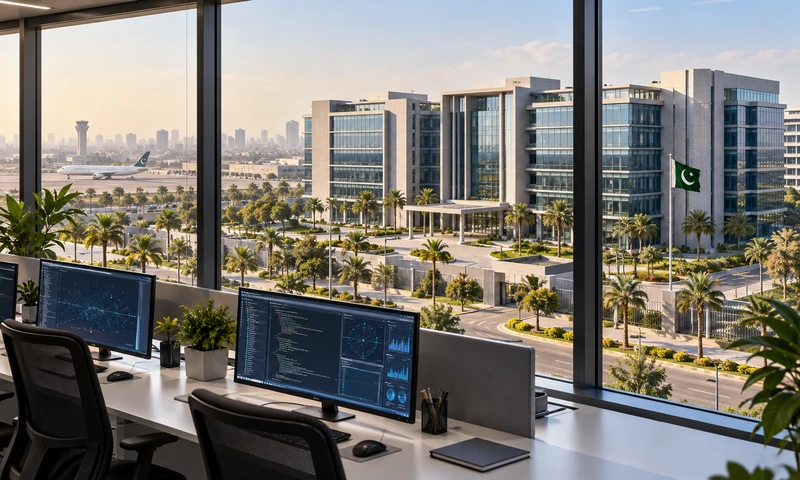
Federal Planning Minister Ahsan Iqbal says Karachi’s IT Park will create an estimated 15,000 jobs. He also expects the facility to generate up to $100 million annually in information and communication technology exports. The Pakistan Software Export Board (PSEB) is developing the project near Jinnah International Airport. It forms part of the government’s E-Pakistan programme under the Uraan Pakistan initiative. The planned park will offer approximately 1.18 million square feet of covered space. Its facilities will include 220 modern offices, 30 dedicated startup spaces and a Tier-III data centre. The government intends to establish a regional technology hub for Karachi through the project. The facility will accommodate IT companies, startups and technology-focused businesses while strengthening Pakistan’s digital economy and export capacity. The employment and export figures represent projected benefits once the park becomes operational. The project remains under development, with parliamentary scrutiny earlier this year highlighting substantial delays. Read More: Pakistan’s Zuma Eyes UK Expansion With Digital eSIMs and Physical SIMs The federal government has allocated approximately Rs3.75 billion for the Karachi IT Park in the 2026-27 Public Sector Development Programme. APP’s reporting on official budget documents puts the precise allocation at Rs3,745.486 million, or about Rs3.745 billion. This represents funding for the current financial year, rather than the project’s total development cost. The allocation forms part of approximately Rs19.58 billion for information technology and digital transformation projects under the federal development programme. The project has a longer history than the latest announcement suggests. The Executive Committee of the National Economic Council approved it on June 4, 2021. An official announcement at the November 2022 groundbreaking put the approved cost at $186.658 million. The financing plan included a $158.416 million loan from Korea Exim Bank and a Pakistani contribution of $28.242 million. That announcement described an eleven-storey complex, comprising eight floors above ground and three underground levels. It also listed testing laboratories, classrooms, an industry-academia linkage centre and an auditorium among the planned facilities. Authorities initially targeted June 2026 for completion, according to the same government statement. However, the National Assembly’s Standing Committee on Information Technology and Telecommunication raised concerns about progress at its June 2 meeting. Read More: Pakistan Earns $417 Million From IT Exports in Just One Month Chaired by Syed Amin ul Haq, the committee criticised the IT Ministry’s handling of the scheme. It noted that nearly five years had passed since the project’s introduction without significant progress. Members said authorities had advertised for a local consultant but had not effectively engaged bidders. They also highlighted the absence of a clear completion timeline and warned that delays continued to increase costs. The committee sought a comprehensive report covering progress, obstacles, next steps and the expected completion schedule. It also directed authorities to ensure transparency, merit and good governance throughout the project.
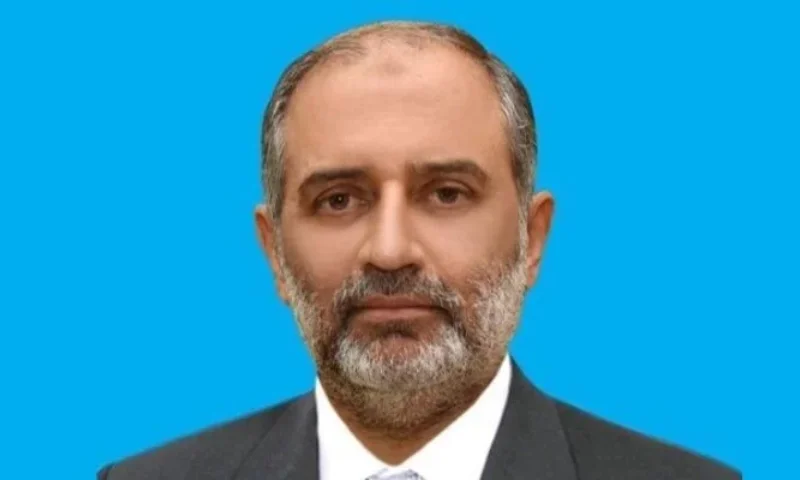
Nauman Mahmood Named Makkah Defence Alliance Secretary General
Pakistan has appointed Lieutenant General (retired) Nauman Mahmood as the first secretary general of the Makkah Defence Alliance. The Foreign Office announced the appointment on Wednesday, September 23. Mahmood will lead the alliance’s General Secretariat, which the three member countries are establishing in Riyadh, Saudi Arabia. The appointment follows last month’s agreement on the leadership and location of the secretariat. The alliance brings together Pakistan, Saudi Arabia and Turkiye under a joint defence framework signed last month. Mahmood becomes its first secretary general as the members put their institutional arrangements into place. Turkish Foreign Minister Hakan Fidan had confirmed on August 31 that a Pakistani would hold the position. He also announced Riyadh as the secretariat’s headquarters during a media briefing in Istanbul. Read More: Trump Hails Pakistan-Saudi-Turkiye Defence Pact as ‘Bold Step’ Pakistan, Saudi Arabia and Turkiye signed the “Makkah Joint Defence Agreement” on August 7. The members subsequently adopted the name “Makkah Defence Alliance”. The three countries held the inaugural meeting of their Strategic Political and Defence Committee in Istanbul on August 31. They established the committee under the tripartite agreement to advance political and defence cooperation. Deputy Prime Minister and Foreign Minister Ishaq Dar and Defence Minister Khawaja Asif represented Pakistan at the meeting. Field Marshal Syed Asim Munir joined them as Chief of Army Staff and Chief of Defence Forces. Saudi Defence Minister Prince Khalid bin Salman also attended the high-level discussions. Turkiye’s delegation included Fidan, National Defence Minister Yasar Guler and Turkish General Staff Chief Selcuk Bayraktaroglu. Officials from the three countries have described the alliance as a pledge to support their collective security. They have stressed that it does not target any country. Fidan outlined several principles governing the framework during his August 31 briefing. These include international law, respect for sovereignty and territorial integrity, and non-interference in countries’ domestic affairs. Read More: Turkiye in Advanced Talks to Join Saudi-Pakistan Military Alliance: Report He said the alliance would promote regional peace, security, stability and prosperity. He also described it as complementary to other alliances involving its members. Friendly countries that accept these principles could participate, he added. The members are also considering how to expand the alliance beyond its three founding countries. Reuters reported that Fidan announced work on a roadmap for admitting additional members after the Istanbul meeting. Fidan previously told Anadolu that Turkiye expected Egypt to join “in the next stage”. He said only “a few technical issues” stood in the way. Bangladesh has also signalled interest in joining the framework. Prime Minister’s Foreign Affairs Adviser Humaiun Kobir said Dhaka maintained a positive approach towards an economic or defence arrangement involving the three countries. Kobir said Bangladesh would consider its own interests alongside changing global economic and trade dynamics when assessing such participation.

PHF Targets Six Months of International Hockey Activity in Pakistan
Pakistan plans to host several international hockey events over the next six months, with China, Canada and European teams expected to visit. Pakistan Hockey Federation (PHF) President Mohyuddin Ahmed Wani announced the plans while speaking to reporters. He said the visits would help promote hockey and revive international activity in the country. The programme includes overseas tours, a proposed multinational tournament and a domestic league. However, the federation has yet to announce detailed schedules for most of these events. China tour scheduled for November Wani said China’s hockey team would visit Pakistan in November 2026, following Korea’s tour. Canada is expected to arrive after China, while three European teams have indicated their readiness to visit Pakistan. The PHF president did not identify the European sides in the reported remarks. He also provided no match dates, host cities or venues for the proposed tours. Read More: Mohsin Naqvi Announces Jobs and Medical Support for Pakistan Hockey Team The planned visits would bring teams from different regions to Pakistan over the coming months. Wani linked their arrival to efforts to rebuild the sport’s domestic profile and international calendar. His six-month outlook extends into early 2027, although China’s November visit remains the only tour with a specified month. Ten-nation tournament and league planned Looking further ahead, Wani said Pakistan intends to host a 10-nation international hockey tournament in December 2027. The federation also plans a domestic hockey league during 2027 as part of its wider development programme. The announcement did not include participating countries for the multinational competition. Details of the league’s format, teams, financing and launch date also remain outstanding. Both initiatives therefore remain plans, with operational arrangements still to emerge publicly. Pakistan brings a substantial sporting history to its efforts to expand international activity at home. The national team won the men’s World Cup in 1971, 1978, 1982 and 1994. It also claimed Olympic gold in 1960, 1968 and 1984, according to Pakistan Olympic Association records. PHF awaits neutral-venue decision Wani also addressed Pakistan’s participation in the upcoming Asian Champions Trophy, which India is scheduled to host. He said the Asian Hockey Federation (AHF) holds the authority to relocate the tournament. The PHF has already asked the continental body to move the competition to a neutral venue. According to Wani, the AHF has not yet communicated a decision on that request. Read More: Pakistan Hockey Captain Blasts Federation After Troubled Australia Tour “We understand the rules and regulations that have to be followed in this matter, but we have made our position clear,” he said. He added that Pakistan’s national honour and dignity remain the federation’s foremost priorities in international hockey matters. Hockey India’s published schedule places the tournament in Mohali and Jalandhar from October 27 to November 5, 2026. Pakistan’s request therefore concerns an approaching continental competition, alongside its separate plans to attract visiting teams and develop new events at home.

Abrar Ahmed Edges Rashid Khan for Top T20I Ranking
Pakistan spinner Abrar Ahmed has become the world’s top-ranked T20I bowler for the first time, overtaking Afghanistan’s Rashid Khan. The ICC’s September 23 update places Abrar first with 736 rating points. Rashid slipped to second, just one point behind, ending his six-month spell at the summit. The ICC attributed the change to Rashid’s performance in Afghanistan’s final match against India. Abrar’s promotion makes him the fifth Pakistan bowler to lead the men’s T20I bowling rankings. He joins Umar Gul, Saeed Ajmal, Imad Wasim and Shahid Afridi on that list. Australia’s Adam Zampa also advanced, moving up one place to third in the latest update. Nawaz holds eighth as Pakistan bowlers move Mohammad Nawaz retained eighth position with 658 rating points, giving Pakistan two representatives inside the bowling top 10. Left-arm seamer Salman Mirza dropped one place to 18th with 636 points. Shaheen Shah Afridi also slipped one position, moving to 33rd with 602 points. Further down the table, Usman Tariq climbed two places to 57th with 524 points. Sufiyan Muqeem gained one position to reach 63rd with 510 points. Read More: Mohammad Amir Breaks Silence on His Pakistan Cricket Future Saim Ayub improved his bowling ranking by one place, reaching 71st with 492 points. Shadab Khan remained 77th on 485 points. Fast bowler Haris Rauf advanced two positions to 86th with 448 points. The movements produced a mixed update for Pakistan’s attack. Abrar claimed the leading position, while Nawaz maintained his place among the format’s highest-ranked bowlers. Farhan stays third in batting rankings Pakistan opener Sahibzada Farhan retained third position in the T20I batting rankings with 848 rating points. India’s Ishan Kishan leads the table, followed by compatriot Abhishek Sharma. Farhan remains Pakistan’s highest-ranked batter in the format. Ayub gained ground in both disciplines during the update. Alongside his bowling improvement, he climbed two batting positions to 39th with 560 points. Former white-ball captain Babar Azam also rose two places, reaching 41st with 555 points. Pakistan T20I captain Salman Ali Agha held 45th position with 547 points. Fakhar Zaman remained 72nd with 481 points. Among the Pakistani batters listed, Farhan maintained a substantial rankings advantage over his teammates. England players also make gains Elsewhere, England captain Harry Brook climbed five places to a career-best fourth in the T20I batting rankings. He scored an unbeaten 114 in Southampton and accumulated 170 runs against Sri Lanka, earning the player-of-the-series award. Read More: Which Teams Will Play Cricket at LA28? ICC Reveals the Full Plan Jos Buttler moved up two places to fifth after scoring 172 runs in England’s 3-0 series victory. England seamer Jamie Overton recorded another significant rise. His five wickets against Sri Lanka lifted him 47 places to a career-best sixth among T20I bowlers.
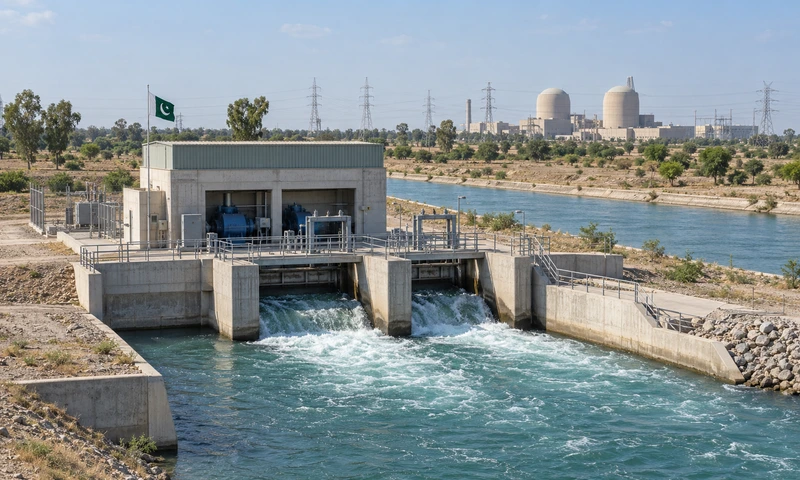
Pakistan Plans New Hydropower Plant at Chashma-5 Nuclear Site
PAEC Foundation has signed a contract for a 5MW hydropower plant at the outfall of the Chashma-5 Nuclear Power Plant. The Foundation Hydel Power Plant Unit-05 (FHPP-05) will become the foundation’s fifth hydropower plant. PAEC announced the agreement on September 23, with electricity generation expected to begin by September 2029. Once operational, the facility should supply approximately 30.66 million kilowatt-hours of clean electricity annually to Pakistan’s national grid. The project will harness available hydropower potential at the site, supporting more efficient water use and expanding the foundation’s renewable-energy portfolio. Chinese-Pakistani joint venture signs contract PAEC Foundation signed the agreement at PAEC Headquarters with a joint venture comprising three companies. The partners include China Ocean Engineering Construction Corporation Ltd. and Ningbo Water Conservancy and Hydro Power Planning and Design Institute Co., Ltd. Pakistan’s Habib Rafique Engineering (Pvt.) Ltd. completes the consortium. The announcement did not disclose the contract value, financing arrangements or individual responsibilities of the joint-venture partners. Read More: $5bn Neelum-Jhelum hydropower project to stay offline until 2028 The planned annual output equals 30.66 gigawatt-hours, or an average of about 84,000 electricity units daily across a full year. These figures represent projected generation after the facility starts operating. The September 2029 target places the anticipated start roughly three years after the contract announcement. PAEC said the development would complement its wider contribution to Pakistan’s energy sector while adding 5MW of renewable generation capacity. Hydropower builds on Chashma’s water infrastructure The choice of a nuclear power plant’s outfall reflects an established approach at the Chashma site. Regulatory documents for the separate Kundian Hydel Power project identify the Chashma-3 and Chashma-4 water discharge canal as its water source. NEPRA’s July 2025 generation licence describes that facility as a 5MW canal-based hydropower plant using two 2.5MW vertical Kaplan turbines. Its licensed supply arrangement serves installations within the PAEC complex. FHPP-05, by comparison, carries an announced target to supply the national grid. The new press release provides no turbine specifications or detailed operating arrangements. Both projects illustrate how water infrastructure associated with nuclear facilities can support additional electricity production. Project complements Pakistan’s nuclear fleet PAEC operates six nuclear power plants with a combined capacity of 3,530MW, according to its announcement and official nuclear-power overview. The commission describes their electricity as clean, sustainable and low-cost. Its existing fleet includes four nuclear plants at Chashma. Chashma-5 itself is a separate, much larger nuclear project with a planned capacity of 1,200MW. Read More: “Mud and Ice Tidal Wave” Exposes a Growing Himalayan Threat The Pakistan Nuclear Regulatory Authority issued its construction licence on December 26, 2024. The regulator identified it as Pakistan’s largest planned electricity-producing nuclear power plant. The newly contracted hydropower facility will expand PAEC Foundation’s renewable operations alongside that broader nuclear development.
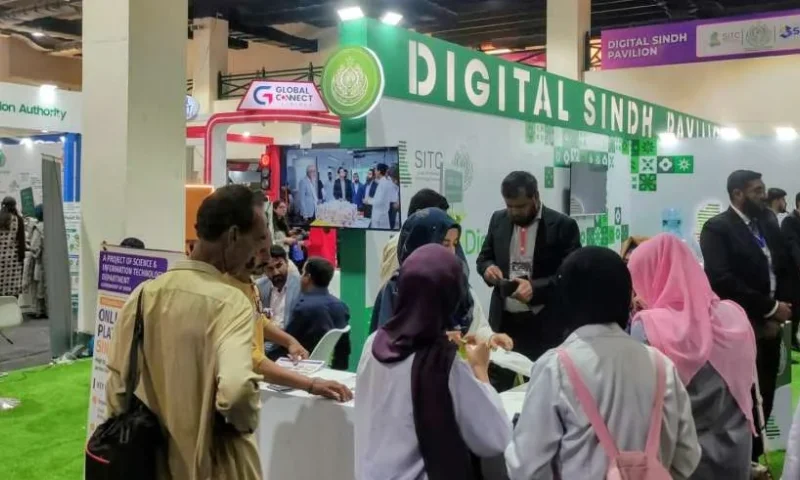
Five Halls of Technology: What to Explore at ITCN Asia Karachi
The 28th ITCN Asia opened at Karachi Expo Centre on September 22, bringing together technology companies, investors and policymakers. Muhammad Ali Rashid, Sindh’s special assistant for science and information technology, inaugurated the exhibition. The organiser’s schedule confirms the three-day event runs through September 24. Ecommerce Gateway Pakistan organises the exhibition, with the Special Investment Facilitation Council (SIFC) serving as strategic supporter. The Special Technology Zones Authority (STZA) and Sindh’s Science and IT Department are strategic partners. Ignite–National Technology Fund serves as national innovation partner. International participation and investment Organisers report more than 850 booths and 3,500 global brands across five exhibition halls. They expect over 75,000 trade visitors, including more than 18,500 CxOs and decision-makers. Projections also include over 350 international delegates and investors, alongside more than 850 government leaders. Participating countries include Azerbaijan, China, South Korea, Australia, Türkiye, Egypt, the United Kingdom and Switzerland. Read More: World CIO 200 Summit: Sindh Backs Tech Talent and Startups Muhammad Umair Nizam, ITCN Asia CEO and P@SHA senior vice chairman, outlined the event’s commercial priorities. “ITCN Asia brings Pakistan’s technology capabilities into direct conversation with international markets and investors. With SIFC’s support, our focus is on helping businesses build partnerships, expand export opportunities and create pathways for startups and innovators to grow.” Dedicated pavilions cover robotics, Azerbaijan, China, Gilgit-Baltistan, SBP banking, Digital Sindh, diplomatic participation, STZA, startups and CIO/CISO participation. Technology demonstrations and business-to-business meetings aim to connect exhibitors with potential commercial partners. Technology and policy leaders join programme The inaugural programme featured Digital Cooperation Organization Secretary-General Deemah Al-Yahya and World Business Angels Investment Forum Chairman Baybars Altuntas. Other participants included A2Z Creatorz CEO Zohaib Khan, Finserv Experts Managing Director Areiel Wolanow and SKSEED Secretary-General Dr Wael Bedda. GIZ Pakistan’s Daniel Gautsch, implementation manager for the EU–Talent Partnership Pakistan, also featured. ICCD Holding Company CEO Dr Mohamed Ibrahim and senior strategist Zeba Qureshi joined the programme. Read More: Pakistan’s $1 Trillion Ambition Gets a Tech Push With Quantum Valley Pakistani representatives included Brigadier Syed Nadir Hussain Shah, SIFC’s IT and telecom project director, and STZA Chairman Azfar Manzoor. NTC Managing Director Maj Gen (retd) Ali Farhan and Pakistan Digital Authority Vice Chairperson Mohammad J. Sear also featured. The programme included Ignite CEO Muhammad Bilal Abbasi and Pakistan Software Export Board CEO Faisal Jeddy. Universal Service Fund CEO Chaudhry Mudassar Naveed and STZA Chief Market Development Officer Hamza Saeed Orakzai also participated. The official agenda listed Al-Yahya’s contribution as a virtual keynote. It also included discussions on responsible AI and moving technology exports from services towards products. AI, cybersecurity and workforce sessions The opening day included the 13th Pakistan Investor Summit 2026. September 23 features STZA’s “Pakistan’s AI Imperative” and NTC’s “Connected Nation: Leadership Roundtable”. The Future Leaders Awards and a programme on Saudi Arabia’s gaming ecosystem also feature. September 24 includes Ignite’s “Cyber Crisis Command: Executive Tabletop Exercise” and Best of Entrepreneurship Asia. TABADLAB’s “Workforce 2.0: Building Pakistan’s AI-Ready Economy” completes the announced programme, linking technology adoption with workforce development.
Pakistan Eyes Higher-Value Seafood Exports With New Korangi Estate
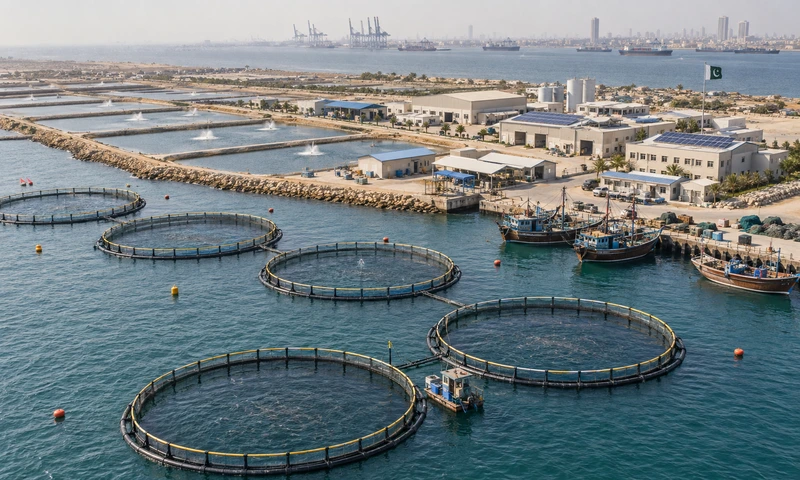
Pakistan plans to establish a 100-acre mariculture estate at Karachi’s Korangi fisheries harbour to attract investment and expand higher-value seafood production. Federal Maritime Affairs Minister Muhammad Junaid Anwar Chaudhry outlined the proposal during a briefing on September 22. The proposed Mariculture Investment and Development Estate (MIDE) would bring marine farming, hatcheries, research and commercial services into one development. It would also incorporate seafood processing, value addition and cold-chain facilities. The concept identifies the National Deep Sea Fishing Harbour, under the Korangi Fisheries Harbour Authority (KoFHA), as the project’s institutional setting. Four zones for farming, hatcheries and research The concept master plan allocates 30 acres to mariculture and 20 acres each to hatcheries, an aqua research park and a commercial district. These four allocations total 90 acres. The announcement does not specify a separate allocation for the remaining 10 acres. “The development of a modern mariculture ecosystem can help Pakistan move towards higher-value fisheries production, strengthen aquatic seed production and promote value addition and export-oriented activities,” Junaid Chaudhry said. Read More: Pakistan Eyes $300m Seafood Export Opportunity in Russia The hatchery zone would support advanced aquatic seed production. Meanwhile, the research park would provide facilities for scientific work, innovation and training. Mariculture involves farming marine organisms in coastal and ocean environments while managing their interaction with surrounding ecosystems. These organisms can include fish, shrimp, oysters, mussels and seaweed. The announcement did not identify which species the proposed estate would prioritise. Cold-chain facilities and renewable energy Beyond farming and research, the estate would accommodate processing facilities, cold-chain infrastructure, commercial services and hospitality facilities. The infrastructure plan includes internal roads, electricity supply and renewable-energy facilities. Water supply, water treatment and wastewater treatment systems also form part of the proposal. Information and communication technology would support smart-estate management. Security, surveillance, green belts and landscaping would complete the planned supporting infrastructure. Chaudhry said the initiative aimed to attract investors, raise exports, create jobs and encourage technology and innovation within Pakistan’s blue economy. “Investing in modern marine infrastructure and technology is essential for building a sustainable blue economy and creating new economic opportunities for coastal communities,” he said. Wider fisheries reform provides context The proposal follows earlier efforts to develop a coordinated national approach to fisheries and aquaculture. In July 2025, the Maritime Affairs Ministry held a national consultation on the National Fisheries and Aquaculture Policy 2025–2035. The Food and Agriculture Organization provided technical support. Read More: Pakistan’s $80M Seafood Zone at Korangi Aims to Boost Exports and Jobs At that consultation, Chaudhry described the sector as underdeveloped despite Pakistan’s marine and inland water resources. Officials highlighted overfishing, weak regulation and the need for stronger federal-provincial coordination. The policy discussions also covered climate resilience, environmental protection, modern technology and seafood exports. For the Korangi estate, the September 22 announcement outlined a concept rather than a construction schedule. It provided no project cost, financing arrangement or completion deadline.
Guterres’ Final UN Address Urges AI Curbs, End to Wars
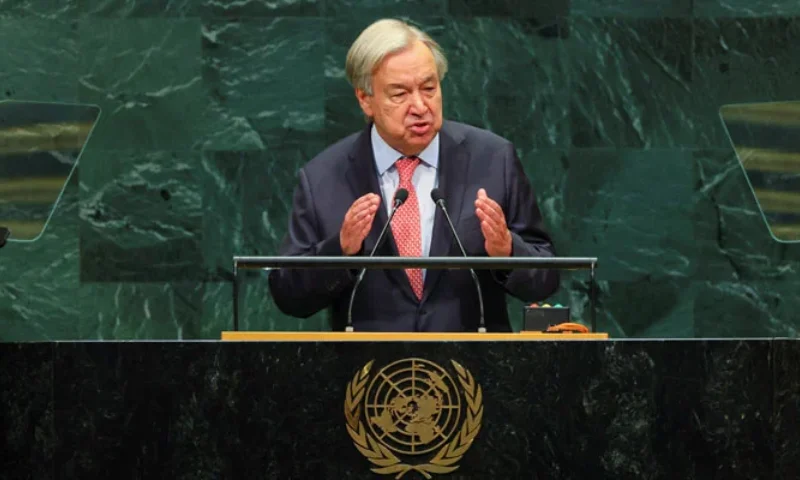
UN Secretary-General Antonio Guterres urged global AI safeguards, an end to wars and institutional reform in his final General Assembly address. Speaking in New York on September 22, he also demanded climate action. The former Portuguese prime minister’s second five-year term ends December 31. Nearly 130 world leaders gathered, although China’s Xi Jinping and leaders from India, South Africa and Germany stayed away. AI safeguards take centre stage “Those countries leading this technological revolution must share information on emerging safety risks, cooperate on testing and evaluation – and work towards common safeguards that protect us all,” Guterres said. He urged leaders to “advance the conditions for the responsible pacing of AI and the additional safeguards needed to address risks”. They should also “work towards a multilateral AI risk management framework, supported by credible and independent oversight.” His appeal preceded a briefing by AI leaders to the 15-member Security Council. US Treasury Secretary Scott Bessent said Sunday that Washington had proposed an AI safety notification mechanism. Trump and Xi would consider it at their summit this week. Emerging from US-China AI dialogue talks, it would cover incidents with national-security implications. The UN established a 39-member AI advisory body in 2023, bringing together executives, officials and academics, including Americans, Russians and Japanese. The Security Council first discussed AI risks that year. China warned against a “runaway horse”, while Washington opposed AI-enabled censorship and repression. The General Assembly subsequently established an independent scientific AI panel and global governance dialogue in August 2025. Wars and climate dominate appeals Guterres called for “de-escalation and dialogue” as Houthi gains threatened Red Sea shipping and tensions persisted in the Strait of Hormuz. “Together, let’s send a clear message from this hall: The fighting must stop. Humanitarian aid must flow. And navigational rights and freedoms must be fully restored in accordance with international law,” he said. Delegates applauded his defence of an Israeli-Palestinian two-state solution, demands that “polluters must pay” and calls for institutional reform. A farewell amid UN strains Throughout his decade in office, Guterres promoted conflict mediation and international technology governance. However, major powers increasingly bypassed the organisation. Trump and others criticised UN inefficiency. Washington withdrew from several agencies and cut funding. Guterres warned that “our mechanisms for collective action are under growing strain”. Global institutions, he said, “continue to reflect the power realities and interests of a largely bygone age.” He closed by promising continued advocacy after leaving office. “So, on January 1st, when I am no longer Secretary-General, be sure of this. Wherever I will be, whatever I will be doing – I will keep championing the conviction that peace is possible,” he said. “I will continue to stand up for the values of the United Nations Charter and I will never, ever give up. Thank you.”

Apple Takes On Microsoft and Nvidia With Macs Built for Local AI
Apple is pitching its upgraded Mac mini and Mac Studio computers to businesses seeking lower artificial intelligence costs. Its argument: buying desktop hardware can cost less than renting cloud computing capacity. The machines, scheduled to start shipping Tuesday, can approach $20,000 and run demanding AI tasks locally, Reuters reported. These include writing code and completing complex business work without buying cloud “tokens” from providers such as OpenAI or Anthropic. They will compete with new desktops from Nvidia and PC manufacturers. Those machines will likely feature at Microsoft’s Windows event in San Francisco next month. Apple faces a substantial market gap. IDC’s Linn Huang puts its enterprise desktop share at 4.6%, against Windows’ 91.3%. Apple’s memory design strengthens AI push Apple’s opening stems partly from its focus on energy efficiency, including lessons from battery-powered iPhones. Its 2020 transition to Apple Silicon brought computing and memory closer through unified memory architecture. That design also helped Macs handle AI workloads. Nvidia and others have more recently moved towards closer integration. Mac mini demand surged as OpenClaw, an open-source agentic AI tool, gained popularity in markets including China. Read More: JBS Adds Apple to Its Portfolio in New Enterprise Partnership Apple also added specialised capabilities to Mac Studio, originally aimed at video and music professionals. These include RDMA over Thunderbolt for communication between machines. This month, Apple demonstrated four connected Mac Studios running a trillion-parameter model to identify and fix a graphics coding bug. The setup used one wall outlet. “Once you have the machine on your desk, you’ve paid for it. And I believe we provide absolutely great value, not only in terms of performance, but cost,” said Johny Srouji, Apple’s chief hardware officer. “There’s no cost per token. You’re just using the machine again and again.” Apple’s earlier M3 Ultra Mac Studio already offered up to 512GB of unified memory in March 2025. Microsoft pursues “unmetered intelligence” Microsoft CEO Satya Nadella describes on-device AI as “unmetered intelligence”. He also plans to combine AI features into a Windows “super app”. Windows supports many hardware vendors, which can complicate chip-specific optimisation for developers. Microsoft said Windows ML helps streamline that work, while RDMA remains an active investment area. Its documentation confirms support for local AI across CPUs, GPUs and neural processing units. Nvidia declined comment. At its summer PC-chip launch, CEO Jensen Huang downplayed direct competition with Apple, emphasising expanded Windows capabilities. From desktop Macs to iPhones Nvidia retains its data-centre stronghold. Apple instead highlights shared chip designs that let developers scale models between expensive Mac Studios and cheaper iPhones and iPads. The corporate push contrasts with co-founder Steve Jobs’ ambivalence towards enterprise sales, where end users often lacked purchasing choice. Read More: Apple Launches iPhone Duo, but Is It Worth the $1,999 Price? “There is so much power you can pump into the data center,” Srouji said. “We’re offering a variety of products that customers can choose based on their own needs: Which computer, which product do I need?”
Pakistan Seeks Boeing Deal to Modernise PIA’s Fleet
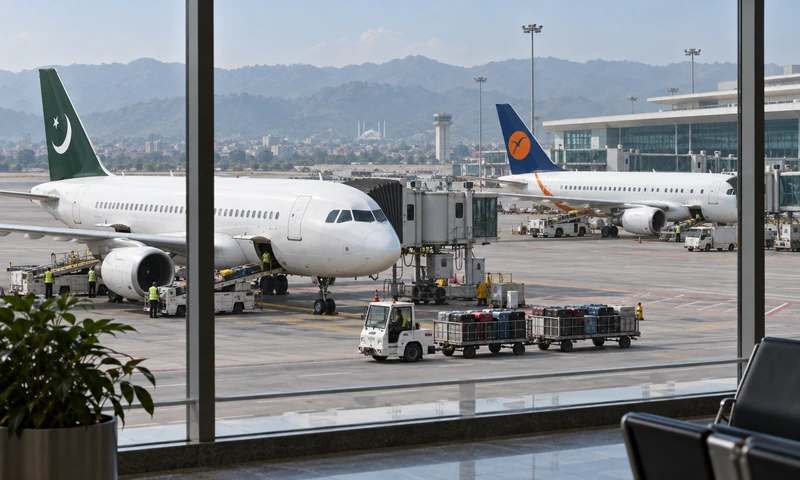
Boeing will share a revised proposal for new aircraft with Pakistan International Airlines as both sides explore earlier deliveries and interim leasing arrangements. Finance Minister Muhammad Aurangzeb discussed the plans with Boeing Global President Dr Brendan Nelson during his visit for the 81st United Nations General Assembly. The meeting covered PIA’s fleet modernisation and broader aviation cooperation. Aurangzeb welcomed Boeing’s commitment to revise its proposal and explore ways to accelerate aircraft availability. Discussions included US Export-Import Bank financing support, engine procurement, spare parts, maintenance and restoring grounded aircraft. Read More: PIA Passes IATA Safety Audit, Secures Registration Until 2028 Aurangzeb outlined PIA’s privatisation and plans to outsource major airports’ management. He also praised Boeing’s support for aviation safety, regulatory engagement and efforts to restore direct flights to the United States. The minister highlighted Pakistan’s long-term aviation growth potential. The talks follow a July meeting between Interior Minister Mohsin Naqvi, PIA’s new management and Boeing in Washington. That discussion covered a proposed acquisition of 16 aircraft, according to Associated Press of Pakistan. Hepatitis C screening faces delays Separately, Aurangzeb met a representative of Abbott’s Pharmaceuticals Division to review Pakistan’s Hepatitis C elimination programme and pharmaceutical-sector concerns. He expressed concern that the programme had used only around 100,000 of approximately three million diagnostic tests procured. That represents roughly 3.3% of the available tests, highlighting the scale of the implementation shortfall. Aurangzeb attributed the slow progress to leadership turnover, weak project management and limited public awareness. He appreciated Abbott’s technical assistance, drawing on its experience supporting Egypt’s large-scale screening programme. The meeting also addressed the Drug Regulatory Authority of Pakistan’s regulatory capacity and pharmaceutical export diversification. Abbott’s oncology treatment plans and delays in resolving hardship medicine-pricing cases also featured. Aurangzeb stressed the need to balance affordability, commercial viability and uninterrupted medicine supplies. He committed to raising implementation problems with relevant Pakistani authorities to accelerate progress. Pakistan presses for faster climate finance At the UN-hosted “Solutions Dialogue on Climate Finance”, Aurangzeb highlighted Pakistan’s acute climate vulnerability. He said the government must establish credible adaptation and disaster-response frameworks, early-warning systems and climate strategies. Developing a pipeline of bankable projects also remained essential. Climate resilience, he said, required domestic macroeconomic stability and adequate fiscal and external buffers. International assistance should complement national resources. Read More: PIA Adds Three More London Flights as Travel Demand Grows He outlined a financing strategy combining domestic funding, World Bank assistance and the IMF’s Resilience and Sustainability Facility. Green capital-market instruments and private-investor partnerships also formed part of that approach. The IMF approved approximately $1.4 billion for Pakistan under the facility in May 2025 to strengthen resilience against climate-related shocks. Aurangzeb voiced concern over delays in making the Loss and Damage Fund operational. He urged the Green Climate Fund and other international institutions to simplify accreditation, approval and disbursement procedures. Faster processes would help vulnerable countries access climate financing more efficiently.
