


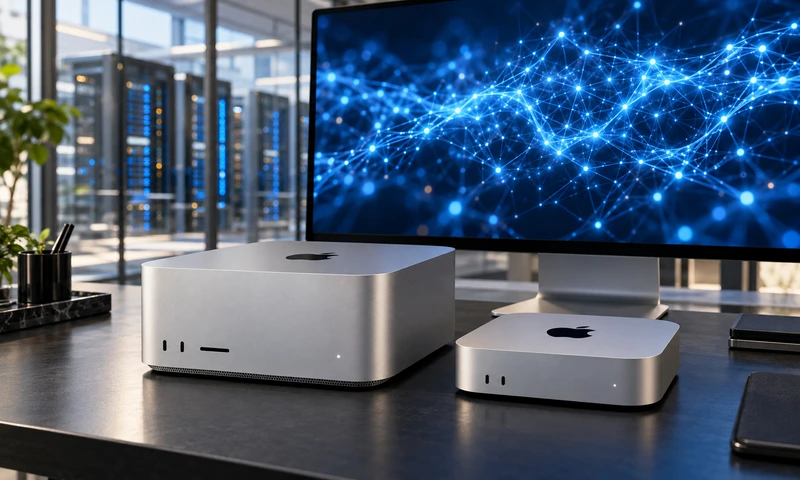
Apple is pitching its upgraded Mac mini and Mac Studio computers to businesses seeking lower artificial intelligence costs. Its argument: buying desktop hardware can cost less than renting cloud computing capacity.
The machines, scheduled to start shipping Tuesday, can approach $20,000 and run demanding AI tasks locally, Reuters reported. These include writing code and completing complex business work without buying cloud “tokens” from providers such as OpenAI or Anthropic.
They will compete with new desktops from Nvidia and PC manufacturers. Those machines will likely feature at Microsoft’s Windows event in San Francisco next month.
Apple faces a substantial market gap. IDC’s Linn Huang puts its enterprise desktop share at 4.6%, against Windows’ 91.3%.
Apple’s memory design strengthens AI push
Apple’s opening stems partly from its focus on energy efficiency, including lessons from battery-powered iPhones.
Its 2020 transition to Apple Silicon brought computing and memory closer through unified memory architecture. That design also helped Macs handle AI workloads. Nvidia and others have more recently moved towards closer integration.
Mac mini demand surged as OpenClaw, an open-source agentic AI tool, gained popularity in markets including China.
Read More: JBS Adds Apple to Its Portfolio in New Enterprise Partnership
Apple also added specialised capabilities to Mac Studio, originally aimed at video and music professionals. These include RDMA over Thunderbolt for communication between machines.
This month, Apple demonstrated four connected Mac Studios running a trillion-parameter model to identify and fix a graphics coding bug. The setup used one wall outlet.
“Once you have the machine on your desk, you’ve paid for it. And I believe we provide absolutely great value, not only in terms of performance, but cost,” said Johny Srouji, Apple’s chief hardware officer.
“There’s no cost per token. You’re just using the machine again and again.”
Apple’s earlier M3 Ultra Mac Studio already offered up to 512GB of unified memory in March 2025.
Microsoft pursues “unmetered intelligence”
Microsoft CEO Satya Nadella describes on-device AI as “unmetered intelligence”. He also plans to combine AI features into a Windows “super app”.
Windows supports many hardware vendors, which can complicate chip-specific optimisation for developers.
Microsoft said Windows ML helps streamline that work, while RDMA remains an active investment area. Its documentation confirms support for local AI across CPUs, GPUs and neural processing units.
Nvidia declined comment. At its summer PC-chip launch, CEO Jensen Huang downplayed direct competition with Apple, emphasising expanded Windows capabilities.
From desktop Macs to iPhones
Nvidia retains its data-centre stronghold. Apple instead highlights shared chip designs that let developers scale models between expensive Mac Studios and cheaper iPhones and iPads.
The corporate push contrasts with co-founder Steve Jobs’ ambivalence towards enterprise sales, where end users often lacked purchasing choice.
Read More: Apple Launches iPhone Duo, but Is It Worth the $1,999 Price?
“There is so much power you can pump into the data center,” Srouji said.
“We’re offering a variety of products that customers can choose based on their own needs: Which computer, which product do I need?”

























