


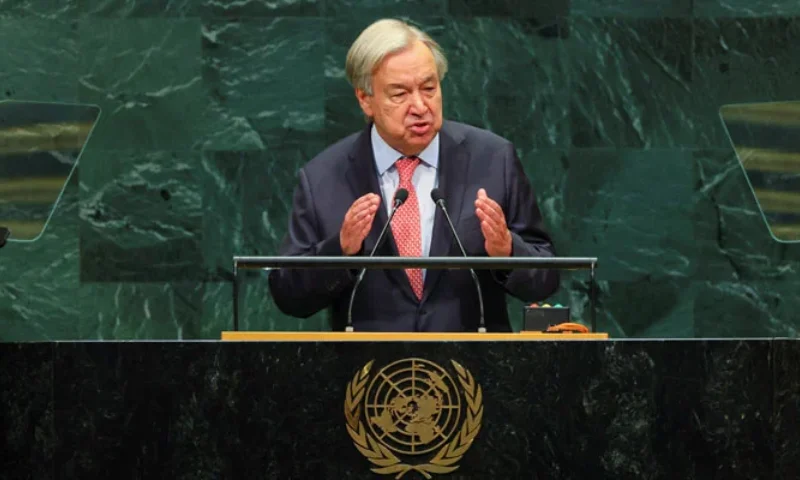
UN Secretary-General Antonio Guterres urged global AI safeguards, an end to wars and institutional reform in his final General Assembly address.
Speaking in New York on September 22, he also demanded climate action. The former Portuguese prime minister’s second five-year term ends December 31.
Nearly 130 world leaders gathered, although China’s Xi Jinping and leaders from India, South Africa and Germany stayed away.
AI safeguards take centre stage
“Those countries leading this technological revolution must share information on emerging safety risks, cooperate on testing and evaluation – and work towards common safeguards that protect us all,” Guterres said.
He urged leaders to “advance the conditions for the responsible pacing of AI and the additional safeguards needed to address risks”. They should also “work towards a multilateral AI risk management framework, supported by credible and independent oversight.”
His appeal preceded a briefing by AI leaders to the 15-member Security Council.
US Treasury Secretary Scott Bessent said Sunday that Washington had proposed an AI safety notification mechanism. Trump and Xi would consider it at their summit this week.
Emerging from US-China AI dialogue talks, it would cover incidents with national-security implications.
The UN established a 39-member AI advisory body in 2023, bringing together executives, officials and academics, including Americans, Russians and Japanese.
The Security Council first discussed AI risks that year. China warned against a “runaway horse”, while Washington opposed AI-enabled censorship and repression.
The General Assembly subsequently established an independent scientific AI panel and global governance dialogue in August 2025.
Wars and climate dominate appeals
Guterres called for “de-escalation and dialogue” as Houthi gains threatened Red Sea shipping and tensions persisted in the Strait of Hormuz.
“Together, let’s send a clear message from this hall: The fighting must stop. Humanitarian aid must flow. And navigational rights and freedoms must be fully restored in accordance with international law,” he said.
Delegates applauded his defence of an Israeli-Palestinian two-state solution, demands that “polluters must pay” and calls for institutional reform.
A farewell amid UN strains
Throughout his decade in office, Guterres promoted conflict mediation and international technology governance. However, major powers increasingly bypassed the organisation.
Trump and others criticised UN inefficiency. Washington withdrew from several agencies and cut funding.
Guterres warned that “our mechanisms for collective action are under growing strain”. Global institutions, he said, “continue to reflect the power realities and interests of a largely bygone age.”
He closed by promising continued advocacy after leaving office.
“So, on January 1st, when I am no longer Secretary-General, be sure of this. Wherever I will be, whatever I will be doing – I will keep championing the conviction that peace is possible,” he said.
“I will continue to stand up for the values of the United Nations Charter and I will never, ever give up. Thank you.”

























