


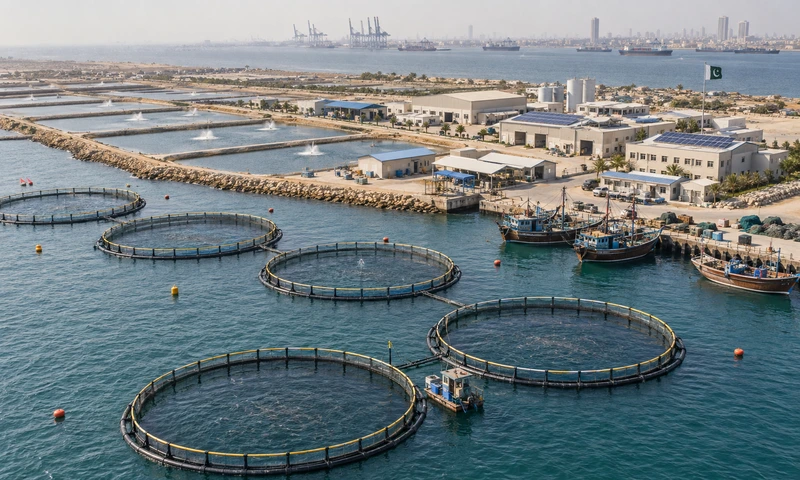
Pakistan plans to establish a 100-acre mariculture estate at Karachi’s Korangi fisheries harbour to attract investment and expand higher-value seafood production.
Federal Maritime Affairs Minister Muhammad Junaid Anwar Chaudhry outlined the proposal during a briefing on September 22.
The proposed Mariculture Investment and Development Estate (MIDE) would bring marine farming, hatcheries, research and commercial services into one development. It would also incorporate seafood processing, value addition and cold-chain facilities.
The concept identifies the National Deep Sea Fishing Harbour, under the Korangi Fisheries Harbour Authority (KoFHA), as the project’s institutional setting.
Four zones for farming, hatcheries and research
The concept master plan allocates 30 acres to mariculture and 20 acres each to hatcheries, an aqua research park and a commercial district.
These four allocations total 90 acres. The announcement does not specify a separate allocation for the remaining 10 acres.
“The development of a modern mariculture ecosystem can help Pakistan move towards higher-value fisheries production, strengthen aquatic seed production and promote value addition and export-oriented activities,” Junaid Chaudhry said.
Read More: Pakistan Eyes $300m Seafood Export Opportunity in Russia
The hatchery zone would support advanced aquatic seed production. Meanwhile, the research park would provide facilities for scientific work, innovation and training.
Mariculture involves farming marine organisms in coastal and ocean environments while managing their interaction with surrounding ecosystems. These organisms can include fish, shrimp, oysters, mussels and seaweed.
The announcement did not identify which species the proposed estate would prioritise.
Cold-chain facilities and renewable energy
Beyond farming and research, the estate would accommodate processing facilities, cold-chain infrastructure, commercial services and hospitality facilities.
The infrastructure plan includes internal roads, electricity supply and renewable-energy facilities. Water supply, water treatment and wastewater treatment systems also form part of the proposal.
Information and communication technology would support smart-estate management. Security, surveillance, green belts and landscaping would complete the planned supporting infrastructure.
Chaudhry said the initiative aimed to attract investors, raise exports, create jobs and encourage technology and innovation within Pakistan’s blue economy.
“Investing in modern marine infrastructure and technology is essential for building a sustainable blue economy and creating new economic opportunities for coastal communities,” he said.
Wider fisheries reform provides context
The proposal follows earlier efforts to develop a coordinated national approach to fisheries and aquaculture.
In July 2025, the Maritime Affairs Ministry held a national consultation on the National Fisheries and Aquaculture Policy 2025–2035. The Food and Agriculture Organization provided technical support.
Read More: Pakistan’s $80M Seafood Zone at Korangi Aims to Boost Exports and Jobs
At that consultation, Chaudhry described the sector as underdeveloped despite Pakistan’s marine and inland water resources. Officials highlighted overfishing, weak regulation and the need for stronger federal-provincial coordination.
The policy discussions also covered climate resilience, environmental protection, modern technology and seafood exports.
For the Korangi estate, the September 22 announcement outlined a concept rather than a construction schedule. It provided no project cost, financing arrangement or completion deadline.

























