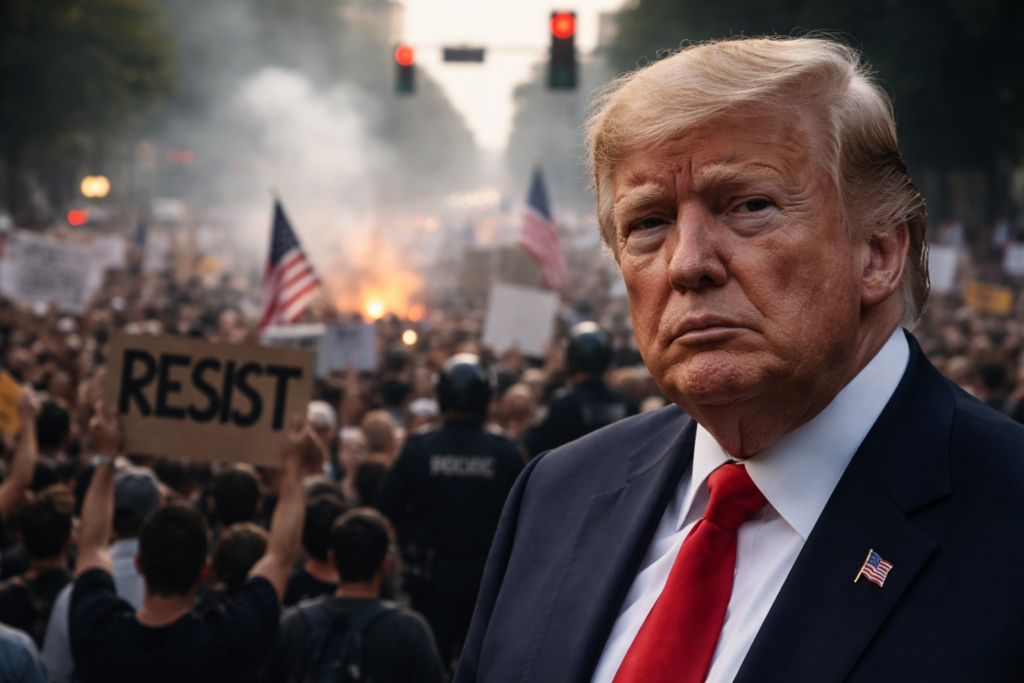
From Minneapolis to major coastal cities, a widening wave of protests against Donald Trump is turning into one of the most sustained opposition movements of his current tenure—raising questions about how much political pressure the White House can absorb while pushing controversial policies.
The latest flashpoint emerged in Minneapolis, where thousands poured onto the streets after a fatal shooting involving a federal immigration officer during an enforcement operation. City officials described the incident as unjustified, while federal authorities defended the officer’s actions. The clash ignited days of demonstrations, some peaceful and others tense, forcing local authorities to deploy additional police and issue repeated appeals for calm.
What stands out, however, is that Minneapolis is no longer an exception—it has become part of a nationwide pattern.
How widespread are the protests?
Independent protest-tracking initiatives and academic research paint a clear picture: opposition to Trump’s policies has translated into tens of thousands of protest events across the United States since January 2025.
Civil rights groups and grassroots coalitions have coordinated hundreds to more than a thousand demonstrations on single national days, while smaller, localized protests continue almost daily. Importantly, these rallies are not limited to traditionally liberal urban centers. Research shows that more than a third of U.S. counties have witnessed at least one protest in peak months, including areas that previously voted for Trump.
Unlike one-off protest surges seen in earlier political cycles, this movement has shown persistence. Protest activity has flared repeatedly around immigration enforcement, civil liberties, and federal-state tensions—creating a rhythm of mobilization rather than a single moment of outrage.
Why this matters for Trump’s presidency
Street protests alone do not remove a U.S. president from office. Yet analysts warn that the scale, spread, and consistency of the current demonstrations could still pose a serious challenge to Trump’s ability to govern effectively.
First, the geographic reach matters. When opposition activity spills into politically mixed or conservative-leaning regions, it increases pressure on Republican lawmakers and local officials who must balance party loyalty with voter sentiment.
Second, the protests are policy-driven, especially around immigration raids and federal enforcement actions. Each new operation risks triggering another cycle of demonstrations, lawsuits, and political confrontation—draining time and political capital.
Third, sustained protests shape the national narrative. They influence media coverage, energize opposition voters, and keep controversial policies in the spotlight ahead of critical elections and legislative battles.
The bigger picture
The demonstrations erupting in Minneapolis—and echoed across the country—signal that public resistance to Trump’s agenda is no longer sporadic. It is organized, recurring, and increasingly national in character.
While the White House remains institutionally secure, the growing protest movement represents a long-term political stress test: not an immediate threat to Trump’s position, but a mounting force capable of complicating governance, weakening public approval, and reshaping the political landscape as his tenure continues.