China’s reported artificial intelligence computing power has sparked global attention after figures suggested it could be as much as 6,000 times larger than what is reflected in widely used international benchmarks, raising questions about how AI capacity is measured and compared.
The striking gap stems from differences in methodology rather than a sudden technological leap, according to analysis cited in recent reporting. Official Chinese data points to a massive domestic computing capacity, while global rankings such as the Top500 list capture only a fraction of that power.
At the centre of the debate is the concept of a “dark pool” of computing resources, referring to infrastructure that is not fully accounted for in international comparisons. China’s Ministry of Industry and Information Technology has reported national AI computing power reaching around 1,882 exaflops, or quintillions of calculations per second, far exceeding figures seen in global rankings.
Different metrics, different results
Experts say the apparent 6,000-fold difference is largely due to how computing power is measured.
International benchmarks such as Top500 focus on high-performance supercomputers, while China’s figures include a broader range of distributed computing resources, including data centres and AI-specific infrastructure.
This means the two datasets are not directly comparable, even though they are often interpreted as such.
Analysts note that China’s approach reflects a shift toward measuring practical AI capacity rather than just peak performance of individual machines.
Massive infrastructure push
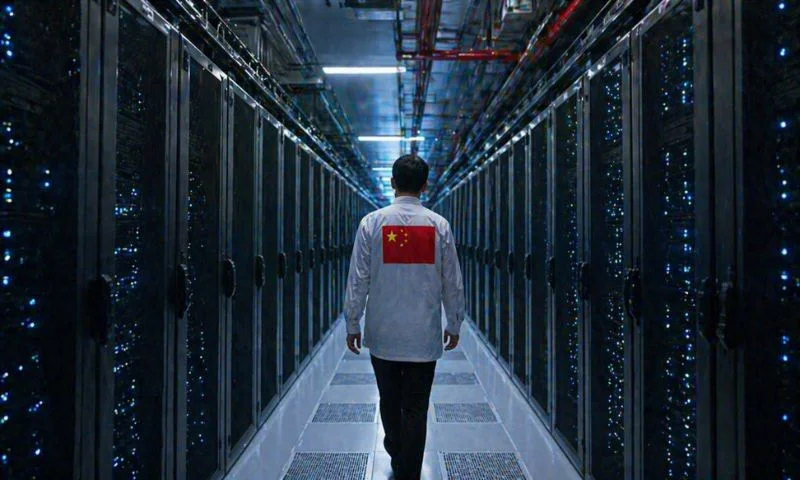
The data also highlights China’s aggressive investment in AI infrastructure. The country has been building large-scale computing clusters and nationwide networks linking multiple data centres, enabling them to function as a single system.
Recent developments include the launch of massive AI computing clusters and distributed networks connecting dozens of cities, designed to accelerate training of large AI models and support industrial applications.
China’s strong electricity supply and energy infrastructure are also seen as key advantages, as AI systems require vast amounts of power to operate at scale.
Narrowing gap with the US
The debate comes amid intensifying competition between China and the United States in artificial intelligence.
While the US continues to dominate global AI benchmarks and hosts many of the world’s largest data centres, China’s rapid expansion of domestic computing capacity is narrowing the gap.
Unlike China, the US does not publish a single national figure for AI computing power, as much of its infrastructure is privately owned and measured differently.
This makes direct comparisons difficult and contributes to the perception of a dramatic disparity.
What it means for the AI race
Experts say the key takeaway is not the headline number, but the underlying trend.
China’s computing capacity is growing rapidly, supported by government policy, infrastructure investment and industrial demand for AI applications.
The country has made artificial intelligence a central pillar of its economic strategy, integrating it across manufacturing, healthcare and technology sectors.
Reality behind the numbers
Despite the attention-grabbing figure, analysts caution against interpreting the 6,000 times claim as a direct measure of technological superiority.
Instead, it reflects differences in reporting standards and the inclusion of broader computing resources.
Even so, the data underscores the scale of China’s AI ambitions and its determination to compete at the highest level.
As global competition intensifies, the race for computing power is likely to become a defining factor in the future of artificial intelligence.