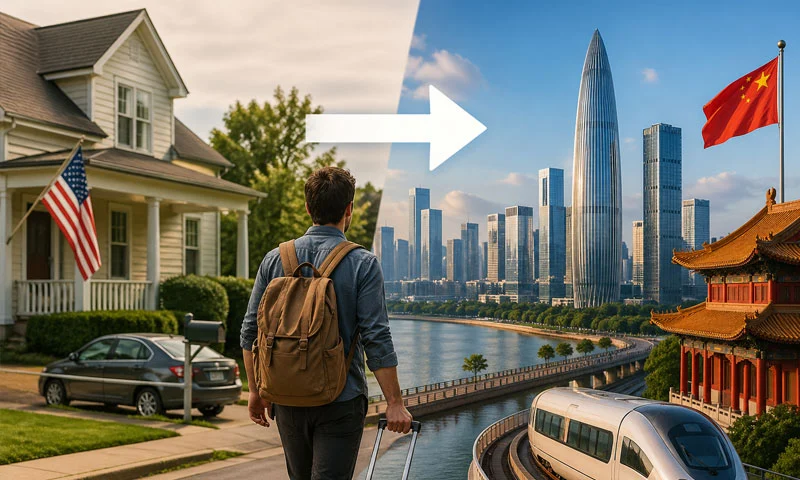
Bradley Krae says his life in Shenzhen represents his version of the American Dream in China, after moving from the United States nearly a decade ago and building a new life with his family.
From One-Way Ticket to New Life
Krae moved to Shenzhen in 2016 at the age of 27 after securing a job as an English teacher. He funded the move by selling his car in North Carolina and buying a one-way ticket. It marked his first trip outside the United States.
“If you’d told me back then that I’d end up in China, I would’ve laughed,” he said.
Read More: Five New Chinese EVs in The Price of One Car in US: The Price Gap Shaking the Auto Industry
Born in California, Krae grew up across several states including Arizona, Colorado, Virginia, Montana and Oklahoma. He said he never stayed in one place long enough to call it home.
Over the next four years, he travelled across Asia, visiting countries such as Cambodia and Thailand. He said the experience helped him “test” his courage and expand his worldview.
Krae later met his wife in Shenzhen. She was born in French Polynesia to Chinese parents and worked as a French teacher. The couple spent three years in China before the Covid-19 pandemic forced them to relocate to Tahiti when borders closed.
Five years later, they decided to return. “China still felt like our true home,” he said. The family moved back to Shenzhen in June 2025 and now live there with their two young children.
Lower Costs and Tech-Driven Lifestyle
Krae said the cost of living played a major role in his decision. He estimates that he now spends about 25 percent of what he used to spend in the United States.
“All told, I’m paying about a fourth of the cost of what I used to pay for my monthly expenses when I lived in the US — and that was when I was living by myself,” he said.
Read More: Is China Really 6,000x Ahead in AI? The Reality May Surprise You
He earns around $4,000 a month teaching English. The family rents a three-bedroom apartment for about $1,000 monthly. Internet costs roughly $29, electricity averages $100, and groceries for a family of four total about $100 per month.
Dining out remains affordable, with meals rarely exceeding $10 for the entire family. Healthcare costs stand at around $90 per month.
Krae described Shenzhen as a city shaped by rapid technological growth. “To me, Shenzhen is like if Silicon Valley and New York City had a baby,” he said.
He pointed to drone deliveries, autonomous taxis and widespread QR-code payments as examples of everyday innovation. Public transport also remains inexpensive, with subway fares starting at around 30 cents.
“Technology feels both advanced and accessible here,” he added.
Family Life and New Opportunities
Krae said safety remains one of the biggest advantages of living in Shenzhen. “I have no need or desire to become a helicopter parent here,” he said. “I’m not worried about things like gun violence.”
He joked that his main concern involves “electric scooters flying down the sidewalks.”
Read More: China Launches World’s First Floating Artificial Island for Deep-Sea Research
The city offers more than 1,000 parks and multiple indoor play areas. His children attend a public kindergarten where they learn Mandarin. At home, they speak English with him and French with their mother.
The school costs about $300 per semester for both children, including meals. Krae also said food quality appears healthier compared to his experience in the United States.
During his time in Tahiti, Krae began sharing his experiences online. In 2025, he started posting regularly on TikTok, encouraged by his wife. His videos gained traction, turning him into a social media influencer.
He later secured a marketing manager role earning about $3,500 monthly, alongside $1,200 from side income and content creation.
“It’s a more traditional job than what I’m used to,” he said, “but I’m not stuck at a desk all day.”
“No one is more surprised than me that I’ve found my own version of the American Dream here in China,” he said.