University of Tokyo researchers have transformed food scraps into small, rigid prototype materials, with Chinese cabbage waste producing the strongest result. The sample reached nearly 18 megapascals in bending strength, about four times the team’s benchmark for ordinary concrete.
It suggests a new use for food waste, but does not establish cabbage as structural concrete. The 2021 work appeared as a conference paper and non-peer-reviewed preprint.
Food scraps pressed into solid material
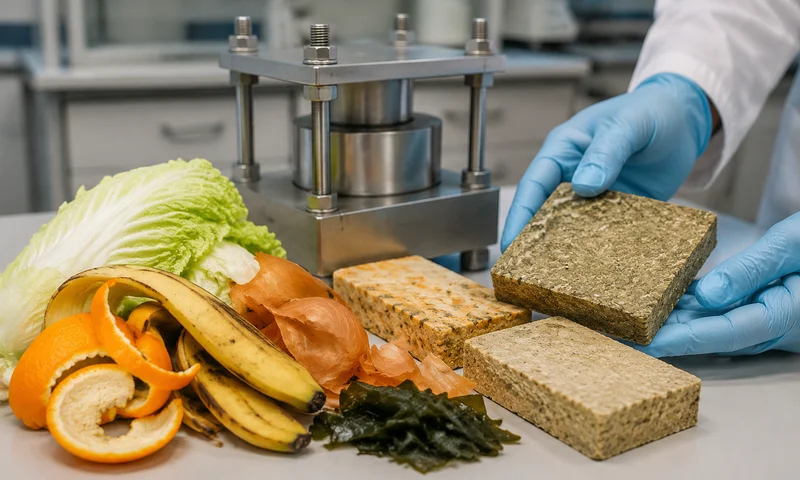
Kota Machida and materials engineer Yuya Sakai used orange, onion, pumpkin and banana peels. They also tested outer leaves from Chinese and ordinary cabbage, plus seaweed.
The team cut and dried the scraps at 105 degrees Celsius or used vacuum drying. They then ground them with a blender or disk mill. After adding water and sometimes edible seasonings, the researchers compressed the powder inside a heated mould.
Read More: From Farm Waste to Fashion: Pakistan Launches Banana Fiber Initiative
Test conditions ranged from 60 to 180 degrees Celsius and from 6 to 50 MPa of pressure. One common setting used 100 degrees, 50 MPa and 10 minutes. Each ingredient required its own combination of temperature, moisture and pressure.
No petroleum-based resin held the particles together. Heat softened glucose and other sugar-rich components, which filled gaps between plant fibres and hardened after cooling.
“Initially, I thought we could make lumps from these materials, but I never imagined they would be so strong,” Sakai said.
Chinese cabbage delivers standout strength
A three-point bending test put the Chinese cabbage sample at 17.7 MPa. The researchers used 5 MPa as their ordinary-concrete comparison, making the sample about 3.5 times stronger. University accounts rounded that result to four times.
Most other food-based specimens met or exceeded the 5 MPa target. Pumpkin fell short, but adding 25 percent Chinese cabbage lifted the mixture to about 10 MPa.
Sakai said strength depends on particle size, drying method, moisture and processing temperature. The balance between sugar and dietary fibre also matters. The university has since reported usable materials from about 30 food-waste types.
Still, flexural strength measures resistance to bending. Concrete usually carries buildings through compressive strength. The tests therefore do not establish suitability for columns, foundations or reinforced slabs.
Edible claim comes with limits
The untreated samples contained food-derived ingredients, and the authors tasted them. Salt improved flavour and sometimes strength, while sugar and natural edible clay were also tested. Vacuum-dried pieces kept more colour, smell and taste. Oven-dried samples often darkened and became bitter.
Yet the project included no formal food-safety, toxicology or shelf-life assessment. “Edible” means the experimental pieces contained food ingredients, not that future building panels would be safe to eat.
Read More: From Waste to Wonder: Beaconhouse Students Redefine Sustainable Art
Moisture also weakened uncoated samples. Researchers saw no visible mould, rot, insects or worms during four months indoors, but long-term durability remains unproven. Urethane coatings can improve water resistance, although they remove the material’s edible and all-food character.
Machida later co-founded University of Tokyo spin-off fabula. The company has made tableware, promotional items and furniture, including cacao-husk bench surfaces used at Expo 2025 Osaka.
The wider waste problem remains vast. UNEP estimates that consumers discarded 1.05 billion tonnes of food in 2022, including inedible parts.