The FIFA World Cup has long produced stories that extend beyond football. At the 2026 tournament, one of the most fascinating narratives involves four families whose sons are representing different countries on the sport’s biggest stage.
For parents and relatives, national allegiances have become secondary to family pride. Yet the possibility remains that brothers could face each other in matches that carry the highest stakes in international football.
“The ultimate test for any parent: two sons lining up on opposite sides of the pitch. Who do you cheer for?”
The unusual scenario is not entirely new. Football fans still remember the famous rivalry between half-brothers Jérôme Boateng and Kevin-Prince Boateng, who represented Germany and Ghana respectively.
The pair first faced each other at the 2010 FIFA World Cup in South Africa when Germany defeated Ghana in the group stage. Four years later, they met again at the 2014 World Cup in Brazil, creating one of football’s most memorable family stories.
Sixteen years later, the possibility of similar encounters remains alive at the 2026 tournament.
Williams and Doué Brothers Follow Different Paths
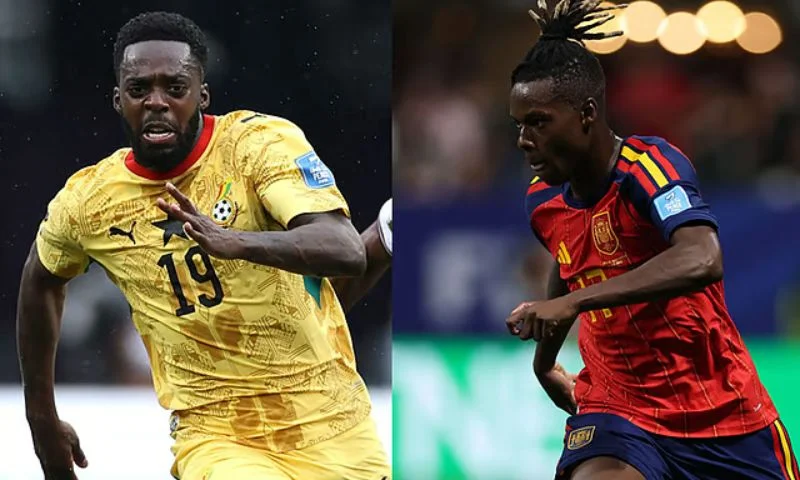
The highest-profile sibling story at this year’s World Cup belongs to Iñaki and Nico Williams.
Born in Bilbao to Ghanaian parents who migrated to Spain, both brothers developed through the youth ranks of Athletic Club and became stars in European football.
However, their international journeys took different directions.
Iñaki Williams, 32, chose to represent Ghana and switched allegiance from Spain in 2022. Since then, he has become one of the Black Stars’ most experienced players and a key figure in their attack.
His younger brother Nico Williams, 23, opted to remain with Spain. The winger emerged as one of Europe’s most exciting talents and played a crucial role in Spain’s UEFA Euro 2024 triumph.
Another family divided by international football is the Doué family.
Désiré Doué has rapidly established himself as one of France’s brightest young stars following his breakthrough performances for club and country.
His older brother, Guéla Doué, represents Ivory Coast. Although both were born in France, family heritage and personal choices led them down different international paths.
The possibility of France and Ivory Coast meeting later in the tournament has added another layer of intrigue.
Ghana Features in Two Sibling Stories
Ghana appears in two separate sibling rivalries at World Cup 2026.
Netherlands striker Brian Brobbey progressed through the Dutch football system and earned his place in the Oranje squad. His older brother Derrick Luckassen chose to represent Ghana, strengthening the African nation’s connection to this unique World Cup subplot.
The fourth family involves Harry and John Souttar.
Harry Souttar represents Australia through his mother’s Australian heritage and has become one of the Socceroos’ most influential defenders.
His brother John Souttar plays for Scotland and remains a key figure in the Scottish national team setup.
Football’s increasingly global nature has made such stories more common. FIFA eligibility rules allow players with multiple national connections to represent countries linked through birth, ancestry or residency.
As migration and multicultural identities continue shaping modern football, sibling rivalries across national teams may become less unusual.
For now, however, the Williams, Doué, Brobbey-Luckassen and Souttar families remain among the most compelling human stories of World Cup 2026.
Should the tournament draw align, football fans could witness another unforgettable chapter in the history of brothers divided by flags but united by family.