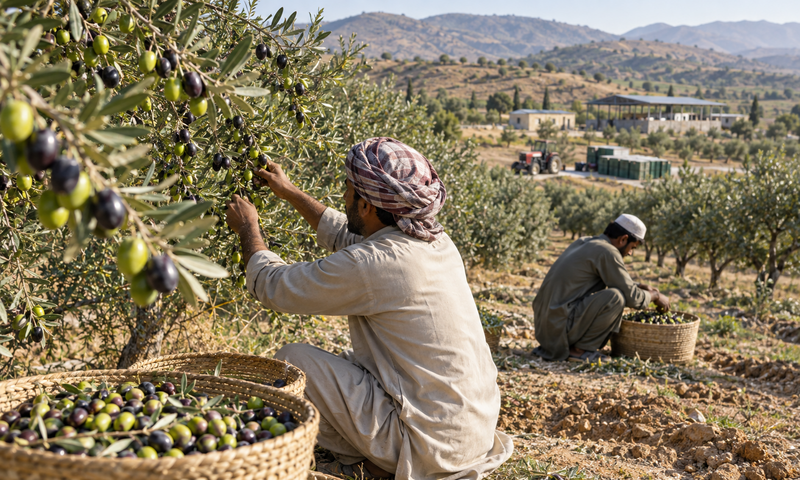
Pakistan is rapidly expanding olive cultivation to reduce its annual $4 billion edible oil import bill and develop a high-value export industry.
The country now has nearly seven million olive trees, compared with about half a million in 2016. Cultivation has expanded across Potohar, Khyber Pakhtunkhwa and parts of Balochistan, where the climate and soil support commercial production.
Dr. Muhammad Tariq, Project Director for the Promotion of Olive Cultivation on a Commercial Scale, said government support had already reduced dependence on imported olive oil.
“Due to our interventions and with government support over the past four to five years, our olive oil imports have decreased by about half, dropping from 400,000 tons to approximately 200,000 tons,” Tariq told Arab News.
He said Pakistan’s spending on olive oil imports fell from $14 million to roughly $9 million during fiscal year 2024-25. Olive oil exports have also shown steady growth.
“Looking at the current pattern, I think over the next three to four years our olive oil imports will be substituted by local production,” he added.
Government targets another 15,000 acres
Pakistan currently grows olives on about 60,000 acres. The government plans to add another 15,000 acres over the next three years.
Prime Minister Shehbaz Sharif formally launched the National Olive Value Chain Policy on August 24. The initiative covers cultivation, processing, quality control, branding and exports.
Sharif said Pakistan spends around $4 billion each year on crude edible oil imports. He described potential annual savings of $400 million as a “monumental service” to the country. The longer-term goal is complete self-sufficiency.
The prime minister also announced government-funded training for 100 young agricultural graduates in Italy. They will study olive farming, processing, quality control and marketing.
Pakistan’s olive programme began more than two decades ago. However, large-scale commercial cultivation has accelerated during recent years.
Dr. Faiyaz Alam, General Secretary of the Olive Council, Sindh, said wild olives have grown for centuries across the country’s hilly regions.
“Public awareness grew significantly after videos highlighting Pakistan’s wild olive resources emerged in 2020,” he said. “Government plantation programs subsequently accelerated the spread of commercial olive cultivation.”
Early grafting efforts started around 2000. Pakistan installed its first olive extraction machine at Tarnab Farm in Peshawar.
Exporters see billion-dollar opportunity
Industry leaders believe Pakistan can move beyond import substitution and capture part of the global olive oil market, estimated at around $22 billion.
“We have only seven million trees at the moment … We can plant 100 million trees and join the billion-dollar club of the global economy,” Loralai Olives founder and CEO Shaukat Rasool said.
His company has secured four international recognitions during the past two years, including awards in New York, Dubai, Berlin and London.
Rasool said Pakistani extra virgin olive oil offers competitive quality, high polyphenol levels and low acidity.
“I think there is a huge potential for Pakistan,” he said. “We have four million hectares of land available and the good thing is that olive is not in competition with other crops. So, we can grow as much olives as we can.”