
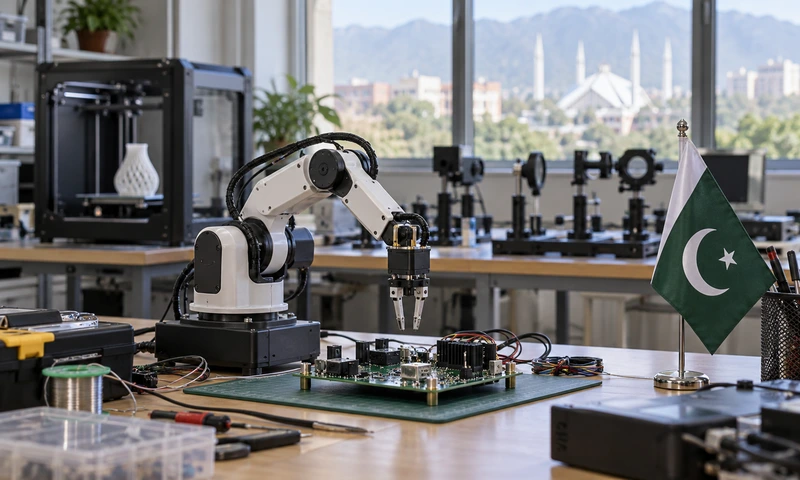
Federal Planning Minister Ahsan Iqbal launched Quantum Valley Pakistan on Wednesday, outlining a push to turn university research into commercially viable technologies.
The initiative combines international startup programmes, specialised science parks and shared development facilities. Its focus spans quantum computing, artificial intelligence, photonics and robotics, alongside technologies serving agriculture, healthcare and mineral industries.
The launch forms part of the government’s ambition to build a $1 trillion economy by 2035 and raise exports to $100 billion.
60 startups to access US innovation networks
According to the initiative’s announced plans, 30 ventures will connect with Silicon Valley through Plug and Play. Another 30 will head to Massachusetts through Cambridge Innovation Center, or CIC.
The programmes aim to help Pakistani startups move beyond domestic research environments and reach international markets.
Quantum Valley Pakistan signed separate agreements with CIC and Plug and Play at the launch ceremony. CIC CEO Tim Rowe, partner Dougan Sherwood and Plug and Play managing partner Seena Amidi attended.
Iqbal said the partnerships would connect young Pakistanis with global technology hubs and support entrepreneurship and high-tech businesses.
The initiative’s website outlines startup incubation and acceleration services, including mentorship, market access and technical guidance. It also states that QVP takes strategic equity stakes in selected startups in return for support.
Four science parks and nine national catapults
The infrastructure plan includes four specialised science parks covering agri-tech, biosciences, mines and minerals, and emerging technologies.
These facilities will support the broader effort to connect scientific expertise with industrial needs and commercial opportunities.
Nine planned national catapults will provide shared fabrication laboratories, pilot production lines and testing facilities. Their purpose is to help teams develop prototypes into products ready for commercial launch.
Shared facilities could give smaller ventures access to equipment and development capabilities that would be expensive to establish independently.
The programme also addresses steps beyond technical development. QVP lists intellectual property management, patent support, regulatory assistance and legal facilitation among its services.
Its technology-transfer offering includes access to early-stage technologies, dedicated land and assistance with relevant clearances. These services aim to help innovators move towards commercialisation and manufacturing.
Technology linked to export ambitions
Iqbal connected the launch with Pakistan’s wider economic objectives, including the $100 billion export target for 2035.
“Achieving a $1 trillion economy by 2035 is certainly difficult, but it is not impossible,” he said.
He recalled the establishment of national centres in 2017 covering fields including AI, cybersecurity, robotics and cloud computing. Those centres linked universities through a national technology network, he said.
The new initiative seeks to build on that research base by adding commercial support, shared infrastructure and international connections.
The science parks, catapults and overseas startup programmes represent planned components of that effort. Their central objective is to create a route from research laboratories to products that can compete internationally.