
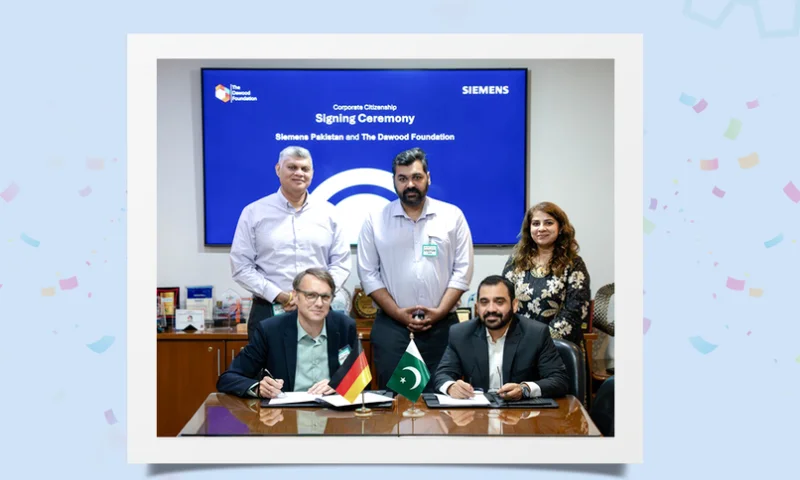
The Dawood Foundation and Siemens Pakistan have signed an agreement to expand access to practical science education for children from underserved communities.
Under the partnership, Siemens Pakistan has contributed Rs1 million to support educational visits to The Dawood Foundation’s MagnifiScience Centre in Karachi.
The initiative aims to bring children from different social and economic backgrounds into an interactive learning environment. It will allow them to explore scientific ideas through exhibits, experiments and practical activities.
Rs1 million contribution supports inclusive learning
The Dawood Foundation announced the collaboration through its official social media channels. It said the funding would help reduce barriers that prevent many children from accessing specialised science facilities.
“This collaboration will help make hands-on science experiences more accessible to children from diverse backgrounds. We thank Siemens Pakistan for supporting inclusive learning and investing in the future of our youth.”
The organisations did not disclose the number of children who will visit under the programme. They also did not announce a timeline for the sponsored visits.
However, the contribution strengthens TDF’s existing efforts to give underprivileged children access to informal science education.
The foundation runs programmes that sponsor visits and help cover practical costs linked to participation. Its public outreach also encourages individuals and companies to support children who may otherwise never visit a modern science centre.
MagnifiScience Centre promotes practical education
TDF describes the MagnifiScience Centre as Pakistan’s first contemporary and interactive science centre. The Karachi facility spans four floors and contains more than 300 exhibits.
The exhibits complement school curricula and help visitors understand how scientific concepts connect with everyday life. They cover several disciplines and encourage children to observe, question, experiment and solve problems.
The centre also seeks to bridge the gap between classroom teaching and practical science. Its approach promotes scientific literacy, critical thinking and curiosity through experiential learning.
TDF says the centre welcomes people of all ages, backgrounds and abilities. This inclusive model remains particularly important in Pakistan, where access to museums and informal STEM learning spaces often depends on household income and location.
Corporate support expands access to STEM
The partnership reflects growing interest in using corporate funding to improve access to science, technology, engineering and mathematics education.
For children from low-income households, admission fees and transport costs can make educational visits difficult. Sponsored programmes can give schools and community groups a chance to include practical learning in their activities.
The Dawood Foundation said Siemens Pakistan’s support represents an investment in young people and inclusive education.
The collaboration also aligns with the centre’s guiding belief that science learning should remain open to everyone, regardless of background or financial circumstances.
By supporting visits rather than limiting assistance to physical equipment, the programme will place children directly inside an environment built for discovery.