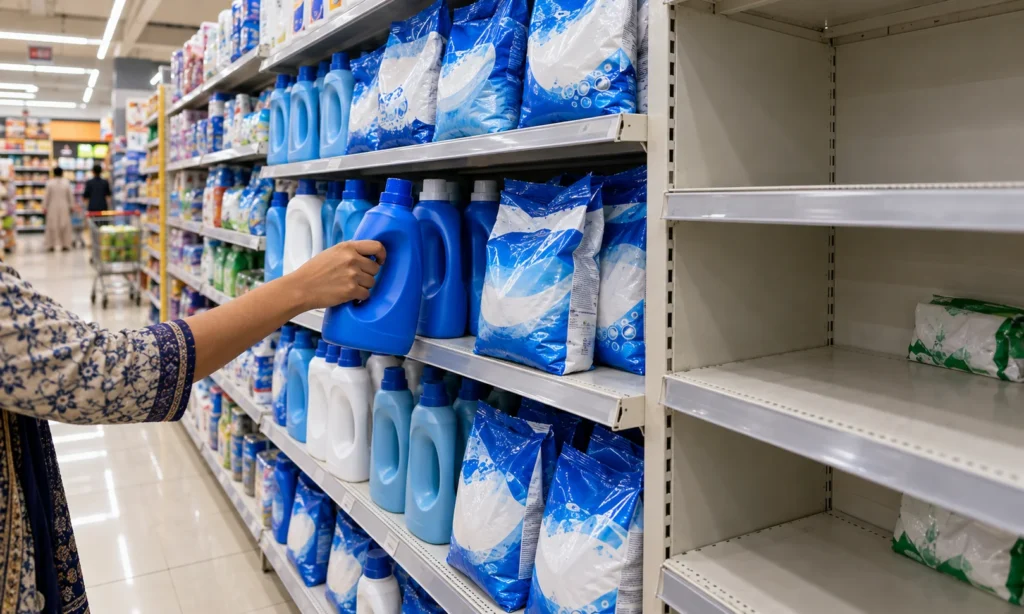
Unilever Pakistan says it is ahead of internal targets to capture demand left by Procter & Gamble’s withdrawal.
Home Care head Ammad Danish said three to four organised players are pursuing the share, but withheld volume and revenue figures.
Competition for P&G’s Former Market
“I think this is very unfortunate that P&G had to leave. I’m a firm believer in competition; it keeps you on your toes,” Danish said.
He argued that international competition promotes “fair play”. Local companies, he said, “don’t always play by the rules when it comes to taxation, formulation, pricing,” making competition tougher.
“We are ahead of track, and I think that’s a great place to be in. We will continue that next year,” he said.
Danish also warned of lost public revenue. “We all went for the pie that P&G vacated.”
“If organised players don’t operate, it’s bad for the government, because there’s a certain amount of taxation income that goes out.”
P&G announced its exit in October 2025 under global restructuring. Reuters said third-party distributors would continue serving Pakistan.
Home Care Business Returns to Growth
Unilever’s Home Care division, including Surf Excel and Vim, endured a three-to-four-year “lull period” before growing competitively for 24 to 36 months. “Competitive growth means market-beating growth.”
He credited restructuring into four focused units and a change in priorities. “We put the consumer back at the heart, not the P&L [profit and loss],” he said.
This strategy supported Surf Excel Whites and Surf Excel Liquid. Powder detergents still dominate 99% of Pakistan’s fabric-care market, but liquids are growing rapidly.
“We’re practically doubling every few quarters driven by consumer demand.”
Danish said broader participation remains essential because “multiple companies spoke about the benefits. The same needs to happen for liquids. If one player promotes liquids, it won’t accelerate conversion,” he said.
Supply Chain and AI Strategy
“The powder market [detergent] is heavily dependent on raw materials from the Middle East. All players in Pakistan were impacted. There were local shortages where raw material wasn’t coming in,” Danish said.
“This is where a multinational’s strength shows. With presence across markets, our vendor negotiation ability is stronger. We sustained that pressure better, and that’s become our strength in growth,” he added.
Unilever uses AI for planning, insights, content and performance management. “From ideation to execution, what took 3 weeks now takes 3 days. Man-hours saved are impeccable,” he said.
“We’re moving a lot of testing to digital. It’s 95%+ accurate. That saves cost and time, so decisions are faster and we can invest more back into the consumer,” Danish added.
His five-year ambition is “to become the biggest home care business in Pakistan,” overtaking Colgate-Palmolive.
“It’s an exciting time. If we keep the consumer at the centre and use tools like AI to enable our people, not replace them, I think home care has a very strong future in Pakistan.”