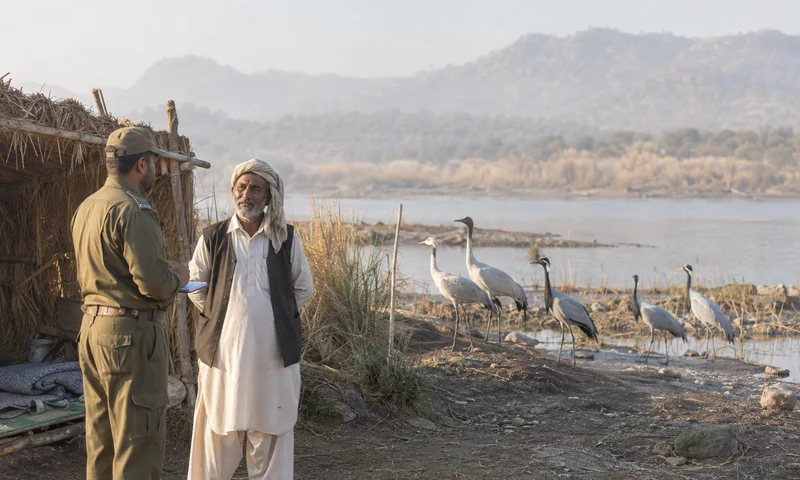
The Khyber Pakhtunkhwa Wildlife Department has opened the province’s 2026 live crane capture season under quotas, permit fees and strict movement controls.
The season runs from September 1 to October 15. The department has authorised up to 100 camps across selected districts, with each camp allowed to capture no more than 15 live cranes.
Only Common Cranes and Demoiselle Cranes fall within the permit system. Hunters and camp operators cannot hunt or capture any other bird species during the season.
Capture banned in protected locations
The notification imposes a complete ban on crane hunting and capture along the Kurram River and within designated refuges in Lakki Marwat and Zarmilan. Authorities have set both camp allocations and capture quotas at zero in those areas.
Officials will issue permits only to residents of authorised districts. Permit holders must rely on traditional capture practices. The rules prohibit electronic equipment, firearms and nets, and violations can trigger enforcement action.
Read More: Pelicans’ Eyes Stitched Shut in Shocking Wildlife Smuggling Case
The conditions aim to regulate a practice with deep roots in parts of southern KP while protecting migratory birds from uncontrolled capture. Both permitted species travel through Pakistan along regional migration routes.
Research has documented significant pressure on these birds. A 2021 study covering Bannu, Lakki Marwat and Karak found 93 hunting camps during earlier surveys. Researchers concluded that hunting and capture had a significant effect on local crane conservation.
Strict controls on movement and ownership
Camp operators may transport captured cranes only between 6am and midnight. Moving the birds between midnight and 6am remains prohibited.
At the close of the season, operators must dismantle every camp and register all captured cranes. The department will prohibit further movement after October 15 and confiscate birds found in violation.
Each camp permit costs Rs15,000. Owners must also pay an annual fee of Rs400 for every crane in their possession.
The notification sets the official value of a Demoiselle Crane at Rs7,000 and a Common Crane at Rs13,000. It bans the use of captured cranes for any commercial purpose.
Five-year blacklist for violations
Anyone who breaks the rules faces cancellation of their licence and a five-year blacklist. Authorities can also take action against camp leaders when hunters linked to their camps engage in illegal capture.
Wildlife officials warned that violations “will not be tolerated under any circumstances.”
The controls come amid wider concern about threats along Pakistan’s Indus Flyway. A 2026 study in the journal Waterbirds recorded 212 Common and Demoiselle cranes killed or captured in Punjab’s Bhakkar district between September 2023 and March 2024.
Read More: The Wildest Insurance Scam: Rolls-Royce ‘Bear Attack’ Turns Out to Be Human in Disguise
Researchers linked 61% of those cases to household consumption. Live capture for illegal trade and domestication accounted for 29%, while recreational hunting made up 10%.
The same study recorded about a 75% decline in wetland area across Bhakkar between 2000 and 2024. Its authors called for stronger anti-poaching enforcement, wetland restoration and measures to reduce collisions with power lines.