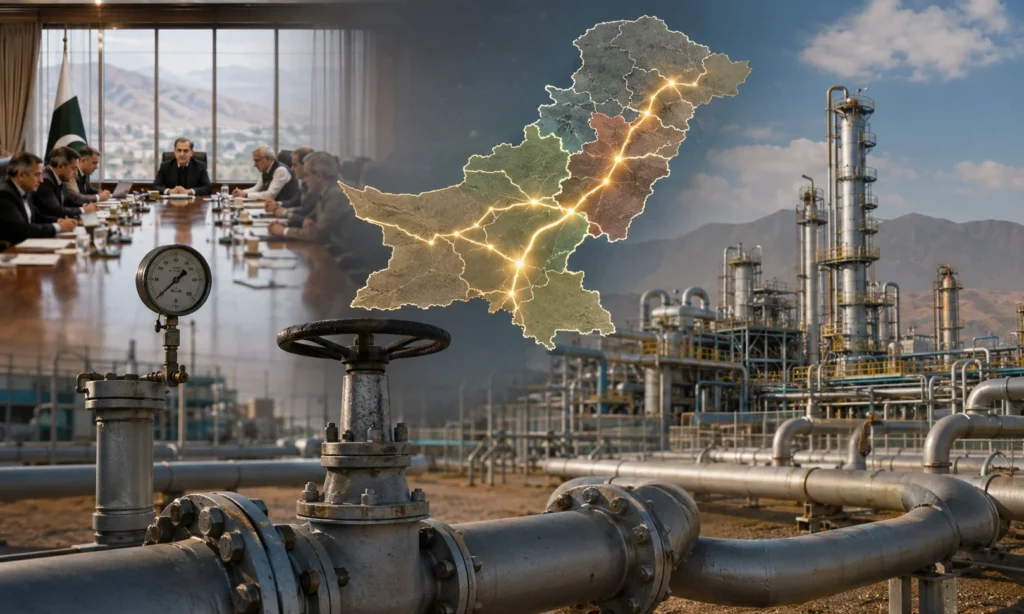
The government is finalising a plan to split Pakistan’s two gas utilities into five smaller companies. It would create one transmission company and four provincial distribution firms.
Petroleum Minister Ali Pervaiz Malik reviewed the roadmap on Tuesday with World Bank Country Director for Pakistan Bolormaa Amgaabazar. SNGPL, SSGCL and OGRA officials also attended.
“The reform framework also proposes the restructuring and unbundling of the Sui companies by separating their transmission, distribution and energy businesses, while creating greater opportunities for private sector participation throughout the gas value chain,” an official statement said.
Government Seeks Approval by End of August
The Petroleum Division wants to fast-track the process and place the final roadmap before the prime minister by the end of August 2026. “The meeting reviewed and endorsed the strategic direction of Pakistan’s gas sector reforms,” the statement said.
“Following the prime minister’s approval, the Petroleum Division will initiate phased implementation of the reform programme in consultation with all stakeholders to ensure a smooth and sustainable transition to a modern, competitive and financially viable gas sector,” it added.
The division plans to appoint a transaction adviser immediately. The adviser would design the separation of SNGPL and SSGCL into five entities.
Read More: HBL Backs Mari Energies Project in Pakistan to Turn Polluting Gas into LNG
The World Bank may finance the advisory work. Another option would require both utilities to share the cost and recover it through consumer tariffs. However, the companies and their shareholders oppose both the breakup and any requirement to fund it.
Under the proposal, a National Gas Transmission Company would take over the transmission networks and businesses of both utilities. It would operate as a common carrier, similar to the National Grid Company in the power sector.
The company would not buy or sell gas. It would transport locally produced gas and imported LNG, while charging wheeling fees to suppliers and buyers. Sources said major business groups were interested in the transmission business through privatisation.
Viability, Pricing and Provincial Concerns
The four distribution companies would operate within provincial boundaries. Officials would shape them around population, network density, gas demand, workload, supervision and operational efficiency.
The proposal faces difficult pricing questions. Pakistan applies uniform national gas prices, although system losses differ sharply across provinces. Sources said Balochistan records the highest losses, followed by Khyber Pakhtunkhwa, Sindh and Punjab.
Read More: Pakistan Restricts Gas to Factories as Middle East War Disrupts Energy Flow
The plan therefore requires a weighted average sale price equalisation mechanism, or another pricing formula. The official roadmap also calls for targeted subsidies, a revised protected customer category and movement towards a single market-clearing price.
KPMG and OGRA opposed a similar model in 2020 on financial and technical viability grounds. They urged consultations with provinces, shareholders and other stakeholders before any breakup. Experts also warned that distribution companies could become loss-making while the transmission company remained profitable.
The earlier plan was shelved. Opposition remains to appointing an adviser or splitting the utilities before provinces are consulted and the Council of Common Interests considers the agreed mechanism.