After food and clothing, people need a safe place to live. Once families can feed themselves and afford basic clothing, they usually begin to dream of owning a home.
However, decent and affordable housing has become increasingly difficult to find around the world. Even New York, one of the most important cities in the world’s wealthiest country, faces a severe housing crisis. The issue became so politically important that Zohran Mamdani gained electoral support by placing affordable housing at the centre of his campaign.
The problem extends far beyond the United States. Major commercial cities in the United Kingdom, France, Germany, China and several other countries also face growing pressure on housing.
Read More: Asia-Pacific Leaders Back Climate-Resilient Housing in Karachi
Pakistan faces similar challenges in cities, towns and rural areas. Thousands of families live in old, poorly maintained houses or buildings with weak foundations. These unsafe structures threaten lives and property, and several deadly accidents have occurred over the years.
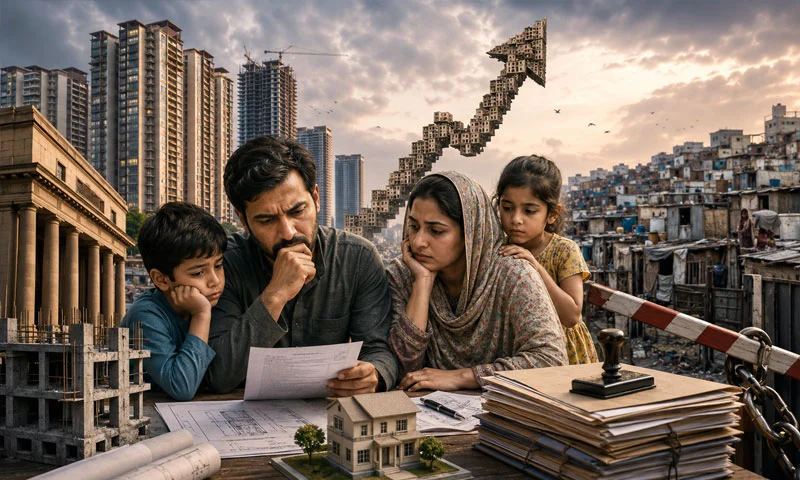
A World Bank report estimates that Pakistan faces a shortage of more than 12 million housing units. The shortage grows by around 350,000 homes every year. Urban areas account for between 40 and 47 percent of the deficit.
The lack of affordable and properly constructed homes has also fuelled the rapid expansion of informal settlements. Karachi presents one of the clearest examples. Informal and unplanned neighbourhoods reportedly cover around 60 percent of the city, where millions of residents often lack basic civic services.
Many families cannot afford to purchase a home, so they continue to live in rented properties. They pay rent for years, and sometimes for decades, but still fail to become homeowners.
Successive governments have introduced housing programmes to address the shortage. However, most initiatives have failed to produce lasting results.
The government launched one of Pakistan’s largest housing programmes in 1999 under the Pakistan Housing Scheme. A change of government disrupted the project and left it incomplete.
Read More: Nepra Grants DHA City Historic Electricity Licences for 21 Years
Later, governments led by the Pakistan Peoples Party, Pakistan Muslim League-Nawaz and Pakistan Tehreek-e-Insaf introduced low-cost housing initiatives. However, shifting priorities, political instability and changes in government prevented these programmes from continuing for long.
For most citizens, the biggest barrier to home ownership remains the lack of affordable financing.
Housing finance still represents a very small part of Pakistan’s banking sector. Banks and financial institutions have provided around Rs293 billion in loans to nearly 65,000 people for the purchase or construction of homes.
The current government has also launched a subsidised loan scheme to help citizens purchase or build houses. Applicants can seek financing from commercial, Islamic and microfinance banks.
The government has set the interest or profit rate at six percent and will cover the remaining financing cost through a subsidy.
Borrowers will receive the discounted rate for the first 10 years. After that period, banks will link the profit rate to the Karachi Interbank Offered Rate, commonly known as KIBOR.
The federal government has allocated Rs71 billion in the current financial year’s budget to support the housing subsidy.
At the government’s request, the State Bank of Pakistan approved a more favourable financing structure. Applicants will contribute 10 percent of the property’s value, while banks will finance the remaining 90 percent.
Under ordinary housing loans, borrowers usually contribute 15 percent and banks provide the remaining 85 percent.
Applicants must hold Pakistani citizenship and possess a valid national identity card. Overseas Pakistanis can also apply by presenting a Pakistan Origin Card or a citizenship certificate.
The programme also requires applicants to confirm that they do not already own registered property.
The government has introduced property size limits to stop wealthy individuals from benefiting from subsidised financing. Applicants can use the loan for a house or plot measuring up to 10 marlas, or 2,720 square feet. For apartments, the covered area cannot exceed 1,500 square feet.
Read More: Pakistan Could Become World’s 4th Most Populous Country in 5 Years
The scheme offers loans of up to Rs10 million. However, its structure also allows low-income citizens to apply.
Salaried individuals must provide salary slips for the previous three months, an employment letter and a bank statement covering one year.
Business owners must submit proof of their business, including a tax registration number, tax documents and a one-year bank statement.
Families can also combine their incomes. When an applicant’s monthly income falls below the bank’s requirement, the bank can include the income of parents, siblings, a spouse or children while assessing eligibility.
The Ministry of Housing has developed an online portal for loan applications. However, many applicants say technical problems have made the process difficult and frustrating.
State Bank officials have acknowledged these problems. They say officials are upgrading the portal and expect the application process to become faster and easier within 15 to 20 days.
After applicants submit their documents, banks review their credit history and verify the information. The bank then approves or rejects the application.
The Government of Pakistan guarantees the scheme, which should reduce unnecessary resistance from banks.
Every Pakistani citizen can apply, whether they live in a city, town, village or informal settlement. Banks cannot reject applicants simply because of their profession or type of employment.
The State Bank aims to provide housing loans to 300,000 people every year.
Banks have received more than 100,000 applications so far. They have approved around 13,000 applications, while nearly 6,000 people have received loans worth Rs26 billion.
These figures place the average loan amount at approximately Rs4.8 million.
Loan approval does not automatically solve the housing problem.
Applicants often struggle to find properties that meet the scheme’s legal requirements. Anyone who wants to purchase a completed house must find a seller who holds complete ownership documents, legal records and approved building plans.
Many properties, especially those in older neighbourhoods and informal settlements, lack these documents. This problem prevents many potential buyers from using their approved loans.
Read More: Pakistan Records Mysterious 6x Surge in Credit Card ATM Use
Developers in new housing projects and residential societies have also raised property prices as demand has increased.
As a result, many people cannot find a suitable home within their budget, even after receiving loan approval.
The government must address these problems if it wants the scheme to benefit ordinary citizens. Provincial governments and district administrations must provide affordable land and speed up approvals for building plans, construction and other legal requirements.
Affordable loans offer an important starting point, but financing alone cannot solve Pakistan’s housing crisis. The country also needs affordable land, legally approved housing units and an efficient regulatory system.
Without coordinated action at the federal, provincial and local levels, millions of Pakistanis will continue to see home ownership as a distant dream.
This story has been taken and translated from ARY Urdu.