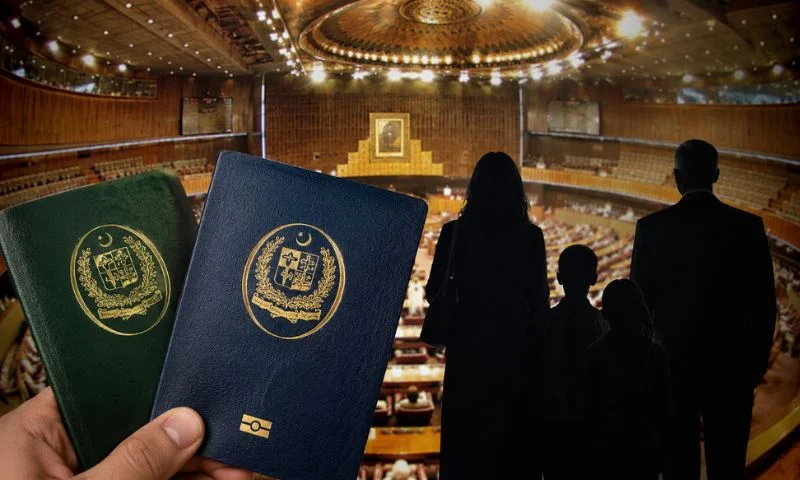
A proposed law allowing dependent children of former members of parliament to receive official blue passports has sparked strong criticism across Pakistan. Politicians, journalists and academics argue the move expands elite privileges while ordinary citizens continue to struggle with economic challenges.
The controversy erupted after the Senate Standing Committee on Interior and Narcotics Control approved the Members of Parliament (Salaries and Allowances) (Amendment) Bill, 2026. Senator Mohammad Abdul Qadir introduced the private member’s bill.
Read More: Overseas Pakistanis Send Record $41.6 Billion Home in FY26
If Parliament passes the legislation, former lawmakers, their spouses and dependent children under the age of 28 will qualify for official blue passports. The proposal would place them on par with retired Grade 22 government officers and their dependent children.
Interior Ministry distances itself
Minister of State for Interior Tallal Chaudhry said he opposed the proposal during the committee meeting. He also urged members to first consult the federal cabinet and other stakeholders before moving ahead.
“Despite my reservations, the Senate & Standing Committee on Interior proceeded with its decision to pass the bill,” he said.
I opposed the passport bill when it was presented in the Senate and reiterated yesterday that it should first be discussed with the Cabinet and relevant stakeholders.
Despite my reservations, the Senate & Standing Committee on Interior proceeded with its decision to pass the… https://t.co/HjKUtcUfru
— Senator Tallal Chaudry (@TallalPMLN) July 11, 2026
The Interior Ministry had also raised concerns during earlier discussions on the proposal. Officials questioned whether extending blue passport privileges beyond serving officeholders was appropriate. The bill must still secure approval from both houses of Parliament before becoming law.
Political leaders and experts react
The proposal quickly drew widespread criticism on social media.
Senior PML-N leader Khawaja Saad Rafique compared it to the recently debated privileges bill in the Khyber Pakhtunkhwa Assembly.
“Until the extraordinary privileges enjoyed by politicians, bureaucrats, higher judiciary, and senior military officers are brought to an appropriate level, injustice will continue to gnaw at society like termites, fostering social discord and public unrest,” he wrote on X.
ابھی لوگ خیبر پختونخواہ اسمبلی کی جانب سے موجودہ اور سابقہ اراکین اسمبلی اور ان کے اھل خانہ کیلئے آفیشل بلیو پاسپورٹ سمیت مختلف مراعات کی منظوری کے صدمے سے باھر نہیں نکلے تھے کہ سینٹ کی ایک قائمہ کمیٹی نے سابق پارلیمینٹیرینز اور انکے اھل خانہ کیلئے بلیو پاسپورٹ کی سفارش کر دی…
— Khawaja Saad Rafique (@KhSaad_Rafique) July 11, 2026
Journalist Fahd Husain called the bill “shameless”. He said it reflected the widening trust deficit between “elite politicians” and ordinary Pakistanis.
Digital policy expert Habibullah Khan agreed.
“Our ordinary passport is laughed at because of their inability to make policies and pass reforms to generate wealth in this country and spread it equitably.”
He added that the bill would allow lawmakers to “bypass the consequences of their incompetence”.
ابھی لوگ خیبر پختونخواہ اسمبلی کی جانب سے موجودہ اور سابقہ اراکین اسمبلی اور ان کے اھل خانہ کیلئے آفیشل بلیو پاسپورٹ سمیت مختلف مراعات کی منظوری کے صدمے سے باھر نہیں نکلے تھے کہ سینٹ کی ایک قائمہ کمیٹی نے سابق پارلیمینٹیرینز اور انکے اھل خانہ کیلئے بلیو پاسپورٹ کی سفارش کر دی…
— Khawaja Saad Rafique (@KhSaad_Rafique) July 11, 2026
Journalist Iftikhar Firdous described the proposal as an attempt to secure “foreign escape routes”.
“If you don’t have skin in the game, you shouldn’t be deciding its future,” he wrote.
Journalist Arifa Noor also questioned the need for the privilege.
“Why do parliamentarians’ kids under the age of 28 need diplomatic passports?”
One of the first priorities for far too many in Pakistan’s political elite is securing blue passports and foreign escape routes. That mindset says everything.Pakistan deserves leaders whose futures are invested here, not parked in offshore accounts while asking the world to… https://t.co/hcgZ2qhZxZ
— Iftikhar Firdous (@IftikharFirdous) July 11, 2026
Debate over elite privileges intensifies
Historian Ilhan Niaz argued that only serving officials should hold official or diplomatic passports.
“Honour lies in declining privileges, not in exercising them or expanding their scope,” he wrote.
The correct decision would be to eliminate the use of all official, diplomatic, passports for everyone except for actual officials.
Honour lies in declining privileges, not in exercising them or expanding their scope. https://t.co/2sYdYmmHMI
— Ilhan Niaz (@IlhanNiaz) July 11, 2026
Television host Amir Zia echoed that view.
Blue passports “should only be for officials on diplomatic assignments and that too only until their term lasts,” he said.
He added that extending the facility to lawmakers and their families amounted to “a form of corruption” that undermined democracy.
Blue Pakistani passports should only be for officials on diplomatic assignments — and that too only until their term lasts.
Why should every MNA, MPA & senator along with their families get them? This is also a form of corruption. These undue privileges undermine democracy.— Amir Zia (@AmirZia1) July 11, 2026
LUMS sociology professor Umair Javed said the proposal reflected a broader culture of privilege within the state. Business journalist Khaleeq Kiani wrote, “Pakistani nationality should be cancelled of those ashamed of green passport and seeking blue ones.”
He added that the green passport represented national pride and deserved respect.
Pakistani nationality should be cancelled of those ashamed of green passport and seeking blue ones.
Green passport is a sign national pride. If you don’t respect it, don’t expect outsiders will
— Khaleeq Kiani (@KhaleeqKiani) July 12, 2026
Former Citigroup executive Yousuf Nazar also criticised lawmakers. He said they remained focused on “their privileges, perks, and powers”.
The next step would be to extend the privilege of blue passport to the neighbours of parliamentarians. These people are just concerned with their privileges, perks, and powers. We don’t need such parliamentarians. https://t.co/mJWsRxzjQL
— Yousuf Nazar (@YousufNazar) July 11, 2026
The bill has reignited debate over official privileges in Pakistan. Critics say Parliament should focus on reforms that benefit citizens instead of expanding perks for political elites. Supporters argue the proposal simply extends benefits that retired senior civil servants already receive. The legislation will now move through Parliament for further consideration.