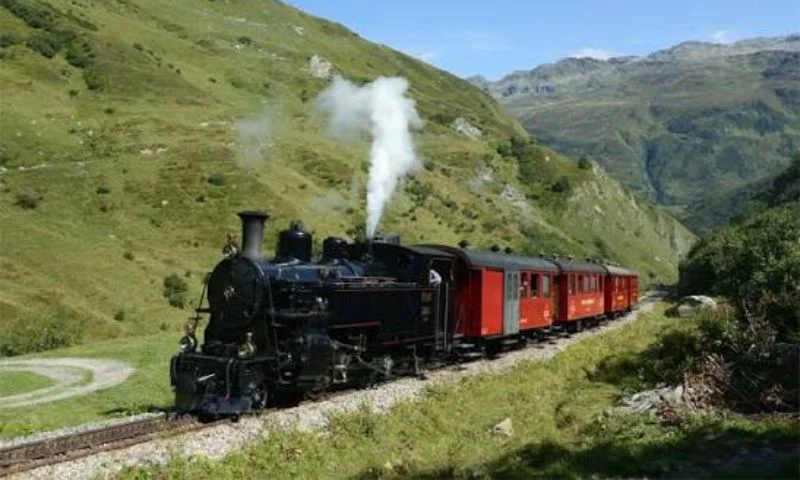
Train enthusiasts from across Europe are gathering in Switzerland this weekend to celebrate the 100th anniversary of one of the country’s most iconic mountain railways, as restored steam locomotives once again climb through the spectacular Furka Pass.
The celebrations mark exactly one century since a steam train completed the first continuous journey across the Furka Pass on July 3, 1926. The railway created a vital connection between the Swiss regions of Uri and Valais and became a major engineering achievement in the Alps.
Located 2,431 metres above sea level, the Furka Pass ranks among Switzerland’s highest Alpine crossings. It is famous for dramatic mountain scenery and the winding hairpin roads featured in the 1964 James Bond film Goldfinger, starring Sean Connery. Long before Hollywood arrived, however, the railway had already earned a place in Swiss transport history.
The anniversary celebrations run from July 3 to July 5 in Realp and Gletsch. Visitors can enjoy historic exhibitions, vintage railway vehicles, special steam train services and guided displays celebrating the line’s remarkable history.
Volunteers brought the railway back to life after closure
The railway’s future looked uncertain in the early 1980s after the opening of the Furka Base Tunnel diverted regular rail traffic away from the mountain route.
The historic line closed, but hundreds of volunteers refused to let it disappear.
Known as the railway’s “pioneers,” they spent decades restoring tracks, repairing locomotives and rebuilding infrastructure. Their efforts allowed the first section to reopen as a heritage railway in 1992. The complete 18 kilometre route finally reopened in 2010. Today, the railway operates exclusively during the summer tourist season between Realp and Oberwald.
Read More: New UAE Train Will Reach Abu Dhabi in Just 1 Hour 45 Minutes
Passengers travel in restored vintage carriages through Alpine meadows, rivers, mountain tunnels and lush green valleys where patches of snow often remain even in summer.
A one way ticket starts at 46 Swiss francs, or about $57, for a journey lasting just under two and a half hours.
Passenger Stephan Willareth described the experience as “wonderful,” while former Swiss railway employee Kurt Guldemann praised the engineering and history behind the century old locomotives.
Steam locomotives continue to inspire a new generation
Operating the railway requires years of training and dedication.
Bernhard Lang, one of the volunteer locomotive drivers, said mastering a steam engine demands patience and instinct.
“It’s something like a living machine, so you have to get kind of the feeling for it,” he said. “To feel how it behaves, how it moves, how it smells, how it sounds.”
Jacob Kallert, a 21 year old German transport engineering student and the railway’s youngest train manager, said listening carefully to the locomotives is essential.
“You hear every sound, you hear if everything is right,” he said. “You can pretty much feel how it was then and how it is now.”
Volunteer Sergio Rovelli said nearly everyone who joins the restoration project develops a lifelong attachment.
“We say, in German, that everyone who works here has the ‘Furka Virus, the Furka disease,'” he joked. “Once you come here, you like it, and you stay.”
Organisers expect thousands of visitors throughout the anniversary weekend, celebrating not only a remarkable railway but also the volunteers whose dedication has kept a century of Swiss railway history alive.