Pakistan will require an estimated $331 billion in climate financing between 2024 and 2030 to strengthen climate resilience and avoid severe economic losses from increasingly frequent climate disasters, according to the State Bank of Pakistan (SBP).
The estimate, based on data from the Climate Policy Initiative (CPI), equals nearly 10 percent of Pakistan’s cumulative GDP, or about $47 billion annually during the seven-year period.
The findings appear in the SBP’s latest report on climate finance, which highlights the urgent need for greater investment in climate adaptation, mitigation and resilient infrastructure.
CPI, an internationally recognized climate finance research and advisory organization, estimates that the world requires $8.6 trillion in climate finance every year to keep global warming within the 1.5°C target set under the Paris Agreement.
The report also notes that Pakistan ranked as the 15th most climate-affected country worldwide between 1995 and 2024, despite contributing only about 1 percent of global greenhouse gas emissions.
Economic losses continue to mount
The SBP said the Government of Pakistan estimates climate financing needs between $200 billion and $348 billion by 2030 to support climate-resilient development and implement its Nationally Determined Contributions (NDCs).
Meanwhile, the government’s Pakistan Climate Prosperity Plan estimates that the country will require $1.6 trillion by 2050 for phased investments, technology access and sustainable development.
Climate-related disasters have already inflicted enormous damage on Pakistan’s economy.
According to the report, climate events caused economic losses of $58.8 billion by 2025.
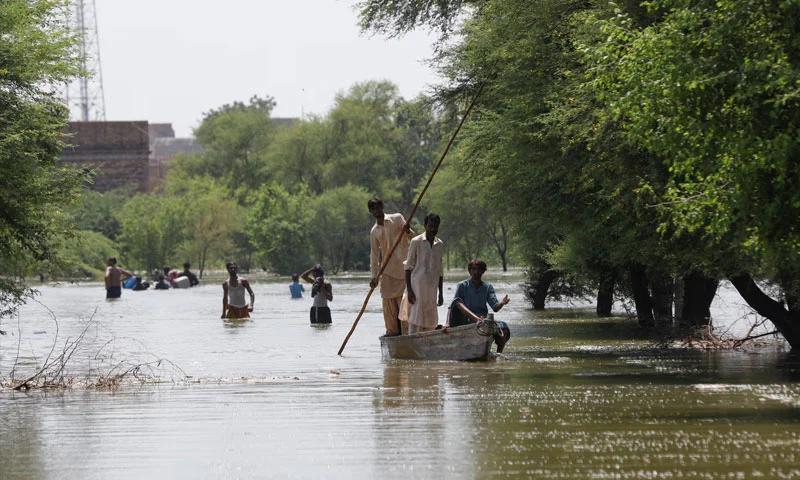
Of this amount, $29.3 billion occurred between 1992 and 2021. The catastrophic 2022 floods alone caused nearly $28 billion in damage, while floods in 2025 added another $1.5 billion in losses.
SBP analysis shows floods have directly reduced economic growth by damaging infrastructure, agriculture and businesses. Rising input costs also created indirect pressure on GDP, although post-flood agricultural recovery and reconstruction partly offset the overall impact.
The report also cites World Bank projections showing Pakistan’s GDP could decline by 4.5 to 6.5 percent by 2050 under an optimistic climate scenario. Under a pessimistic scenario, losses could reach 7 to 9 percent, with agriculture and industry facing the greatest risks.
Funding remains far below requirements
Despite its growing vulnerability, Pakistan receives only a fraction of the climate finance it needs.
The SBP said the country attracted only $1.4 billion to $2 billion annually in climate finance over the past decade. Funding peaked at around $4 billion in 2021, but remains well below national requirements.
The report says Pakistan also receives significantly less climate finance per person than comparable countries, including Bangladesh, India, Kenya and the Philippines.
SBP identified several reasons for the financing gap.
Globally, investors prefer mitigation projects because they generate stronger financial returns than adaptation projects. Pakistan, however, requires greater investment in adaptation due to its high exposure to floods, droughts and extreme weather.
The report also points to recurring macroeconomic instability, exchange rate volatility, political uncertainty, sovereign risk and weak financial markets as factors reducing investor confidence.
Another major challenge is the country’s limited ability to develop bankable climate projects.
The report notes that stronger project pipelines help attract financing from Multilateral Development Banks and private investors. However, bureaucratic delays and institutional weaknesses continue to slow implementation.
It cited the World Bank’s Pakistan Hydromet and Climate Services Project, which concluded in 2025 after key components, including weather radars and automatic weather stations, were dropped because of procurement delays and institutional frictions.
The SBP stressed that improving project preparation, strengthening monitoring systems and accelerating reforms will be essential if Pakistan is to secure the climate finance needed to protect its economy from future climate shocks.